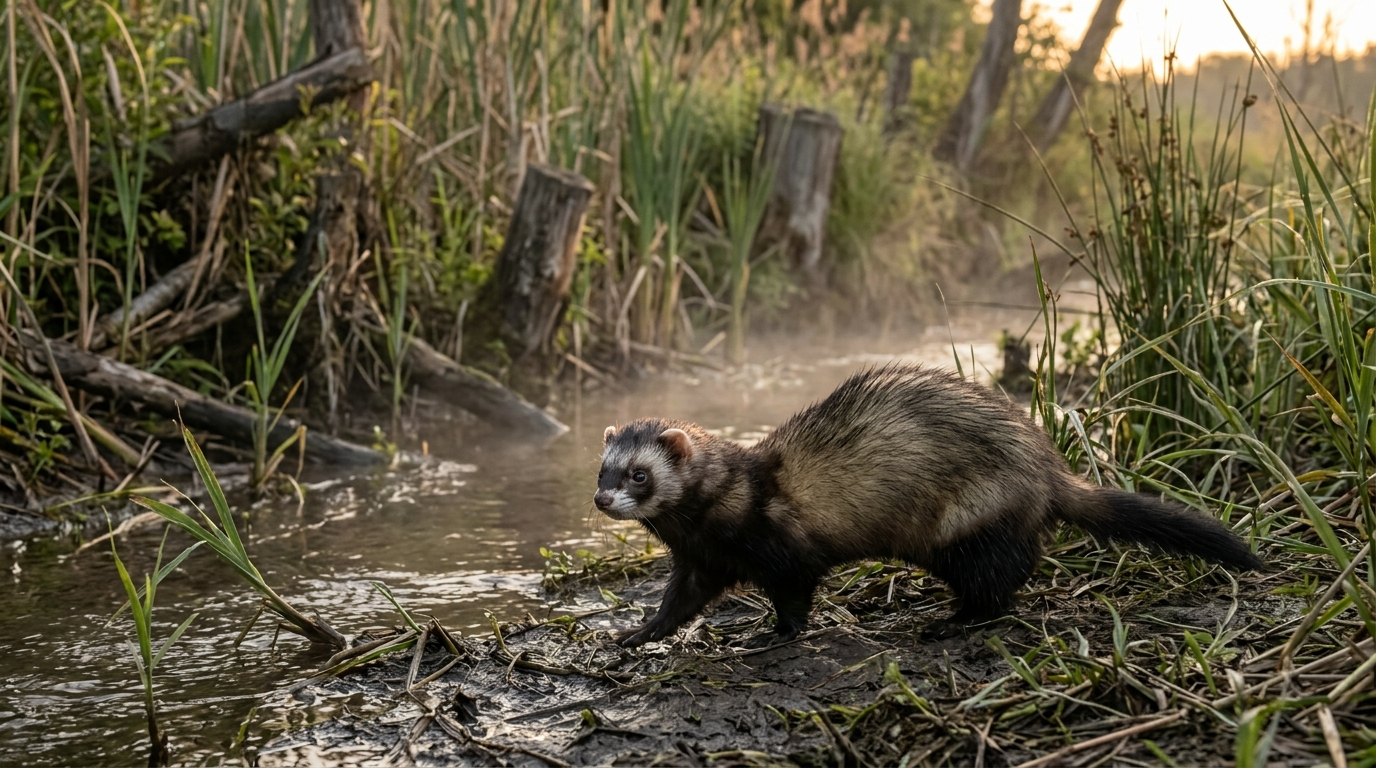
Hunter of frogs from the wetlands — in a bandit mask and with a cloud of scent in reserve.
The European polecat is a wetland specialist and an underrated frog hunter — its dark mask on its face betrays a nocturnal robber, and the characteristic smell from its anal glands gave it its Polish name. Where other mustelids hunt rodents, the polecat descends to the water.
28–46 cm
body length
10–19 cm
tail length
0.5–1.7 kg
weight (males up to 2)
4–6 years
lifespan in the wild
100–300 ha
male territory
4–8 young
in a litter (up to 10)
40–43 days
gestation (without diapause)
9–12 months
to maturity
LC Least Concern Game species in Poland with year-round protection — formerly hunted for fur, currently marginal harvest; requires wetland habitat conservationDecreasing in many regions of Europe — loss of wetlands, habitat fragmentation, hybridization with ferrets
In short
Bandit mask — dark band on the face with light stripes; the most reliable identification feature in the field
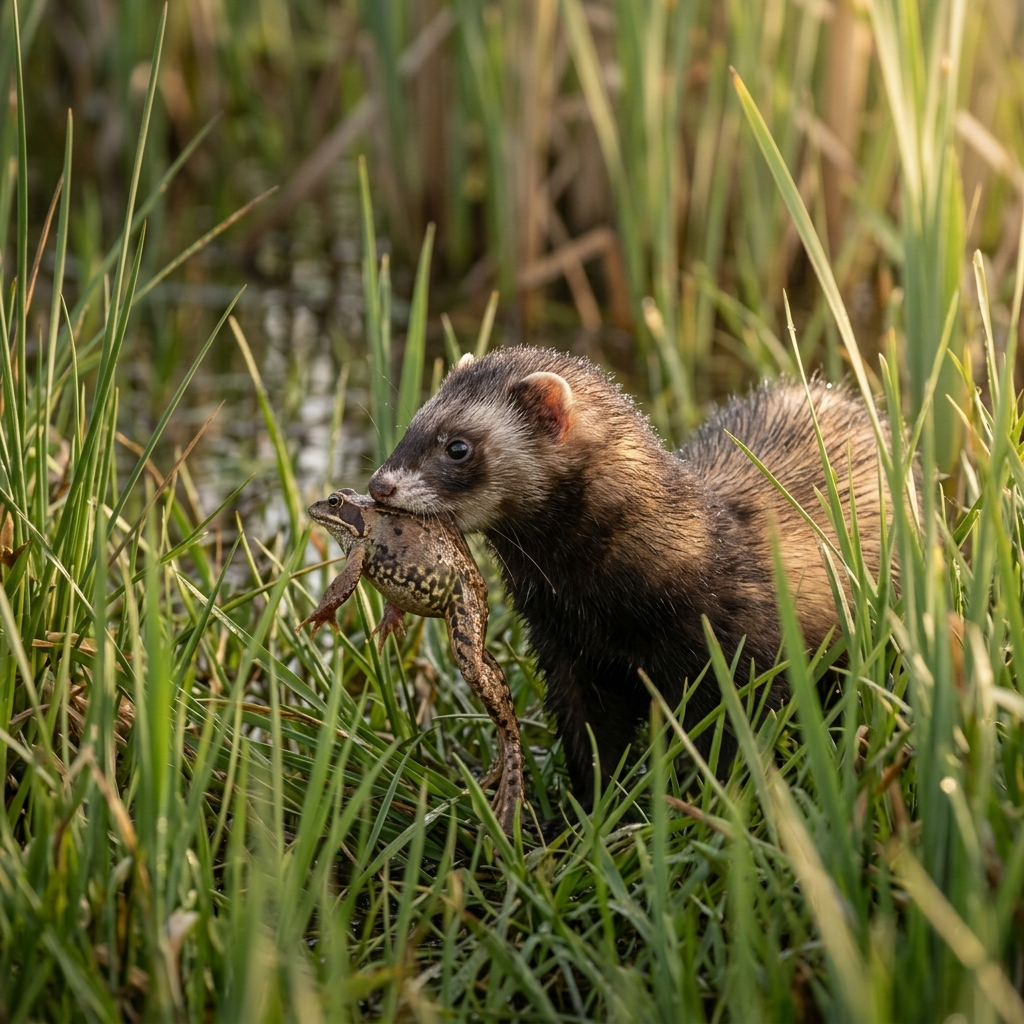
Frog specialist — amphibians make up to 50% of its diet, especially outside the prey's breeding season
Stores paralyzed frogs — unique behavior: a bite to the head immobilizes the prey, which remains alive for weeks in a winter pantry
Stinking secret from anal glands — hence the name putorius (Latin putor — stench); secreted under stress
Wetland inhabitant — river banks, oxbow lakes, riparian forests, wet meadows; in decline along with drainage
Wild ancestor of the domestic ferret (Mustela furo) — fertile hybrids are common near human settlements
Mainly active at night — during the day in thick reeds, abandoned burrows, or under woodpiles
Classification
Kingdom
Animalia
Phylum
Chordata
Class
Mammalia
Order
Carnivora
Family
Mustelidae
Genus
Mustela
Species
M. putorius
The European polecat (Mustela putorius) belongs to the Mustelidae family and is the largest representative of the genus Mustela in Polish fauna. In our geographical latitude, it occupies a narrow slice of the landscape that is not managed by either the weasel or the marten: river banks, oxbow lakes, wet meadows, riparian forests, and reed belts along drainage ditches. In these habitats, it realizes its unique hunting strategy — hunting amphibians and creating winter pantries of paralyzed frogs. The polecat is also the wild ancestor of the domestic ferret (Mustela furo), which generates contemporary problems: hybrids, depletion of the gene pool, and diagnostic conflicts. The Polish population is significantly smaller today than it was two generations ago — primarily due to the drainage of wetlands and the regulation of rivers.
01
Appearance and anatomy
A mask on the face, two-layer fur, and a low, elongated silhouette designed for squeezing through reeds.
The polecat is the largest of the Polish representatives of the genus Mustela — significantly sturdier and longer than the weasel or stoat, but still much lighter than martens of the genus Martes. The silhouette is low, long, and slightly hunched — typically mustelid, but with a heavier build.
The body length of an adult individual is 28–46 cm, tail 10–19 cm, weight 0.5–1.7 kg. Sexual dimorphism is marked — the male can be 30–40% heavier than the female, with adult individuals in good condition reaching up to 2 kg. The silhouette is cylindrical, short-legged, with a thicker neck than in a weasel. The paws are wide, equipped with partial webbing between the toes — an adaptation to aquatic habitats.
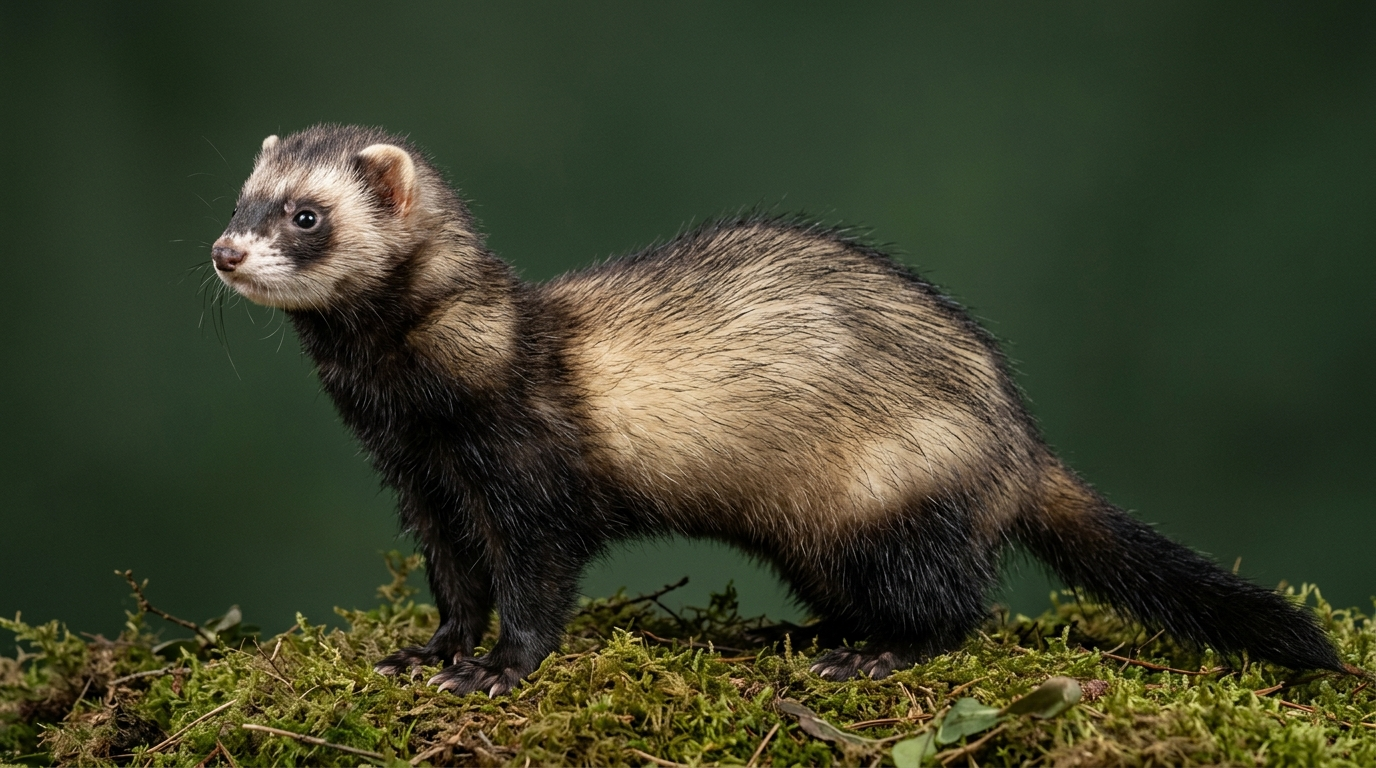
The fur of the polecat is two-layered and very characteristic. The guard hair is long, thick, and dark brown to almost black — giving the impression of dark, almost "raven" fur. Underneath grows a thick, light cream or light gray underfur, which shows through the guard hairs — particularly on the sides and belly. This contrast creates a characteristic two-tone effect, unseen in any other Polish mustelid. In summer, the fur is shorter and darker; in winter, it is long, dense, with the underfur more visible.
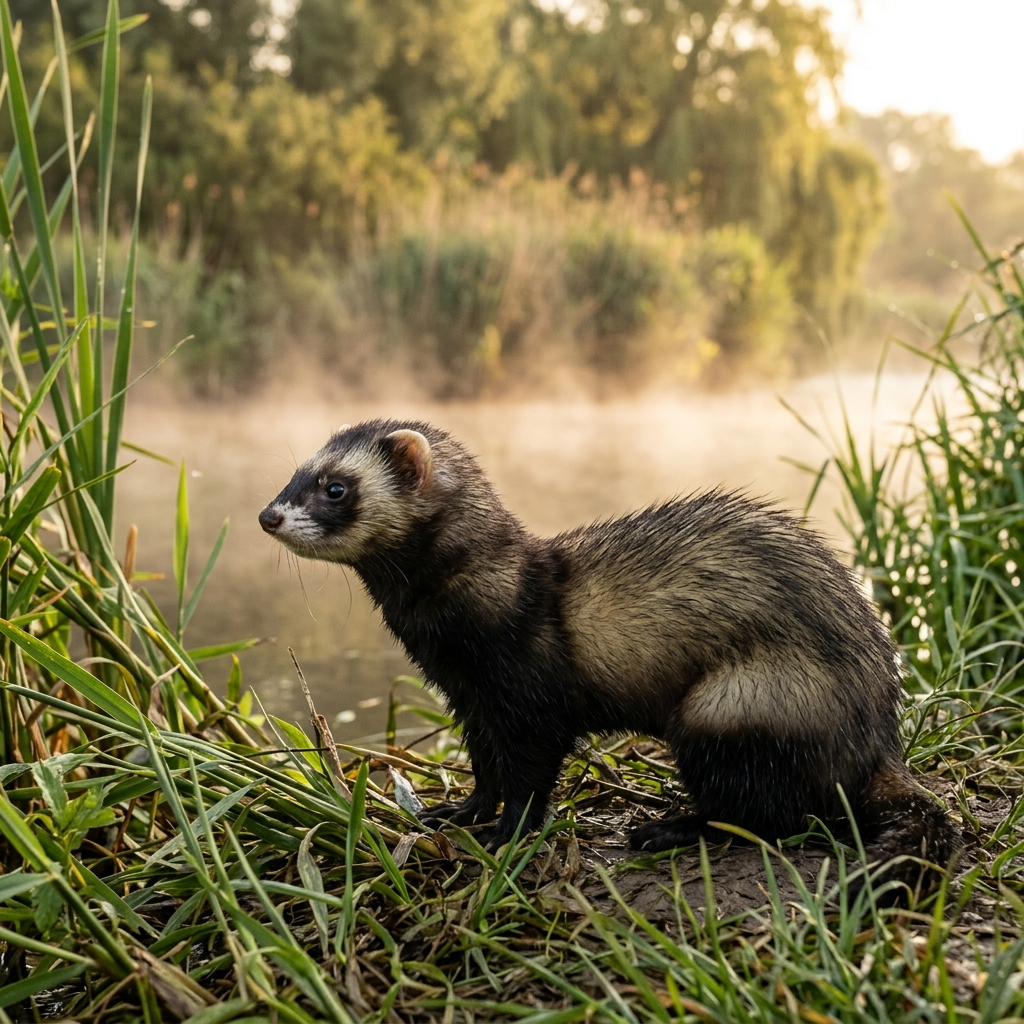
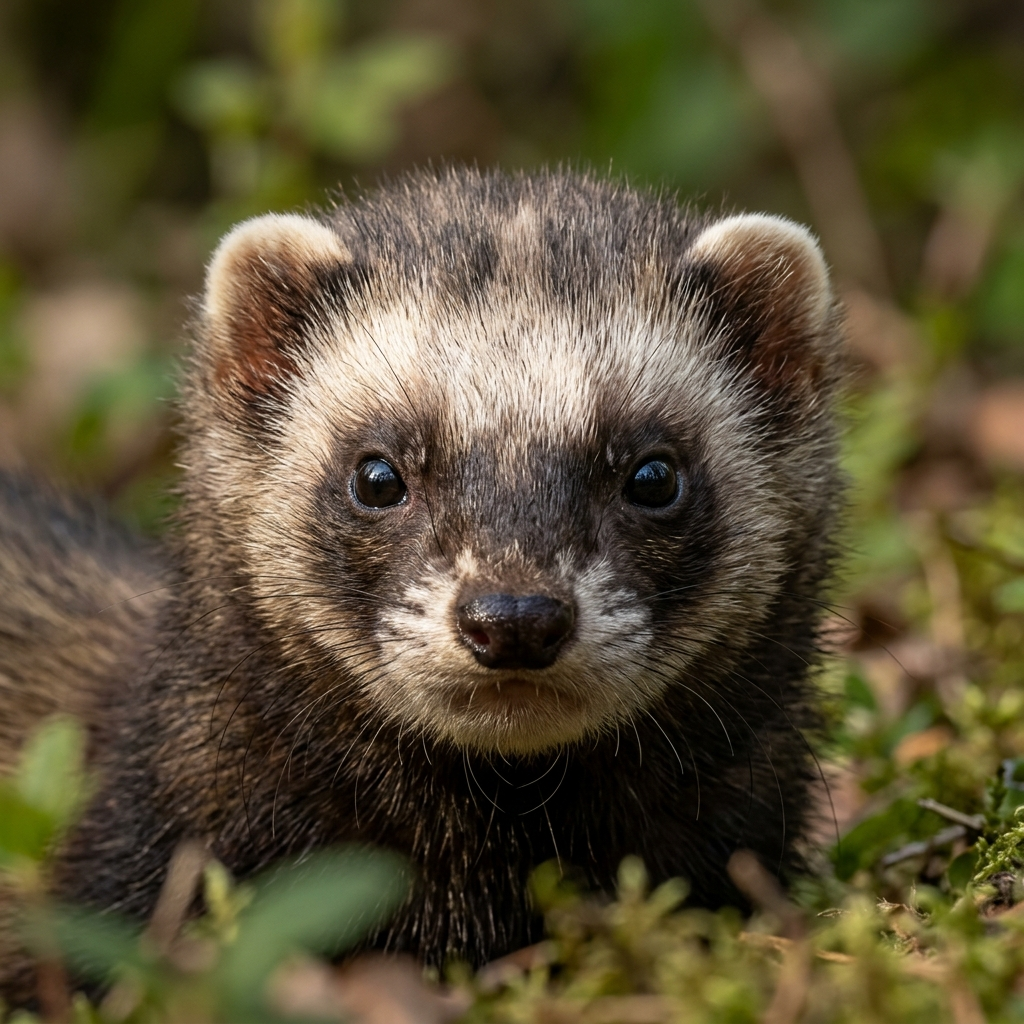
The mask on the face is the species' hallmark. It consists of a dark, almost black band running from the mouth through the eyes toward the ears, and light bands — white or creamy-white — on the forehead between the eyes, around the mouth, and at the base of the ears. The tips of the ears are also outlined in light color. It is this arrangement — contrasting and "guidepost-like" — that distinguishes the wild polecat from the domestic ferret, whose mask is blurred, pale, or completely disappears.
Bandit mask — dark eye band with light stripes above and below (key feature)
Two-layer fur — dark sharp hairs, light underfur showing through on the sides
Stocky silhouette — significantly heavier than a weasel, short-legged, with a strong neck
Long tail constitutes 35–45% of the body length, dark, uniform, without a black tip
Paws with partial webbing between the toes — a sign of adaptation to wetlands
Short, wide snout, strong canines — adapted for piercing an amphibian's head
Stinking secretion from the perianal glands — a sharp smell very different from that of a marten or weasel
Anal glands — chemical defense, not offense
The polecat does not spray secretion like the American skunk. The perianal glands produce an oily, intensely stinking secretion containing sulfuric thiol compounds — it is secreted passively in situations of high stress (predator attack, capture in a trap, copulation, territory marking). The smell lingers on the fur, in the burrow, and on left droppings for many days. The Latin species name putorius comes directly from putor (stench) — and it is a name well deserved.
Fig. 01Silhouette of a polecat in profile — key features: mask, two-layer fur with visible underfur, stocky build.
Feature
European polecat
Domestic ferret
Guard fur
dark brown-black, uniform
light, cream, white-ginger or albino
Facial mask
sharply contrasting, with light bands
blurred, pale or entirely absent
Underfur
light, clearly showing through
often uniform, without contrast
Posture
alert, low, wild
relaxed, trusting of humans
Scent
intense, heavy
present, but weaker (breeding selection)
02
Environment and range
The polecat is a species of water — where wetlands disappear, so does it.
Among all Polish mustelids, the polecat is most strongly associated with water. While not as proficient a swimmer as the otter, in its choice of habitat it consistently selects wetland landscapes — where it finds its primary prey: amphibians.
On a European scale, the polecat inhabits almost the entire continent — from the Iberian Peninsula to the Urals, excluding far Scandinavia and some islands. In Poland, it is recorded across all lowlands, locally penetrating the foothills; however, it does not reach mountain plateaus. The highest densities were historically recorded in the basins of the Biebrza, Narew, Warta, and Oder rivers — where extensive systems of oxbow lakes, riparian forests, and naturally meandering rivers existed.
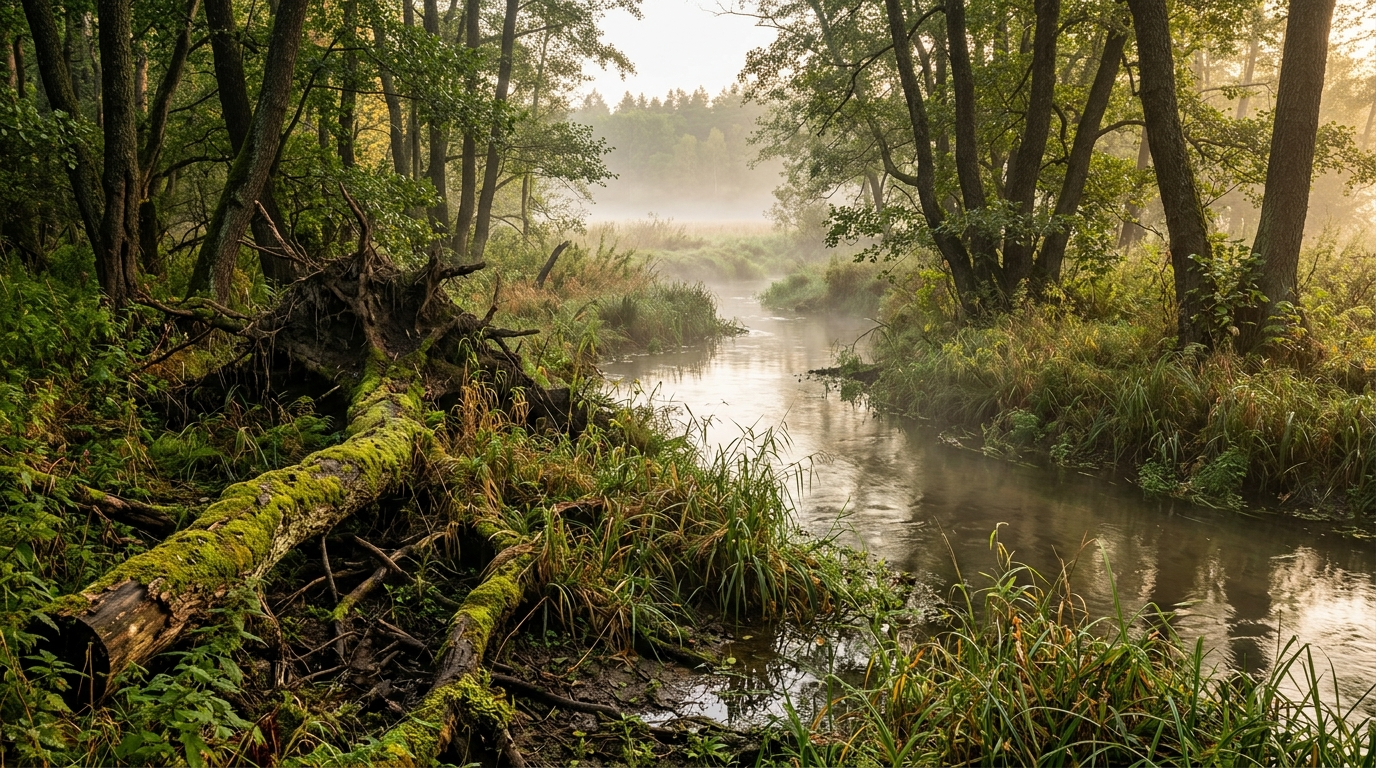
Preferred habitats include the banks of rivers and lakes, oxbow lakes, alder and willow riparian forests, flood meadows, wet reed beds, reed belts along drainage ditches and fish ponds. The polecat chooses mosaic environments — where water borders dense undergrowth, wood piles, uprooted trees, and brush heaps. It avoids dense coniferous forests as much as open fields lacking water. Locally, it enters farmsteads located near rivers and ponds — and it is these individuals that most often get involved in conflicts with poultry farmers.
The trend is clearly downward. The main reasons are the drainage of wetlands, regulation and canalization of rivers, habitat fragmentation, intensification of agriculture, and in recent decades — competitive pressure from the American mink(Neogale vison), an invasive species that occupies the same habitats and is larger and more aggressive. Locally, hybridization with ferrets (abandoned domestic individuals) also plays a role.
Lowland river banks — meanders, fallen trees, undercut banks
Oxbow lakes and ponds — dense reed vegetation around
Alder and willow riparian forests — with uprooted trees and woodpiles
Flood meadows and low bogs — tall grass, drainage ditches
Fish ponds — especially neglected ones with many reeds
Farmstead edges near water — woodpiles, barns, abandoned outbuildings
Fig. 02Typical polecat habitat — riparian forest with a wetland; woodpiles and uprooted trees provide shelter, and shallow pools provide food.
03
Diet
A master of hunting amphibians — and the only Polish predator that stores live prey.
In the food ecology of Polish mustelids, the polecat occupies a unique niche. Amphibians constitute up to 30–50% of its prey biomass — a share unseen in any other domestic predatory mammal.
Diet composition is opportunistic and depends heavily on the season. In spring and summer, frogs and newts dominate during their reproductive and post-activity periods; in autumn — frogs gathering in wintering spots in mud or under banks; in winter — small mammals, birds, carrion, and previously stored amphibians. Small rodents (voles, mice, young rats) constitute the second largest prey group, birds and their eggs — a seasonal supplement, fish — sporadic.
The amphibian hunting technique is what distinguishes the polecat from other mustelids. Instead of killing the prey immediately, as a weasel does with a vole, the polecat incapacitates the frog with a precise bite to the head or neck area, damaging the nerve centers responsible for movement. The amphibian remains alive but immobilized — not killed, but paralyzed. In this state, the polecat carries it to an underground pantry: an abandoned burrow, a hollow under a root, or a hole in a woodpile.
Winter pantry of live frogs
The behavior of storing paralyzed but alive amphibians has been well-documented in polecats since the 19th century. A single pantry can contain from a few to over a hundred individuals — in extreme cases, Polish researchers described surprisingly rich piles of frogs arranged in layers under a single uprooted tree. Key mechanism: the bite doesn't kill but damages motor nerves, while the low temperature of the pantry and humidity keep the amphibian's metabolism at an extremely low level. Victims can survive for weeks — this is fresh meat during a time when the rest of the forest is frozen. Evolutionarily, this is one of the most spectacular hunting adaptations in the Polish mammalian fauna.
Prey
Peak season
Method of acquisition
Common and water frogs
spring and autumn
paralysis by biting the head, storage
Newts and toads
spring
catching in water and around breeding sites
Small rodents
summer and winter
hunting in vole tunnels, in woodpiles
Birds and eggs
breeding season (IV–VI)
plundering ground and low nests
Carrion and waste
winter
scavenging, near human settlements
Farm poultry is attacked less often than rural folklore suggests. The polecat prefers prey of its own size, choosing chicks, nestlings, and eggs — it avoids adult hens, although cases of mass slaughter in small chicken coops occur (the characteristic "pantry" behavior — the polecat kills more than it eats when in contact with a dense population of animals enclosed in a cage). However, it more often chooses wild prey: a small frog or vole is an economically better option for it than fighting an adult hen.
04
Behavior and ethology
A nocturnal loner with a sharp scent language and slow seasonal rhythms.
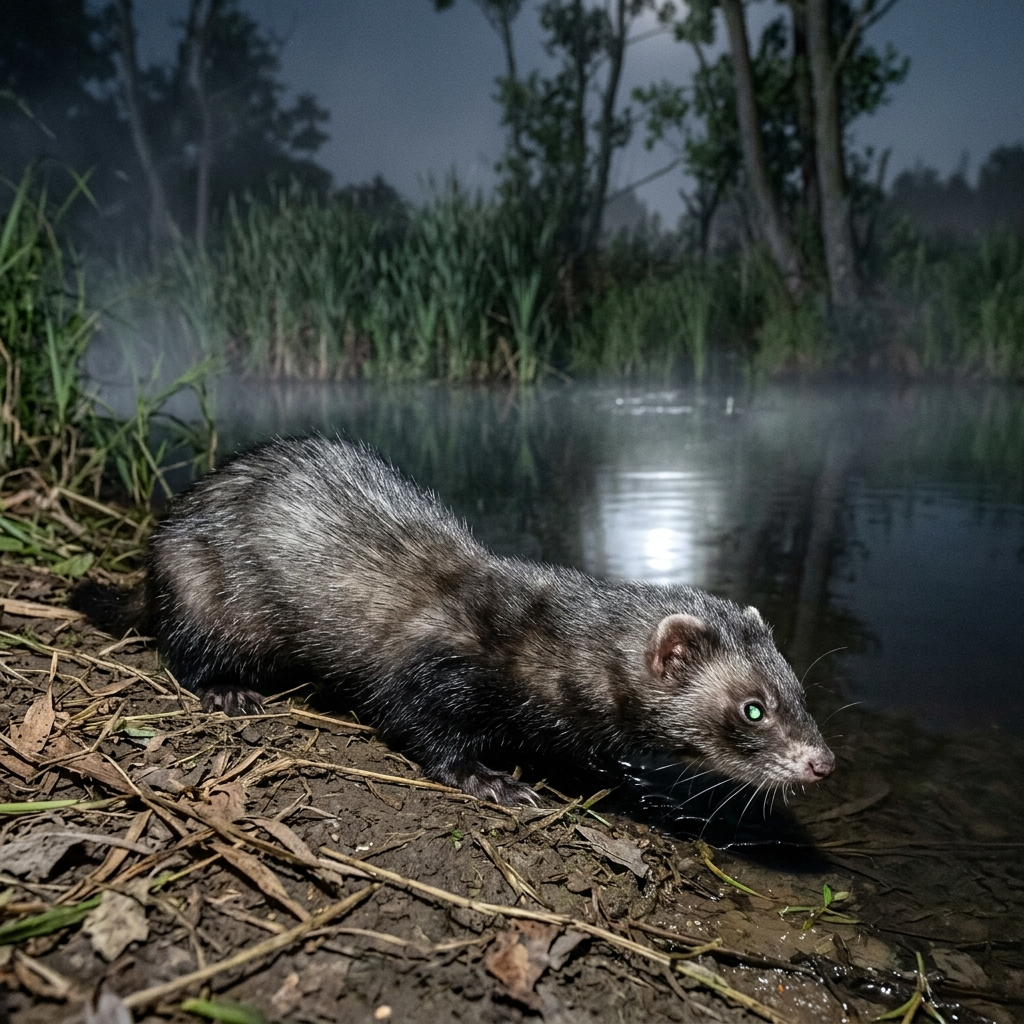
The polecat is a typical nocturnal loner — unlike the day-active weasel, it operates mainly after dusk and in the first half of the night, spending the day in hiding.
Daily activity is clearly two-phased: an evening peak after sunset and a second peak towards morning. During the day, the individual rests in dense reeds, an abandoned fox or badger burrow, under a woodpile, inside an uprooted tree, or in an abandoned outbuilding. In summer, activity can extend throughout the night; in winter — it shortens to a few evening hours. The polecat does not hibernate, but during long frosts, it remains in the burrow for several days in a row, utilizing the stored pantry.
Territoriality is moderately strong. A male occupies 100–300 ha, a female 50–150 ha — the ranges of males and females may overlap, but male ranges usually do not. Boundaries are marked very intensively: with urine, feces left in exposed places (stones, stumps, forks of branches), and perianal gland secretion rubbed onto wood and stones. The smell is so intense that a human can detect it from several meters away from a fresh mark.
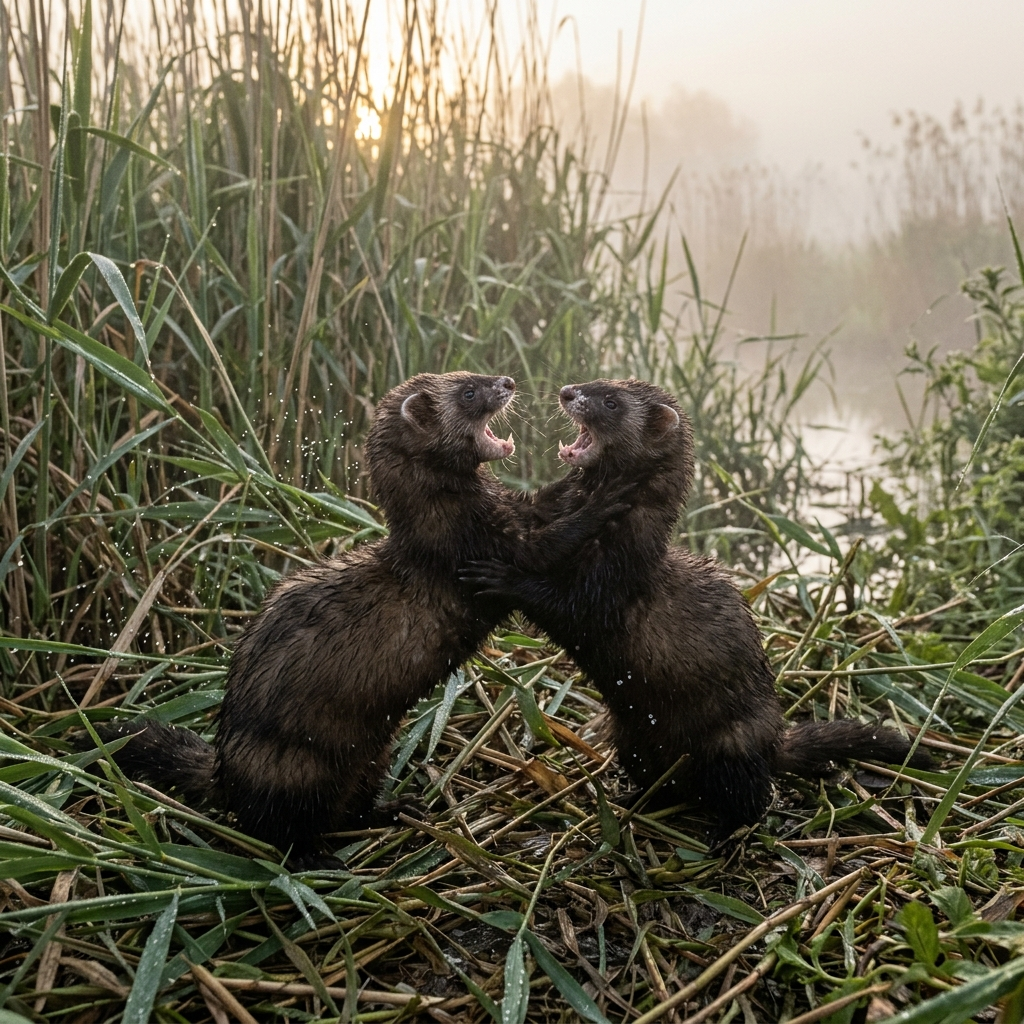
Inter-individual encounters outside the breeding season are rare and usually aggressive. Males fight each other in spring — during the breeding season, characteristic signs of combat are visible: torn ears, scars on the face, patches of torn-out fur. The male–female pair maintains contact only for the dozen or so days of the mating period. After the young are raised, the female rears the litter alone.
The first thing you notice is the smell — and then you know that a polecat passed through here no more than yesterday.
Mainly nocturnal activity — peak after sunset and before dawn
Solitary lifestyle — pairs only during the mating season
Intensive scent marking with urine, feces, and gland secretion
Passive chemical defense — anal gland secretion under stress
Swims and dives readily, though not as skillfully as an otter
Vocalizations — short growls in defense, squeaking of the young, "clucking" during mother-litter contact
No winter sleep — active all year round, but remains in the burrow on freezing days
05
Reproduction and life cycle
Without embryonic diapause — this is a fundamental difference from the weasel of the same family.
The polecat's reproductive cycle is seasonally concentrated: one litter per year, short pregnancy, young grow quickly. Contrary to popular opinion about mustelids — the polecat does not have embryonic diapause.
The mating season lasts from March to June, with a peak in April. Males then wander beyond their permanent ranges looking for females — this is the period when territorial conflicts and road accidents occur most often. Mating is preceded by vigorous courtship: the male grabs the female by the neck and holds her for a long time; the copulation itself lasts 30–60 minutes and is inductive (ovulation occurs only in response to the act of mating).
Lack of diapause — a difference from stoats and badgers
In the least weasel, fertilized cells develop immediately — the same applies to the polecat. This distinction is important because, in the same family (Mustelidae), some species — stoat, badger, beech marten, pine marten — have long embryonic diapause (the embryo suspends development for many months). The polecat and least weasel belong to those that do not — thanks to which pregnancy lasts only 40–43 days and the litter is born at the optimal seasonal time, regardless of the mating date.
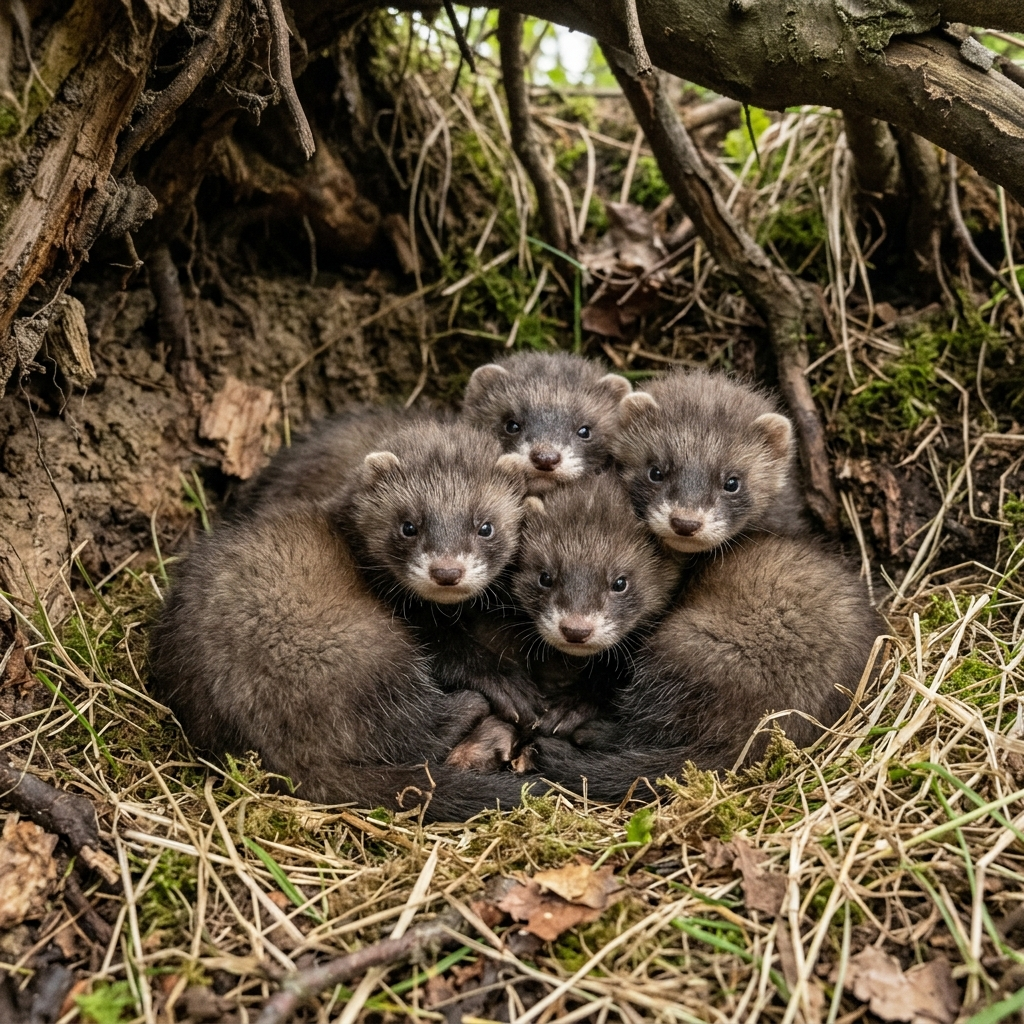
The litter is born from late May to early July — usually 4–8 young, occasionally up to 10. Newborns weigh 8–10 g, are blind, deaf, almost naked, covered with short whitish fuzz. The nest is located underground — in an abandoned fox, badger, or rabbit burrow, in an uprooted tree, woodpile, or sometimes in a farm outbuilding. Lining consists of grass, moss, and hair. The female feeds the litter alone; the male does not participate in rearing.
Weeks 1–2: newborns blind, deaf, weight 8–10 g, full dependence on mother
Weeks 3–4: dark outlines of the mask appear, eyes open (~day 30)
Weeks 5–6: first solid food — mother brings paralyzed small prey
Weeks 7–8: first excursions from the nest, learning hunting under mother's supervision
Weeks 10–12: weaning, young hunt independently alongside mother
Months 4–5: dispersal of the litter, young seek their own territories (autumn)
Months 9–12: sexual maturity — readiness for the first breeding season
Lifespan in nature is on average 4–6 years; in captivity (and in ferrets) — up to 10 years. The highest mortality affects young individuals in their first winter and during the dispersal period (roads, predators — especially fox and eagle owl, locally American mink). Adult polecats most often die under car wheels in spring, during the mating season.
06
Tracks and signs
A track with a webbed base and characteristic, stinking droppings near water.
Tracking a polecat in the field requires the nose as much as the eye — droppings and scent marks are often easier to notice than the paw prints themselves.
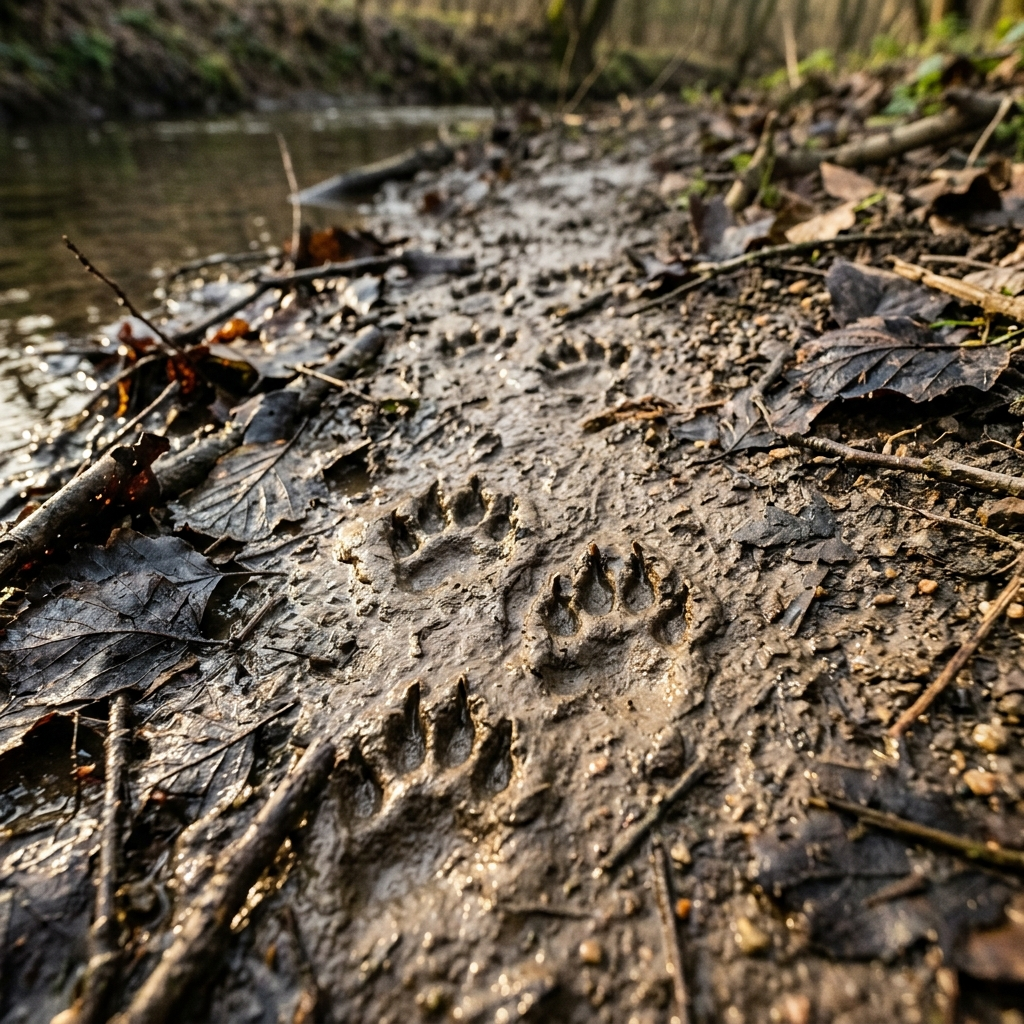
The polecat track is 3–4 cm long and 2.5–3.5 cm wide — significantly larger than a weasel's or stoat's, but smaller than a beech marten's and much smaller than a badger's. A characteristic feature is the partial webbing between the toes — in wet mud and wet snow, it shows as bands connecting the toes at the base, which is absent in martens or weasels. Five toes with claws, the base of the paw usually visible as a compact pad. The gallop pattern is typical of mustelids — pairs of tracks close together, gaps of 50–80 cm, but the polecat often walks at a steady pace along the water's edge, leaving a regular single line of prints.
Feature
European polecat
American mink
Least weasel
Track length
3–4 cm
3–4.5 cm
1–1.5 cm
Track width
2.5–3.5 cm
3–4 cm, wider
~1 cm
Webbing
partial
fuller, clearly marked
none / minimal
Gallop — gaps
50–80 cm
60–100 cm
25–40 cm
Scent mark
sulfuric, heavy
slightly musky, less intense
musky, weaker
Proximity to water
near wetlands
right on the water's edge
meadows, balks, dry habitats
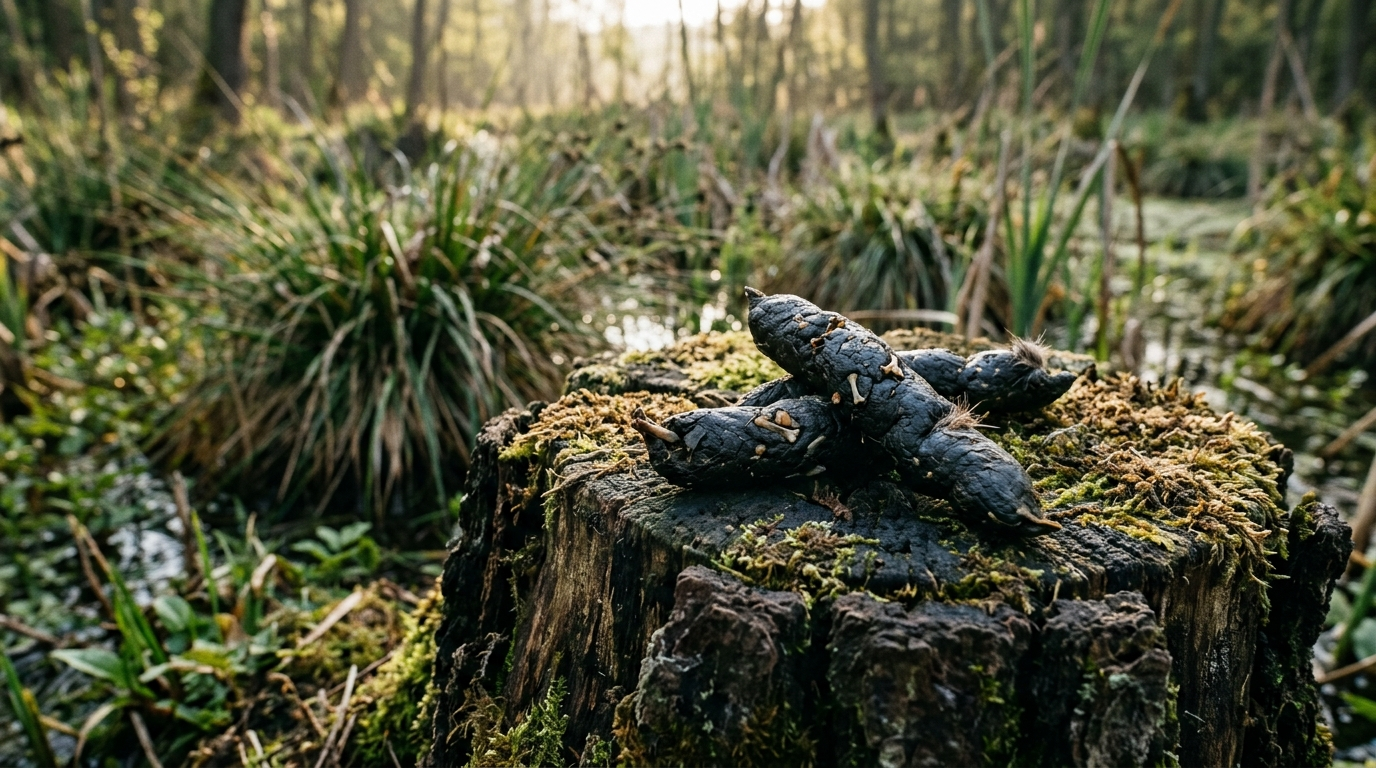
Polecat droppings are dark, twisted cylinders 5–8 cm long and 6–10 mm thick — clearly heavier than a weasel's. Inside: fragments of small bones (especially frog bones — easy to recognize under a magnifying glass), rodent fur, fish scales, sometimes feathers. The smell is very sharp, characteristic, sulfuric — it is the most certain sign of the species' presence. Exposed places for leaving them: stones by the water, stumps by game trails, roots at the mouth of a ditch, boards in an outbuilding.
Fig. 06Polecat droppings in a typical location — an exposed stump by a wetland; frog bones visible inside.
07
Human and polecat
An underrated ally in the control of amphibian-eating pests — and an unfairly demonized chicken coop pest.
The human relationship with the polecat is a story of double misunderstanding: its fur was valued too high, its ecological role too low, and additionally, two modern problems overlap — loss of wetlands and hybridization with ferrets.
Legal status: in Poland, the European polecat is a game species with a year-round closed season — formally listed as a game species, but harvesting is prohibited. This is a remnant of past harvesting for skins; in practice, the protected status means that polecats must not be killed, injured, or their burrows intentionally destroyed. Leg traps and snares are strictly forbidden (Animal Protection Act). Capture in a live trap for the purpose of relocation requires consent from the Regional Directorate for Environmental Protection (RDOŚ). Practical note: it is easy to mistake the polecat for the American mink, which is legal to hunt (invasive species) — a mistake can lead to serious legal consequences for a hunter.
Conflict situations with polecats mainly involve poultry farmers and owners of garden ponds near wetlands. In a chicken coop, the polecat appears less frequently than the beech marten — it prefers wild food — but once it enters, it can cause disproportionately large losses ("surplus killing" behavior in the presence of abundant enclosed prey). In gardens with ponds, it reduces the population of frogs, newts, and sometimes ornamental fish — which is sometimes perceived as damage, although from an ecological point of view, it is a natural function of the species.
Chicken coop by the river — occasional visits, especially with leaky ventilation openings; preferred: chicks, eggs, young chickens
Garden with a pond — elimination of frogs and newts, occasionally fish; the polecat treats such places like a natural wetland
Wet meadow and fish pond — desirable presence: control of water vole populations, small rodents, rarer pressure on fry
Barn and woodpile on the farm — periodic winter lair; presence recognized by smell and characteristic droppings
Night encounter by a stream — usually no contact, the polecat flees first; in a surprise situation, it may use scent defense
Polecat vs American mink — warning, a frequent mistake
The American mink (Neogale vison) is an invasive species, for which hunting is allowed and in many regions even encouraged. The polecat is a protected species. Diagnostic mistake is very common — both have similar size, dark fur, and aquatic habitats. Key differences: the mink does not have a contrasting mask (head uniformly dark, at most with a white patch on the chin/throat), the mink's fur is uniformly dark brown without light underfur showing through, the mink's silhouette is more slender, paws with stronger webbing. If in doubt — do not shoot. Better to let a mink go than to kill a protected polecat.
Hybridization with the ferret is one of the most serious modern problems for the species' conservation. The ferret (Mustela furo) is a domesticated form of the polecat, interbreeds with it fully fertily, and hybrids are often morphologically intermediate — which makes identification difficult. Every abandoned or escaped ferret near wetlands represents a potential source of depletion for the wild gene pool. In some regions of Western Europe, it has been estimated that hybrids already constitute a significant share of the population. Species conservation, therefore, requires not only habitat preservation but also responsible ferret breeding (sterilization, no abandonment, control of enclosures near wetlands).
08
Myths and facts
The most common misunderstandings regarding the polecat.
The polecat is a species surrounded by agricultural folklore and mistaken for almost everything small and dark — from ferrets to mink. Six most common misunderstandings:
MYTH The polecat is just a wild ferret.
FACTPartially true, but misleading. The ferret (Mustela furo) is a domesticated form of the polecat — both taxa are so closely related that they interbreed fully. But a wild polecat is not a ferret: it has a contrasting mask, dark brown-black fur with light underfur showing through, wild behavior, and full hunting capability. After generations of breeding, the ferret is lighter, tamer, and less camouflaged. Hybrids are unfortunately real and are a problem for the species' conservation today.
MYTH The polecat is a typical chicken coop pest and the first thing it will do on a farm is slaughter the birds.
FACTExaggerated. In the polecat's food spectrum, poultry constitutes a marginal share — it decidedly prefers amphibians and small mammals. Attacks on chicken coops happen mainly where the coop borders a wetland and is poorly secured. It is true that in a situation of abundant enclosed prey, a polecat may exhibit surplus killing behavior, but such events are rare. Statistically, the beech marten attacks farms much more often than the polecat.
MYTH The polecat sprays a stinking secretion like the American skunk.
FACTMyth. The polecat does not have a mechanism for spraying secretion — its perianal glands produce an oily secretion that is released passively in situations of high stress, copulation, and territory marking. The smell is intense, sulfuric, and sharp, and it lingers for a long time, but it is not a "shot" like that of the American skunk (Mephitis mephitis), which has specialized muscles and a directional nozzle. The Polish polecat stinks, but it does not attack with smell offensively.
MYTH The polecat has practically gone extinct in Poland.
FACTUntrue — but alarmingly close. The polecat is still present throughout the lowland areas of the country; in some regions (Biebrza, Narew, Warta valley, Podlasie) it has stable local populations. Globally, the IUCN classifies it as LC (Least Concern). The problem is that the local trend is downward: wetlands are disappearing, rivers are regulated, and pressure from the American mink is increasing. It has not gone extinct, but in many areas of Poland, it has become a rare species requiring monitoring.
MYTH Hybrids of polecats and ferrets enrich the population — they combine features of both.
FACTMyth, and a harmful one. Hybrids are a threat to the gene pool of the wild polecat — they introduce traits selected by humans for tameness and breeding (lighter fur, weaker mask, weaker hunting ability, different habitat preferences). On a population scale, this means a genetic dilution of the wild species. From a nature conservation perspective, hybrids are a problem, not a value — which is why responsible ferret breeding should include sterilization and strict control over enclosures near wild polecat habitats.
MYTH The polecat and the American mink are the same animal under two different names.
FACTUntrue. These are two different species, today even belonging to different genera: the polecat is Mustela putorius (native, protected), while the American mink is Neogale vison (invasive, permitted for harvest). They differ in their mask (the mink does not have a contrasting version), fur coloring (mink is uniformly dark), silhouette (mink is more slender and longer), and origin (the mink comes from North America and escaped from fur farms to Europe in the 20th century). Confusing them is one of the main sources of hunting and diagnostic errors.
„
Under the uprooted roots of an old alder, I found a pile of over a dozen frogs — motionless, but still warm. The polecat's pantry was fresh, and the owner was probably watching me from the reeds on the other side of the stream.
— from field notes, Biebrza valley, October
§ Gallery
Species gallery
Eight shots in different conditions — seasons, environments, situations. Click to enlarge.
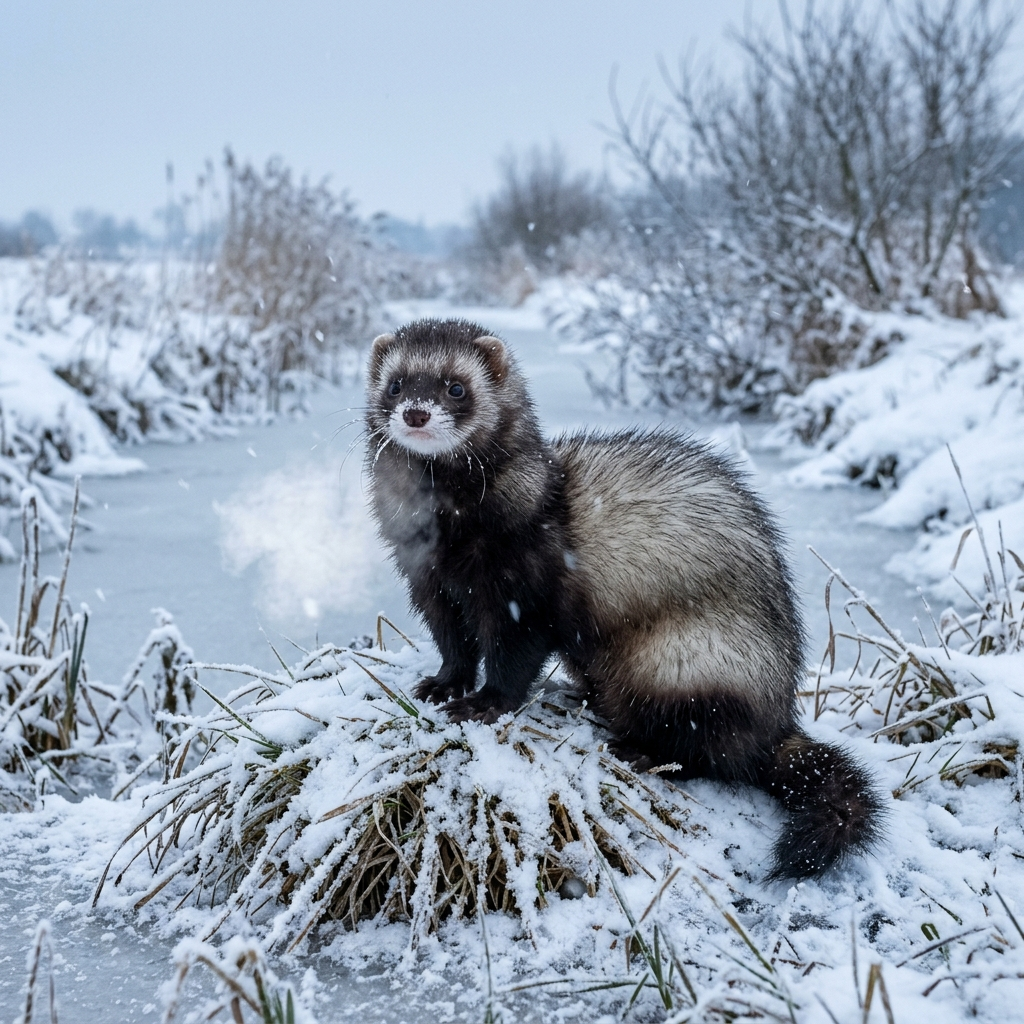
01 Bandit mask · old riverbed bank02 Hunting · common frog03 Litter · under an alder uproot04 Tracks · stream bank05 Winter · full coat06 Dispute · mating season07 Night hunt · floodpool08 Detail · bandit mask
Sources and credits
Pucek Z. (ed.) (1984) Key to the Identification of Polish Mammals, PWN — State Scientific Publishing House · Jędrzejewski W., Jędrzejewska B. (1998) Predation in Vertebrate Communities — The Białowieża Primeval Forest as a Case Study, Springer · Atlas of Polish Mammals (Mammal Research Institute PAS, Białowieża) · Polish Society for Nature Protection "Salamandra" — studies on amphibians as mustelid prey · Davison A. et al. — works on hybridization of Mustela putorius with Mustela furo in Europe · Brzeziński M., Romanowski J. — research on mustelid ecology in Polish lowland river valleys · Editorial field notes from the Biebrza, Narew, and Warta valleys 2022–2026.
Compiled: May 5, 2026
POLAND 2026
— Field correspondence —
One letter from the field, every month.
The latest species profiles, seasonal guides and field observations delivered straight to your inbox. No spam, no clickbait — just solid content once a month.
2,847 readers · 0% spam · unsubscribe with one click