Most readers find this article after a sleepless night — or after seeing the bill for new cables in their car. The question is usually the same: what trap should I buy to finally end this. The answer is simpler than it seems, but governed by several strict legal rules, the violation of which costs much more than any marten in the garage.
This guide covers only live traps — others are simply not allowed in Poland. It shows construction types, baits, placement locations, and separately discusses the procedure for the least weasel (Mustela nivalis), which is strictly protected and requires an RDOŚ permit. If you are not yet sure who your neighbor is, start with the text How to recognize the presence of a marten or weasel in the garden.
§ 01Marten and weasel traps — what the law allows
Polish law is unequivocal on this matter: only live traps are legal — those that catch the animal without injury and allow for later release. Anything that maims, chokes, crushes, or kills — wire snares, leghold traps, irons, loops, spikes — is prohibited. This is backed by Art. 6 and Art. 35 of the Animal Protection Act, and in extreme cases, the Penal Code.
The second level of distinction concerns the species. The stone marten is a game species with a protected period from April 1st to August 31st. Outside this period, only individuals with hunting licenses can hunt them. However, catching a marten in a live trap for relocation is permissible for a property owner — provided it is released immediately and humanely in an appropriate location.
The least weasel is a species under strict species protection. Setting a trap for a weasel without a permit from the Regional Directorate for Environmental Protection (RDOŚ) is a misdemeanor punishable by a fine, and in the case of the animal's death — criminal liability. We discuss the RDOŚ procedure in section 05.
A live trap only works if it is checked at least twice a day — morning and evening. An animal left in a cage in the sun, frost, or for 24 hours without water is no longer „caught alive". This is the foundation of user responsibility.
§ 02Types of live traps
On the market, you will find four basic designs. Each has its place — the choice depends on the species, the placement location, and whether you prioritize discretion or ease of use.
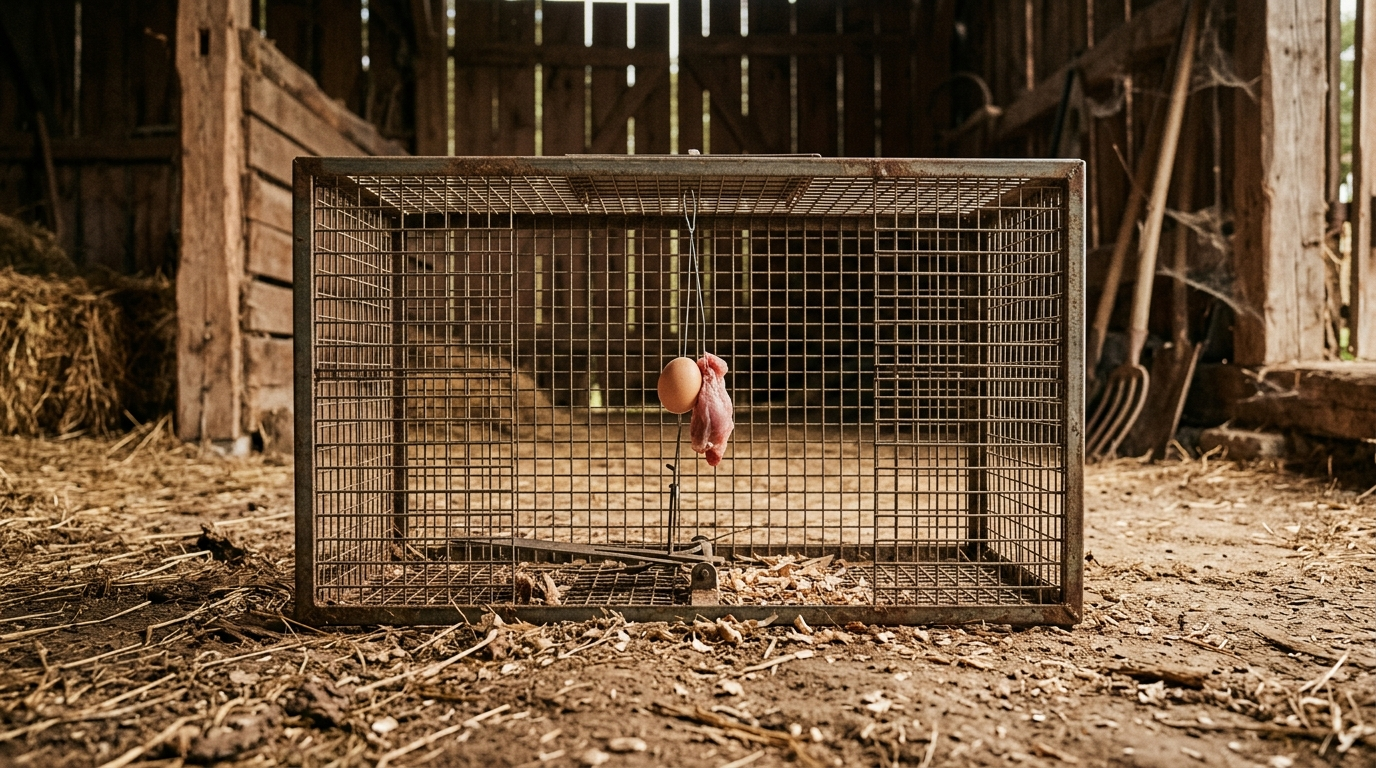
- Folding cage trap — the most popular, rectangular structure made of fine steel mesh (12–16 mm mesh), the door drops after the bait trigger is disturbed. Length 60–80 cm, height 18–22 cm. Works great for martens, less so for weasels (they can squeeze through mesh that is too wide). Price 120–250 PLN.
- Tunnel trap — a wooden or PVC box with two entrances and a flap mechanism in the middle. Natural for mustelids, which instinctively enter narrow passages. Less conspicuous, easy to blend into a woodpile or near a burrow. Price 150–300 PLN, good variants around 200 PLN.
- Foot-plate trigger trap — activated by paw pressure on a plate inside, independent of bait movement. Fewer false triggers from mice and birds. Price 180–280 PLN.
- Infrared sensor trap — an electronic version, doors closed by an electromagnet after crossing an IR beam. Effective for skittish individuals that won't touch bait. Requires power (battery or accumulator). Price 280–600 PLN and up.
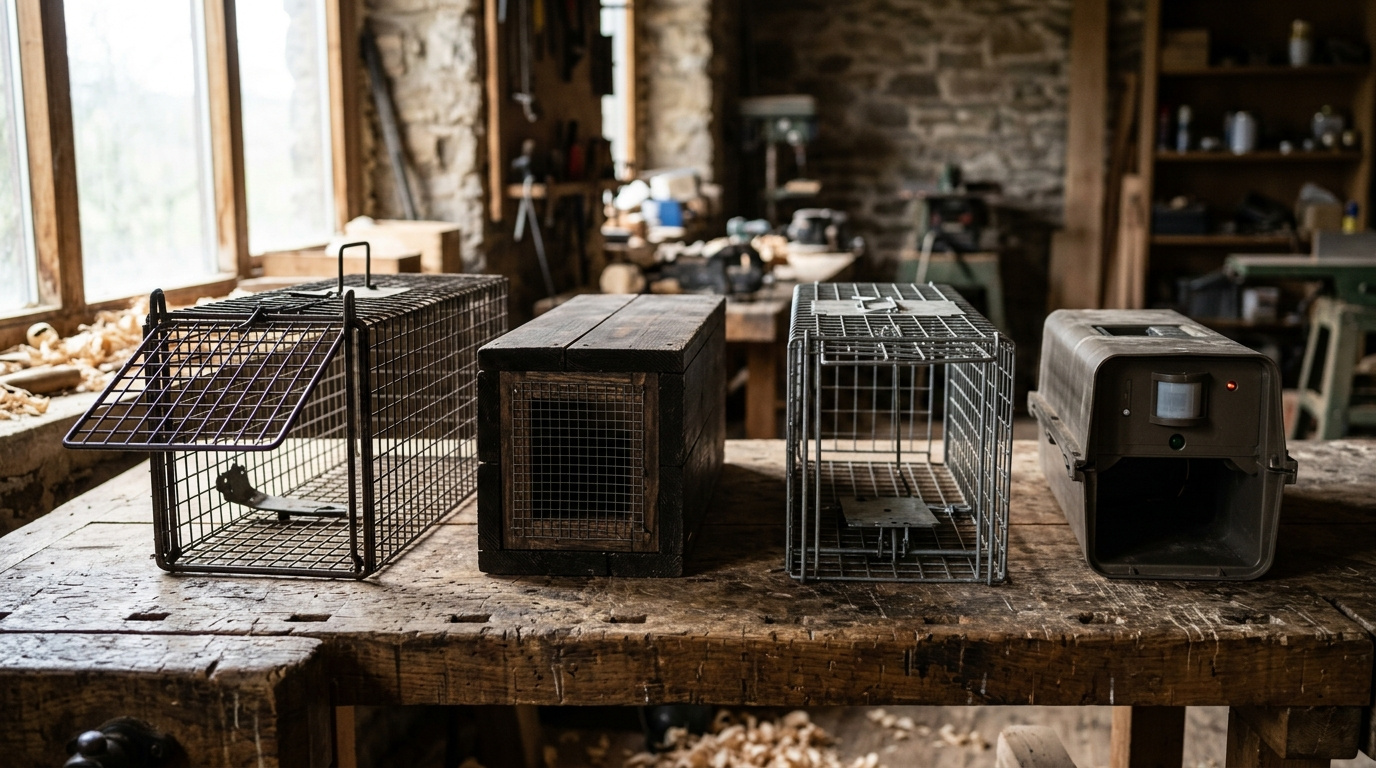
| Type | Price | Best for |
|---|---|---|
| Folding cage | 120–250 PLN | marten in garage, attic, gazebo |
| Tunnel | 150–300 PLN | weasel and marten near burrows, woodpiles |
| Foot-plate trigger | 180–280 PLN | places with many rodents (fewer false alarms) |
| IR sensor | 280–600 PLN | skittish individuals, hard-to-reach places |
For a beginner, the best choice is a 70 × 20 × 20 cm folding cage with a double trigger (both at the bait and underfoot). It costs about 180 PLN, fits in a trunk, is easy to scald after use, and will last for years. You won't catch a weasel in it — but you need a separate procedure for that anyway.
§ 03Lure and bait — what works for martens
The most common question from readers is: what should I use to lure a marten into a trap? The answer is modestly old-school — the marten is an opportunistic predator, so the same things work for it as for weasels and foxes: strongly scented animal protein. Best combined with something that „moves" in the cage when the animal enters.
The proven five:
- Raw chicken egg — an absolute classic, most effective for stone martens. Suspended on a thin wire over the trigger or broken into the trigger, the marten must tug it to pull it out. The smell of raw protein carries through damp air for dozens of meters.
- Fresh piece of raw chicken — preferably a wing with skin, about 60–80 g. The fat under the skin releases scent for several hours. Also works in frost.
- Sardines in oil from a can — a lure for the demanding. The oil leaks from the trigger, creating a scent trail within a radius of several meters. Good in garages where other smells compete.
- Chicken liver or heart — cheap, highly aromatic, easily available. Best slightly dried for 24 hours in a basement.
- Fruit — cherries, sweet cherries, ripe apricots, bananas. They work seasonally (summer and early autumn) when martens naturally reach for fruit.
The best marten lure is one whose scent alone draws the animal from ten meters away. A fresh raw egg beats almost every store-bought ready-made product in this category.
In hunting stores, you can find ready-made marten lures in bottles — usually synthetic compositions based on scent gland extracts, ammonium acetate, and fish oils. They work, but they are expensive (40–80 PLN for 30 ml) and not necessarily more effective than a raw egg. A few drops of the lure are applied to a stick driven 1–2 m from the trap — to pull the animal from a greater distance — while the bait itself remains inside.
Do not use hunting poisons soaked in any stunning agent or chemicals. A live trap must operate exclusively mechanically. Mixing anything into the bait turns it into an illegal device, regardless of intent.
§ 04Where to set the trap
Location determines success more than trap design or type of bait. Martens and weasels move along established paths — the same ones every day, almost to the centimeter. A trap set „roughly where it probably runs" usually stays empty for weeks.
Five locations that work best:
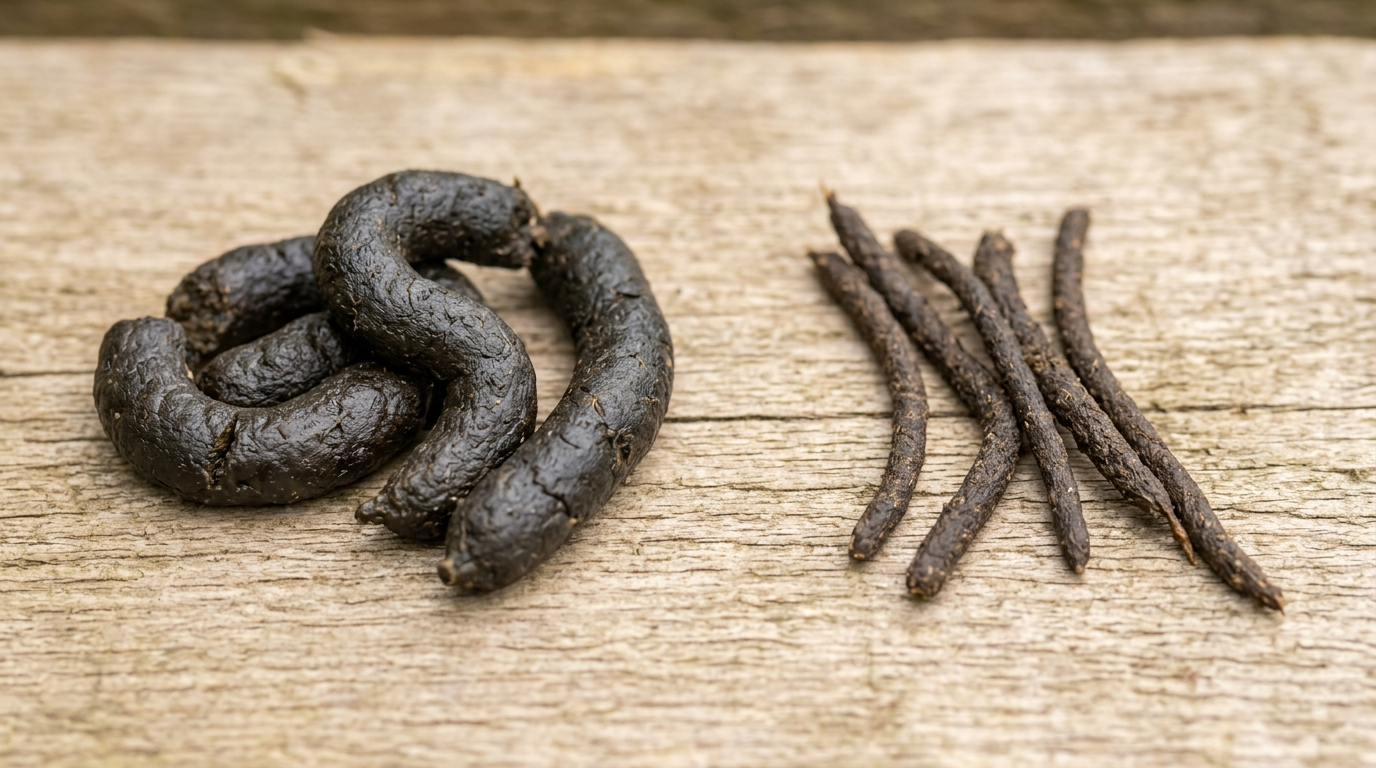
- Paths marked with droppings — the most reliable trail indicator. Spiral-shaped droppings on boards, roof tiles, or wall edges signify a regularly used route. Set the trap 1–2 m away from the marking, in the direction of movement.
- Narrow passages — gaps under floor joists, holes in foundations, passages between woodpiles, openings in fences. The animal must enter the trap to continue its path. Ideal for a tunnel trap.
- Near burrows and hiding places — a marten usually has 2–3 exits from an attic and uses each. Set the trap 2–3 m from the most active exit, preferably in the shade (it should not be visible during the day).
- Close to a food source — chicken coop, compost bin, place regularly visited by rodents, fruit orchard in season. Here, the animal comes with an appetite, making it less cautious in assessing risks.
- Under cover — never in an open space. Set the trap against a wall, under a beam, under evergreen branches, or in a corner of a barn. Martens and weasels avoid open areas and feel safer in a „tunnel".
It's worth setting the trap without arming the trigger for 2–3 days. Let the animal enter, eat the bait, and leave — get used to it. On the third day, arm the trigger. This trick increases effectiveness by about 60–70% for cautious, adult martens. You can read more about trails in the guide Marten tracks and trails.
§ 05How to catch a weasel legally
The shortest answer to the question how to catch a weasel is: with RDOŚ paperwork in hand. Everything else — no matter how humane the trap is — is a violation of species protection regulations (Regulation of the Minister of the Environment of December 16, 2016, on species protection of animals).
The procedure in three steps:
- Application to RDOŚ appropriate for the location of the planned capture. The application must demonstrate a justified reason (e.g., real losses in poultry, threat to human health, conflict with a protection plan), propose a capture method (trap type), and indicate the location for later release. The application is free; waiting time is usually 30–60 days.
- RDOŚ administrative decision specifies conditions: the number of individuals, validity period of the permit, method, documentation method, and release location. A copy must be near the trap in the field, in case of inspection by forest guards or police.
- Documentation — every capture (and every empty checked trap) must be recorded. After completion, a report returns to RDOŚ. No report = loss of ability to obtain further permits.
In practice, for a private individual, this procedure is so time-consuming that it rarely makes sense — a weasel in the garden usually moves out on its own after 3–6 weeks once it has caught the local voles. Securing the chicken coop and leaving the animal alone is more effective and much cheaper. The RDOŚ procedure is mainly handled by poultry farmers with documented losses.
A weasel caught accidentally in a trap set for a marten must be released immediately, in the same place, without touching it with bare hands. Reporting the incident to RDOŚ is not required if the animal was released unharmed. If an injury occurred — immediately contact the nearest wildlife rehabilitation center.
§ 06What to do with a caught marten — step by step
You check the trap at dawn. A marten is sitting inside — terrified, hissing, trying to escape. This is the moment when most people make a mistake: they panic, leave the animal for „later", or do something they later regret. The procedure is simple and always works.
- Step 1 — cover the cage with a blanket or burlap sack. Darkness calms the animal within minutes. Without this, the marten may injure itself trying to get out, and transport will be a nightmare for both sides.
- Step 2 — check if it's a nursing female. Between April and July, females have young. Swollen, visible nipples on the underside of the body mean that somewhere (likely in the attic, basement, or woodpile) there is a litter of 2–5 blind young left behind. Releasing the mother without taking the young = a death sentence for the entire generation. In this situation, the only option is immediate release of the female in the same location and contact with a rehabilitation center.
- Step 3 — transport at least 10 km from home. Martens have excellent spatial memory and return from 5 km in 80% of cases. At 10 km — a dozen percent; at 20 km — practically never. Transport in the trap, in the trunk in the shade, with a window open, drive carefully.
- Step 4 — choose a release site. The edge of a mixed forest, preferably near an old outbuilding or a pile of stones (potential hiding place), far from the nearest buildings (min. 1 km). Do not release on someone else's property or within a reserve without consulting the manager.
- Step 5 — release. Place the cage, open the door, step back a few meters. The marten will come out on its own within a few to several dozen seconds. Do not poke, do not help with a stick, do not take close-up photos.
After returning home — check the attic for young, regardless of the season. If a marten has been choosing your home as a hideout for a week, there's a non-zero chance it left behind more than just a scent. If a nursing female was caught — checking is mandatory and urgent. Afterward, scald the trap with boiling water to remove the scent (otherwise, the next marten will avoid it from afar).
§ 07What is forbidden — lethal traps, snares, poison
Everything described in this section is illegal and punishable. We list these methods only so you know what to avoid and what to recognize on your property if someone else tries to „help". Using any of them entails criminal liability of up to 5 years of imprisonment (Art. 35 para. 2 of the Animal Protection Act — extreme cruelty).
The three most common illegal „folk" methods we encounter in the field:
- Snares made of steel wire or fishing line — a slipknot hung in a passage. Slow suffocation, agony lasts for hours. Absolutely forbidden. Often „accidentally" catch domestic cats, foxes, or young roe deer — with the same consequences.
- Leghold traps („irons") — spring-loaded jaws that snap shut on a limb. The ban has been in place for decades, but they are still found in the attics of old farms. They cause fractures, extensive injuries, and bleeding out. Forbidden throughout the EU.
- Poison — most often anticoagulant rodenticides added to meat or some „specialty" from the internet. Slow death through internal hemorrhage lasting 3–7 days. Secondary poisoning of the food chain (a marten that died in the forest is eaten by a fox, jay, or owl — another animal dies). Illegal in every respect.
Punishments are real. In recent years, courts in Poland have sentenced individuals for setting snares and poisons to fines ranging from 3,000 to 20,000 PLN, community service, and in spectacular cases (e.g., killing protected species), prison sentences of up to a year. In cases of extreme cruelty — up to 5 years of imprisonment. Additionally: a ban on owning animals, legal costs, and a contribution to an animal welfare organization.
If your marten problem exceeds your capabilities, before reaching for anything from the internet — read the guide on effectively deterring martens and weasels. A live trap solves the problem in 90% of cases. In the remaining 10%, securing the attic and perseverance help. There are no other legal paths in Poland.
A 70 × 20 × 20 cm live cage, a raw egg as bait, placed on a path marked with droppings, check twice a day, transport at least 10 km, check the attic afterward. Five steps, one weekend of work, cost under 250 PLN — and the house returns to normal.
★Frequently asked questions
Which marten trap is the best?
For a private individual, the best choice is a folding cage trap measuring 70 × 20 × 20 cm with fine steel mesh (12–16 mm mesh) and a double trigger — at the bait and underfoot. It costs 150–250 PLN, is easy to transport and scald after use, and works effectively on adult individuals. Tunnel traps are better when you prioritize discretion or are trapping near a burrow.
How to catch a weasel legally?
The least weasel (Mustela nivalis) is under strict species protection. Catching it requires a permit from the Regional Directorate for Environmental Protection (RDOŚ), issued upon a written application with a justified reason (most often documented poultry losses). The waiting time for a decision is 30–60 days. Every capture must be documented, and a report sent back to RDOŚ. For a private individual, the procedure is usually not worth the effort — the weasel usually moves out on its own after catching local rodents.
What should I use to lure a marten into a trap?
The most effective marten lure is a raw chicken egg suspended on a wire over the trigger — the marten must tug it to pull it out. Alternatives: fresh chicken wing with skin, canned sardines in oil, slightly dried chicken liver, or ripe cherries/sweet cherries in summer. Ready-made synthetic lures from hunting stores (40–80 PLN per bottle) work but are not more effective than a raw egg — they can be used to soak a stick driven 1–2 m from the trap to draw the animal from a distance.
Can I kill a caught marten?
No. Killing a marten caught in a live trap by a person without a hunting license is a violation of the Animal Protection Act and Hunting Law. During the protected period (April 1st – August 31st), killing a marten is also forbidden for hunters. A caught animal must be released — in an appropriate place and as soon as possible. Breaking this rule results in a fine, and in cases of extreme cruelty, criminal liability of up to 5 years of imprisonment.
What to do with a marten in a trap?
First: cover the cage with a blanket — darkness calms the animal in minutes. Second: check if it's a nursing female (swollen nipples on the underside between April and July). If so — release it in the same spot and look for young. Third: transport at least 10 km from home, in the shade, with a window open. Fourth: release at the edge of a mixed forest, away from buildings. Fifth: check your own attic for young and scald the trap with boiling water.
How much does a live marten trap cost?
Prices in Poland start from 80 PLN for the simplest imported cages measuring 50 × 17 × 17 cm (usually too small for an adult stone marten) and go up to 300 PLN for solid Polish constructions of 70–80 cm made of thick wire with double triggers. Wooden tunnel traps cost 150–300 PLN, electronic ones with infrared sensors — from 280 to 600 PLN. Best value for money: a 70 × 20 × 20 cm folding cage for around 180–220 PLN, which will last 5–10 years with regular disinfection.