Most encounters with the stone marten (Martes foina) follow a single, repeating scenario: you hear it before you see it. Thumping above the ceiling, scratching at the soffit boards, a short tug on something on the roof tile. This acoustic trail is not chaos, but a fragment of a very well-organized day for a predator that feels right at home in the human landscape.
This guide brings together what we know about stone marten ethology—from its daily rhythm and home range size to the importance of scent, the reproductive cycle with delayed implantation, and seasonal behavioral fluctuations. If you wonder why a marten appears at your place in November, disappears in June, and what it actually does between 11 PM and 4 AM—everything is below. Before moving on, it's worth recalling the basic differences from its close cousin in the text Pine marten vs stone marten.
§ 01Daily Rhythm — What a Marten Does at Night
The stone marten is a nocturnal and crepuscular species. The main peak of activity occurs from sunset to about two in the morning, with a second—much shorter—peak an hour before dawn. Telemetry of individuals in Central Europe confirms this pattern with high consistency, regardless of whether the animal lives in a city, on a farm, or at the edge of a mixed forest.
A typical marten night is divided into three phases. The first is leaving the daytime hideout (attic, woodpile, hollow tree, abandoned barn) and conducting a brief inspection of the immediate area—usually walking the same roofs, wall edges, and branches. The second is the actual patrol of the territory, including hunting, exploring food sources, and marking the area with scent. The third is the return, a final feed, and settling down for daytime rest, which takes 14–16 hours a day.
Exceptions to this scheme occur and are diagnostic. A female nursing young in May and June briefly comes out in full daylight—usually between 6 and 8 AM if the night was unsuccessful. Juveniles, which are just learning the territory, are sometimes seen in the early afternoon, especially in August and September. Sick or injured animals also shift their activity to the daytime because they cannot hunt effectively at night.
If you see a marten regularly after 9 AM and it looks healthy—it is very likely a nursing female. This is not a signal for intervention, but for refraining from it: somewhere nearby (most likely in your attic) lie blind young that you won't be able to save if the mother is scared away.
§ 02Territory and Scent Marking
The stone marten leads a solitary lifestyle with clear territoriality. Male home ranges usually cover 80–200 ha, and females 40–100 ha. In urban landscapes, these values drop by half (more food in a smaller area), while in forests and sparsely built-up areas, they increase. Female ranges usually fit within the range of one male, who becomes their partner during the mating season.
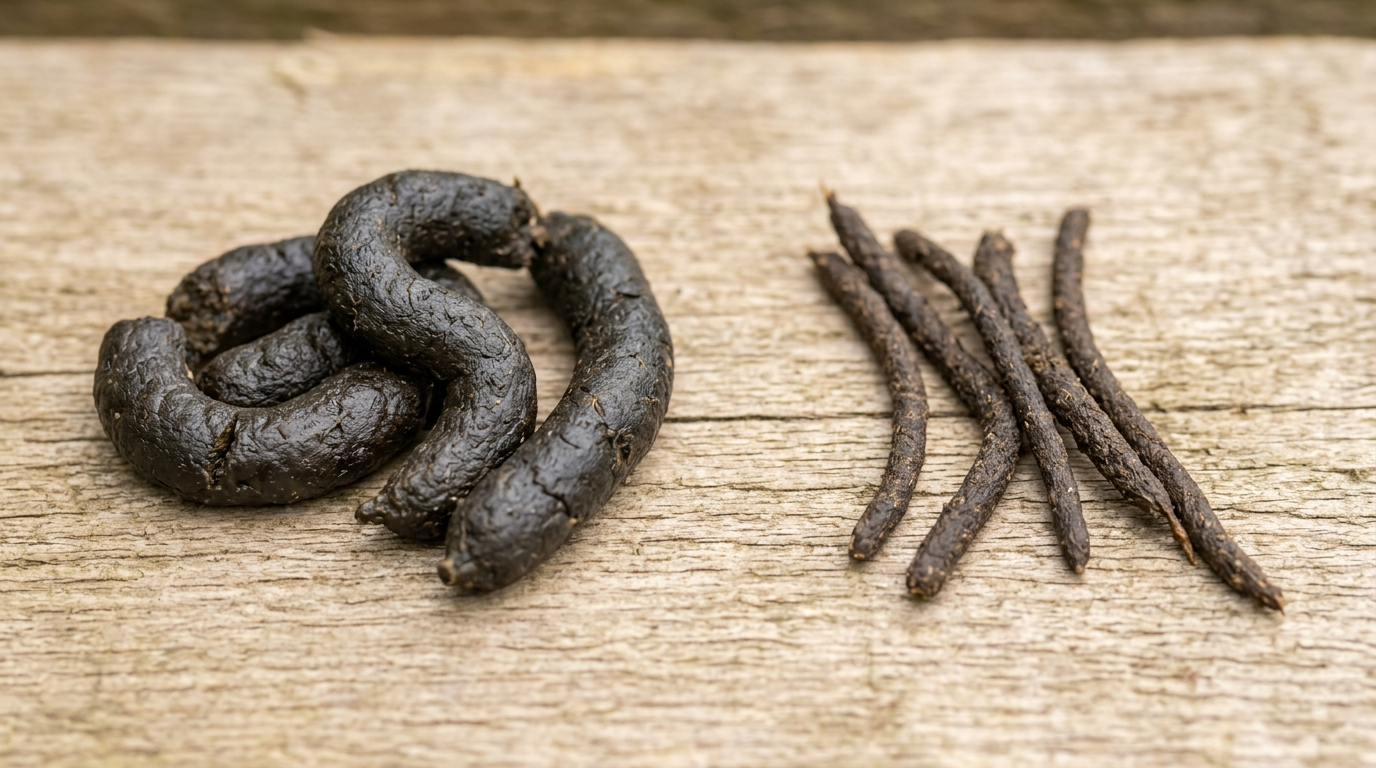
Boundaries are not a defended line but a buffer zone of signals. The marten patrols it regularly, using two tools of scent communication: anal glands and urine. Characteristic scats—cylindrical, black, often containing hair and seeds—are placed in exposed locations: on wall edges, stones, chimneys, or fallen logs. They function as a business card: I was here, I am healthy, this territory is occupied. You can find more practical recognition of these signs in the guide Marten tracks and signs.
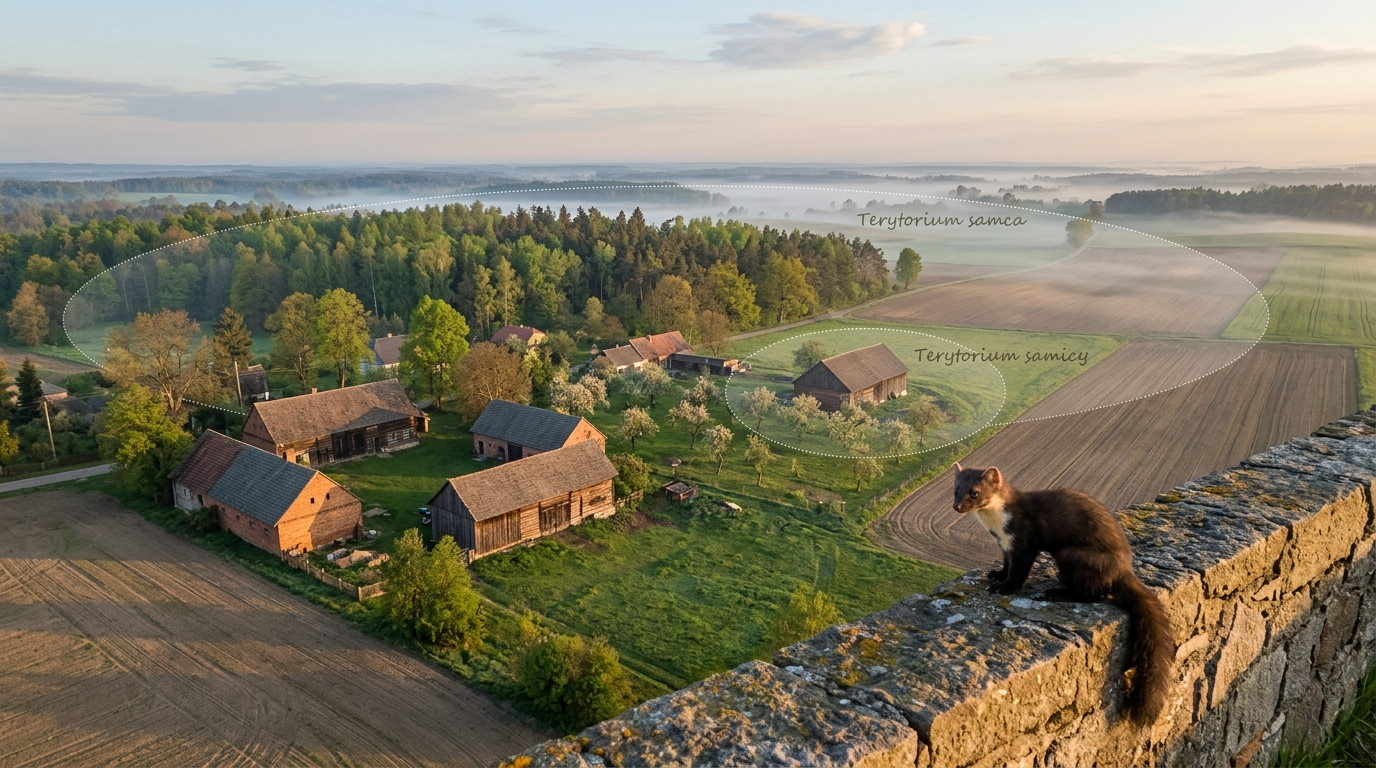
Within its range, a marten has several—usually 3 to 6—daytime hideouts used rotationally. This behavior serves several functions: it limits parasites (fleas, ticks, ants in an old nest), makes it harder for higher-level predators (eagle owl, fox) to track, and during the mating season, it allows the male to react quickly to the appearance of a rival in any part of the territory.
Reactions to a stranger depend on gender and season. Outside of mating, encounters between two adults are rare and brief—one party yields, usually the one in poorer condition. In June–August, males actively patrol boundaries and engage in physical fights, which leave characteristic scars on the snouts of older individuals. Conflicts side-by-side with its cousin—the weasel—are described in a separate text Marten vs weasel — what you should know about these mammals.
§ 03Mating and Delayed Implantation
The mating season of the stone marten falls in June, July, and the first half of August. This is one of the more spectacular periods in the life of the species: animals that are usually discreet and quiet begin to vocalize—emitting long, mournful cries audible from several hundred meters, strikingly resembling the meowing of cats. Anyone who has heard martens mating in the attic remembers it for a long time.
During this time, the male patrols a much wider territory than usual, visiting the home ranges of several females in turn. Copulation is long—from several minutes to even an hour—and repeated multiple times a day. The female is covered by the same male over several encounters, which increases the chances of fertilization.
The marten is a mother whose body can suspend pregnancy for six months, waiting until winter passes and enough food appears to feed the young. This is not caution—it's physiology.
The most fascinating feature of marten reproduction is delayed embryo implantation (embryonic diapause). After fertilization, the blastocyst does not immediately implant in the uterine lining—it floats freely in the uterine cavity for 7 to 8 months in a state of suspended development. Only in January or February, under the influence of hormonal changes related to lengthening days, does the embryo implant and the actual pregnancy begins, which then lasts only about a month.
The young are therefore born in March and April—nearly 9 months after copulation, although the actual embryonic development only takes 4–5 weeks. This mechanism is evolutionarily clever: it separates the time when it's easy to find a partner (summer) from the time when it's easy to find food for the young (spring). This also occurs in pine martens, badgers, stoats, and several other mustelids.
The litter usually consists of 2–5 young, most often three. They are born blind, deaf, and covered in sparse grayish down, weighing only 25–30 g—less than an average mouse. Their full dependence on the mother will last for the next two months.
§ 04Cub Care — From Nest to Independence
The choice of a nest site is one of the main causes of conflict between martens and humans. The female looks for a place that is warm, dry, dark, and inaccessible to larger predators—and in the Polish landscape, these conditions are most often met by the attic of an old house, the ceiling over a cow barn, an abandoned barn, or a hay pile in a working barn. Tree hollows and rock piles are still found, but across the population, they have yielded to anthropogenic structures.
The first weeks of the cubs' lives pass in almost complete silence. They open their eyes around the 30th day, and their first teeth appear in the fourth week. During this time, the female hardly leaves them—she goes out only for short hunting trips around dawn, particularly favoring compost heaps and chicken coops where food can be obtained quickly.
After about 8 weeks, the young begin to leave the nest. First for a few meters within the attic or barn; then further, on their first nightly excursions with their mother. This is the period when homeowners most often notice them—the loud thumping of several pairs of paws instead of one animal, scratching at the soffit boards, and sometimes young falling from the attic and walking on the roof in the morning.
Learning to hunt takes another 4–6 weeks. The mother brings live or weakened prey, the young "finish it off," and gradually take over the role of the hunter. Full independence is reached after 3–4 months—usually in July and August, exactly when the mating season of the next generation begins. This is no coincidence: the dispersal of the young while the adults are busy with each other limits intra-population conflicts.
Deterring a marten from an attic during the March–June period without checking for young usually ends in tragedy: the mother does not return, the young starve for several days, and the owner finds the carcasses under the joists a few weeks later. Any intervention during this period requires an attic inspection—if you hear squeaks, wait until August.
§ 05Living Alongside Humans — Anthropogenic Adaptation
The stone marten is one of the best-adapted predators to humans in Europe—and the name "stone" (or "house" marten in Polish) is not a metaphor, but a precise description of its ecological niche. Unlike the pine marten, which still prefers old-growth forests, Martes foina chooses a mosaic landscape: farms, suburbs, ruins, and increasingly, city centers.
In practice, this means utilizing the full range of anthropogenic structures. Attics and lofts replace tree hollows. Piles of stones, wood, and rubble serve as rocky outcroppings. Ventilation ducts, chimneys, and gaps in insulation act as underground tunnels. Even car engine bays have become typical hideouts: warm after a drive, dry, discreet, and full of scents (a mouse in the garage, a drop of oil) that simply interest the marten.
However, the marten does not coexist with humans "passively." Constant elements of its life near the home include:
- Compost heaps — an easily accessible source of protein (meat scraps, eggs, shells) and a hunting ground for rodents and snails that come to the compost.
- Chicken coops, pigeon lofts, rabbit hutches — the most common flashpoint in the human-marten relationship, discussed in section 07.
- Pet food left on the porch or in the garage — especially wet cat and dog food. The marten quickly learns the owner's daily schedule.
- Car engine bays parked outdoors at night — a hideout, a play area for juveniles, and unfortunately, a source of conflict over wiring.
- Bio-waste bins — especially urban ones, where the marten can open magnetized lids and redirect its entire nightly route to specific containers.
Importantly, the marten's adaptation is generational. Young born in an attic return to attics as adults, not to tree hollows. Today, urban populations are genetically and behaviorally slightly different from forest populations, although formally they are still the same species. In this sense, the stone marten has been our roommate for several hundred years, not a "wild animal that accidentally wandered into the attic."
§ 06Seasonality — What Winter and Summer Change
The marten does not hibernate, but its behavior changes throughout the year more than is apparent to an observer. The annual cycle is divided into four distinctly different phases, and for a resident of a house with an attic, this has concrete, audible consequences.
Spring (March–May) — the period of births and early cub care. Female activity is limited to the immediate vicinity of the nest; males still patrol full ranges but cross paths more often. The loudest period in attics, as the young begin to leave the nest. Diet: eggs, chicks, young rodents—detailed in the guide Marten diet.
Summer (June–August) — dispersal of young and the mating season. Males travel long distances at night (sometimes up to a dozen kilometers), and females regain freedom after raising their young. Vocalizations are audible, including the characteristic "meowing" cry. The male's home range temporarily expands into the territories of neighboring females. Social encounters are the most frequent of the year.
Autumn (September–November) — rebuilding condition, fat storage, and intensive foraging. Young born in the spring leave the mother's range and wander in search of their own—sometimes 10–20 km from their birthplace. This is the period when "new" martens most often appear near people who previously had no issues. A young, inexperienced individual looks for a winter hideout and often chooses the first attic it can enter.
Winter (December–February) — a time for energy conservation. The home range shrinks by 30–50%, the marten moves more cautiously, and accumulates food in larders (a pile of hunted mice in an attic corner, a few eggs taken from a coop), and won't refuse carrion. It marks boundaries less often and sleeps up to 18 hours a day. Paradoxically, this is the loudest period for humans—because the marten is nearby, stays warm in the attic, and hunting is limited to the immediate vicinity of the farm.
March–May: quiet days, noisy nights with young. June–August: cat-like mating cries, adults outside, young still in the nest. September–November: dispersal of young, "new" tenants in attics. December–February: steady resident, minor hunting, little outdoor activity.
§ 07Conflicts with Humans — Where Habits Clash
Most of the habits described above only become a problem at one point—the point of contact with humans. Three conflicts appear regularly and are so intertwined that it's hard to discuss one without the others.
Conflict One — the attic as a nest. From a marten's perspective, an attic meets all the criteria for an ideal hideout: warm, dry, dark, accessible from the outside, and inaccessible to dogs and cats. From a homeowner's perspective, it's an expensive, thermally insulated part of the house whose use by a predator means destroyed mineral wool, flooded ceilings, sleepless nights, and—during mating season—scenes sounding like a cat fight at three in the morning. Before any intervention, it's worth checking signs of activity in the guide How to recognize the presence of a marten or weasel in the garden.
Conflict Two — the chicken coop as a larder. A marten in a closed coop triggers a "kill everything that moves" instinct, which in nature is almost never completed—because victims escape. In a coop with small fencing, they cannot. A single marten can kill 20 chickens in one night, eating one and leaving the rest. This is not malice, but a fragment of ethology that evolution never had a reason to suppress.
Conflict Three — the car as a hollow tree. The engine bay of a car cooling down after a drive is warm, dry, and full of scents for a marten. A young, inexperienced individual marks it with urine; the next—encountering someone else's scent—reacts by attacking the soaked elements: ignition cables, hoses, radiator lines. The result is chewed rubber and silicone components costing hundreds to thousands of dollars in repairs.
What to do about all this? Many homeowners who have tried fighting martens themselves eventually reach for the support of an expert or a professional security contractor—not out of laziness, but because independent intervention during the breeding season or without knowing the animal's paths usually ends in failure. If the problem returns every winter and you don't want to go through it alone, in many cases the most sensible step is to hand the matter over to someone who has done it many times. If, however, you want to try it yourself and start with non-invasive methods, begin with the guide on deterring martens and weasels.
The stone marten is a nocturnal predator with a stable home range (male 80–200 ha, female 40–100 ha), summer mating with delayed implantation, young born in March–April, and full independence after 3–4 months. Conflict with humans is not a result of the animal's "bad habits"—but their natural, evolutionarily grounded fit into the structures we have built ourselves.
★Frequently asked questions
When is the marten most active?
The stone marten is a nocturnal and crepuscular species. The main peak of activity falls between sunset and about two in the morning, with a second—shorter—peak an hour before dawn. During the day, it sleeps 14–16 hours in one of 3–6 hideouts that it uses rotationally. Exceptions include nursing females (short trips in the morning in May and June) and young individuals learning the territory (August–September).
How large is the stone marten's home range?
A male stone marten's home range usually covers 80–200 ha, and a female's 40–100 ha. In urban landscapes, these values drop by up to half, while in forests and sparsely built-up areas, they increase. A female's range usually fits within that of a single male. Boundaries are not a defended line but a buffer zone of scent marks—scat deposits on exposed wall edges, stones, and chimneys.
When does a marten have young?
Stone marten young are born in March and April, although copulation took place the previous summer (June–August). This long gap is due to delayed embryo implantation—the fertilized blastocyst floats in the uterus for 7–8 months in a state of suspended development and implants only in January or February. The actual pregnancy then lasts about a month. A litter consists of 2–5 young, most often three.
After how many months do young martens become independent?
Young martens reach full independence after 3–4 months of life—usually in July and August. They open their eyes around the 30th day and begin leaving the nest after eight weeks. Learning to hunt takes another 4–6 weeks. In autumn, the young disperse to their own territories, sometimes 10–20 km from their birthplace—and these are the ones that most often find "new" attics between September and November.
Does the stone marten hibernate in winter?
No. The marten does not enter winter sleep or hibernate. However, in winter, its home range shrinks by 30–50%, it sleeps up to 18 hours a day, and limits hunting to the immediate vicinity of its hideout. It accumulates stores (hunted mice, eggs from coops) and does not refuse carrion. Paradoxically, this is the loudest period for residents of houses with attics—because the marten is constantly close, stays warm in the attic, and short nightly outings occur within the same building.
Why does a marten appear specifically in the attic?
From a marten's perspective, an attic meets all the criteria for an ideal hideout that would take weeks to find in nature: warm, dry, dark, inaccessible to larger predators, and with multiple escape routes. The species' adaptation to anthropogenic structures is generational—young born in an attic return to attics in adult life, not to tree hollows. Hence, urban and rural stone marten populations are now behaviorally different from forest ones, even though they formally belong to the same species.