Reading tracks is one of those skills you learn once and use for a lifetime. The stone marten is one of the most rewarding species to track — it leaves very clear signs, does so often, and in predictable places. After two or three morning walks in fresh snow, you'll have its route mapped out.
This guide will walk you through all the types of signs a marten leaves in the terrain: single paw prints, characteristic jump patterns, fur in crevices, droppings at territory boundaries, dens, and hideouts. At the end — how to distinguish marten tracks from other animals they are most commonly confused with.
§ 01What to look for — an overview of all signs
Before you head out into the field, it's worth knowing that a marten leaves five types of signs that together provide almost 100% certainty of identification. Each is described in detail below, but here is a short map.
- Tracks — individual paw prints (in snow, mud, soft soil).
- Fur — individual hairs in places where the animal squeezes through.
- Droppings — cylindrical, in visible, exposed places.
- Damage — dug-up lawn, pulled-out insulation, chewed cables.
- Dens and hideouts — in woodpiles, in the attic, in the garage, under the shed.
Usually, two of these five are enough to be sure. All five — and it's a guarantee that you have a permanent resident on your property, not just a random guest.
§ 02Single track — five toes and claws
A single marten paw print is 3–4 cm long and 3 cm wide, roughly square. It clearly shows five toes arranged in an arc and a large triangular pad in the center. Each toe ends with a claw mark — short but distinct, set at an angle to the toe axis.
The number of toes determines the family: canines (fox, dog) — four toes; felines (cat, lynx, wildcat) — four toes, retractable claws not visible in the track; mustelids (marten, weasel, stoat, polecat) — five toes with claws. At this level, 90% of mistakes disappear.
In practice, the fifth toe (the smallest one on the inner side of the paw) is sometimes pressed more weakly and may not be visible — especially on harder ground or in deeper snow. Four clear toes + claws still point to mustelids. If there are no clear claws — reconsider whether it might be a cat.
§ 03Double track — the marten's characteristic „jump"
This is the moment when the marten fully reveals itself. It moves in short jumps, during which the hind paws land exactly in the prints of the front ones (or just behind them). As a result, tracks are arranged in pairs lying close together, with a clear gap between pairs — from 30 to 80 cm, depending on the speed of movement.
When you look down at fresh snow, you see: two prints close together — a gap — two prints — a gap — two prints. This is very characteristic and almost impossible to mistake. A cat doesn't walk like this. A dog doesn't walk like this. A squirrel walks similarly, but its tracks are smaller (2 cm), in less regular pairs, and always lead to a tree.

This type of sign is best visible in winter after a night's snowfall. In summer — in the garden, on a freshly dug bed, on the edge of a muddy puddle, on a dusty board. It's worth remembering that a fresh track lasts 1–3 days in optimal conditions. After a week, it's usually gone.
§ 04Fur and hair — what you'll find in a crevice
The marten has long, stiff fur — a typical guard hair is 3–5 cm long and significantly thicker than that of a cat or dog. Color: dark brown at the base, lighter in the middle, dark at the end. Individual hairs remain in places where the marten squeezes through — between ceiling beams, in narrow chimney gaps, under the edge of a roof tile, in a hole in the fence mesh.
Practical tip: if you found a hair and are not sure if it's a marten or a cat, take it between your fingers and gently bend it. Marten hair is stiff and returns to its straight shape. Cat hair is soft and stays bent. It's simple, but it works.
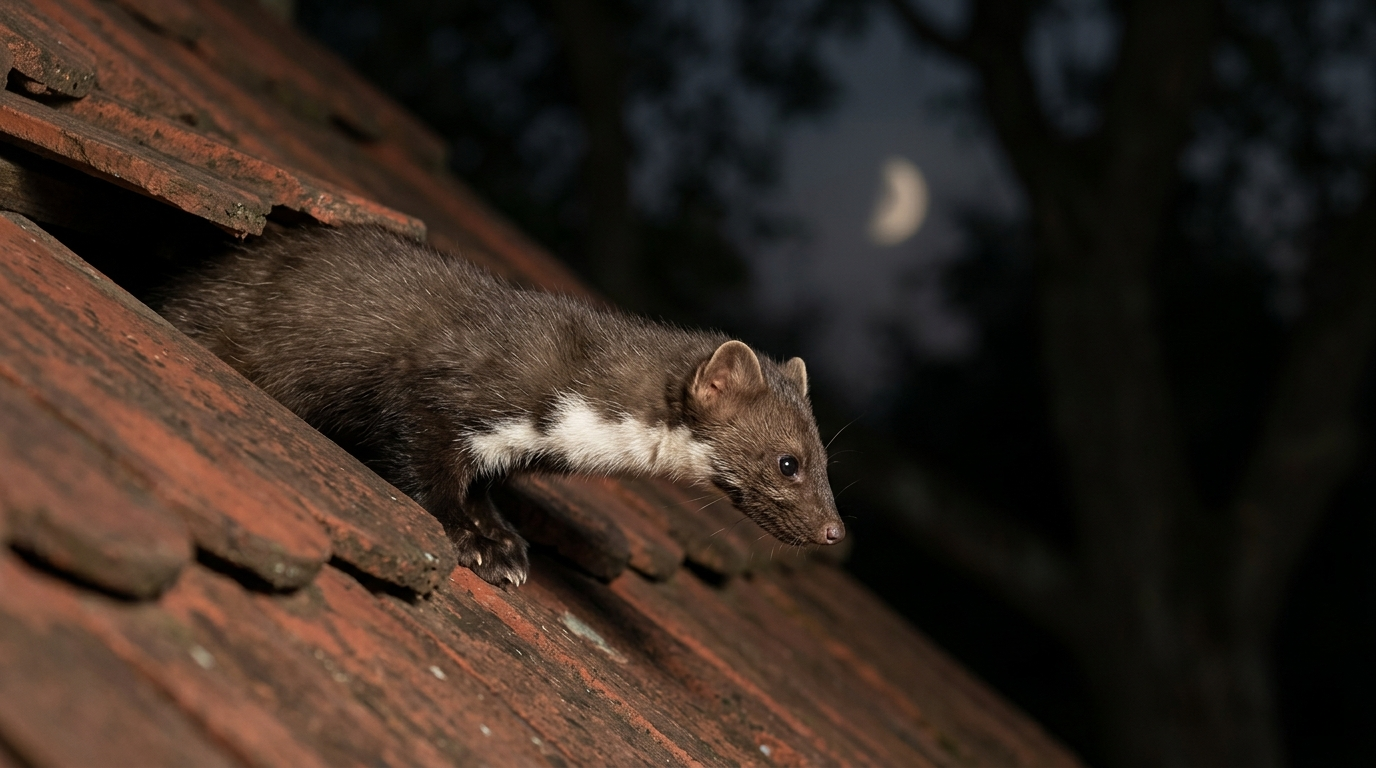
First: the edge of the roof tile at the eaves (this is where martens enter most often). Second: the frame of the ventilation opening in the roof. Third: the external housing of the engine compartment in a car. These three points are checked by practically every marten that has started taking an interest in your property.
§ 05Cylindrical droppings — the surest calling card
Marten droppings are the sign most often found by homeowners — and they are usually what first makes people suspect a problem. They have a characteristic shape: long cylinders, 6–10 cm long, about 1 cm in diameter, twisted and clearly tapered at the ends (sometimes with a twist resembling small „S" letters). Fresh ones are dark brown or black, shiny, and have a distinct musky smell.
Inside, you can almost always see diet remains: bones and fur of small rodents (in spring and winter), fruit pits and seeds (in summer and autumn), feathers (occasionally after a chicken coop raid). After a week, they dry out and turn into gray, brittle cylinders, but they retain their shape for many weeks.
A marten doesn't hide its droppings. It's a sign of ownership, not shame — it leaves them where it wants to be seen.
The most important thing, however, is where the marten leaves them. These are not random places. The marten marks its territory with them and does so in visible, prominent points: on top of a stump in the garden, on the edge of a wall, in the middle of a roof tile, on a shed board, on a car body, on a terrace step. The more prominent the place — the more certain it is a marten, not a cat or a hedgehog.
Fresh marten droppings can contain parasite eggs (including nematodes). Do not touch them with bare hands. Wearing gloves, pouring disinfectant, and removing them into a bag — this is the absolute minimum. Never compost predator droppings.
§ 06Dens and hideouts — where the marten lives
Contrary to its name, the stone marten does not dig dens. It uses ready-made hideouts — natural (tree hollows, cavities under roots, rock crevices) or man-made. In built-up areas, it chooses the attic (most often near the chimney where it is warmer), the space above a suspended ceiling, an unfinished garage, an abandoned utility building, woodpiles, or the space under external stairs.
Keys to a good „marten apartment": warm, dry, two exits, close to food and water sources. This set of conditions is met by practically every Polish single-family house — hence the scale of the problem in the last two decades. A marten doesn't waste energy digging a den when a human has already prepared something for it.
A pair (male + female) occupies an area of 100–250 hectares, but within it, they usually use 3–6 hideouts, between which they move every few days. This explains the readers' impression that „the marten was there for a week, then disappeared, then came back again." This is normal — a marten doesn't live permanently in one place; it rotates through its quarters.
§ 07Marten vs. other animals — quick track differentiation
The stone marten is most often confused with the weasel, polecat, cat, and squirrel. Each of these animals leaves a different sign and can be efficiently distinguished in the field. A full comparison of the marten and the weasel as species can be found in the article Marten vs. Weasel; here — a quick track comparison.
| Animal | Track Size | Characteristic Features |
|---|---|---|
| Stone Marten | 3–4 cm | 5 toes with claws; tracks in pairs (jump); gaps 30–80 cm |
| Pine Marten | 3–4 cm | practically indistinguishable from stone marten in the field |
| Least Weasel | 1.5–2 cm | 5 toes with claws; very tiny; short jumps |
| European Polecat | 2.5–3 cm | 5 toes with claws; creeping gait, tracks not in pairs |
| Stoat (Ermine) | 2–2.5 cm | 5 toes; tracks in pairs like marten, but much smaller |
| Domestic Cat | 2.5–3.5 cm | 4 toes, no claws in the track |
| Squirrel | 2–3 cm | slender toes; tracks always lead to a tree |
In practice, two questions resolve most cases: can you see claws? (if not — it's a feline) and are the tracks arranged in pairs? (if yes — mustelid, most often a marten). The rest is just refining by size and gaps.
If you've established that you're dealing with a marten, it's time to think about securing the attic and the engine compartment. The full step-by-step scenario — with 11 signs, night signals, and garden damage — is described in our article How to recognize the presence of a marten or weasel in the garden.
★Frequently asked questions
How long do marten tracks last?
A single track in snow lasts 1–3 days at a constant temperature. Fresh droppings remain visible for weeks but lose their scent after 5–7 days. Fur in a crevice can stay for months if no one removes it. The track disappears fastest in wet snow (blurring in a few hours).
Are marten signs dangerous to health?
The tracks themselves — no. Fresh droppings can be dangerous (risk of internal parasites — nematodes, roundworms) and in extremely rare cases, saliva (rabies). When cleaning up, always use gloves, a mask, and surface disinfection. Tracks and fur — safe.
How to distinguish a marten track from a cat track?
The fastest way: a marten has 5 toes with clear claws, while a cat has 4 toes and retractable claws (which usually don't leave prints). Additionally, marten tracks are arranged in pairs (jumping), while a cat steps individually. If in doubt, look at the size — a domestic cat's track is very similar in size to a marten's, but the claws and 5 toes are decisive.
Does a marten have one nest or more?
A pair of martens (male + female) usually uses 3–6 hideouts within their territory (100–250 ha). Every few days, they move between them — this is a normal part of their lifestyle. This creates the impression that „it's here one moment, gone the next." Eliminating one hideout does not solve the problem if others remain accessible.
When is the best time to look for tracks?
In winter — in the morning after a fresh snowfall, ideally a thin layer of 2–5 cm. In summer — after rain, on soft garden soil, the edges of beds, or dusty shed boards. The worst conditions are dry heat (no tracks) and deep, powdery snow (tracks blur immediately).
Does a marten dig dens?
No — the stone marten does not dig its own dens. It uses existing hideouts: hollows, crevices, abandoned dens of other animals, and in built-up conditions, attics, garages, and woodpiles. If you see a freshly dug den in the garden, it is more likely a badger, fox, or raccoon dog — not a marten.