Most people only realize they have an uninvited neighbor when something breaks — a chewed cable in the car, a dug-up flowerbed, or a husband sleeping at 3 AM woken by thumping above the ceiling. However, these are the final links in a chain of signals that might have gone unnoticed before. This guide gathers eleven signs that will help you calmly determine whether it's a marten, a weasel, or perhaps something else entirely.
Recognition has practical significance. The stone marten (Martes foina) and the least weasel (Mustela nivalis) require completely different strategies — from the type of trap to the method of securing the attic. Confusing them costs time, money, and often the animal's health. Before reaching for anything on the garden store shelf, it's worth knowing who you're dealing with.
§ 01What You Will Hear at Night
The first signal usually comes through the ceiling. The stone marten is active mainly between 10:00 PM and 4:00 AM and moves across the attic floor in a very characteristic way — short bursts of fast steps interrupted by sudden silence. It sounds more like a gallop than walking. If you hear a sudden thumping above the ceiling in the middle of the night that cuts off after a second and returns after a minute — it's almost certainly a marten.
The second type of sound is scratching claws on wood. The marten likes to make a comfortable mat out of insulation, chaff, or rags — during this “decorating,” it produces distinct, dry friction sounds. The third, least pleasant sound is squealing. During the mating season (March–April, with a second peak in July–August), males fight for territory, and females drive away rivals — the sounds then resemble a fight between two large cats on a narrow balcony.
The least weasel is much quieter and lighter. If you hear clear, “heavy” footsteps of someone the weight of a large cat — it's not a weasel. A weasel weighs a few dozen grams and moves so that a human almost never hears it.
§ 02Signs and Tracks on the Ground
The most can be said from morning snow or after rain when the ground is still soft. The first thing to look for is the number of toes: in a marten and a weasel, five toes with imprinted claws are visible. This immediately excludes canids (fox, dog, wolf — four toes) and felids (four toes, claws retracted).

The marten's track itself is 3–4 cm long. Its way of moving is characteristic — the marten moves in a “jump,” so its tracks are arranged in pairs, a short distance from each other. The weasel's track is much smaller, about 1.5–2 cm, and the animal often leaves a “jumping” track with a stride length half as long.
If the snow has already disappeared, check flowerbed borders, places under the gazebo, windowsills, and boards by the barn. Small, freshly imprinted prints in wet soil can last for several days — and usually lead straight to a hiding place. You can find more about reading tracks in the guide Marten tracks and signs.
§ 03Droppings — the Most Reliable Calling Card
Paradoxically, this is the most pleasant topic of the entire diagnostics, because it requires neither seeing the animal nor hoping for snow. Martens and weasels leave droppings in visible, prominent places — on stumps, edges of walls, gazebo boards, roof tiles. They do this intentionally, marking their territory.
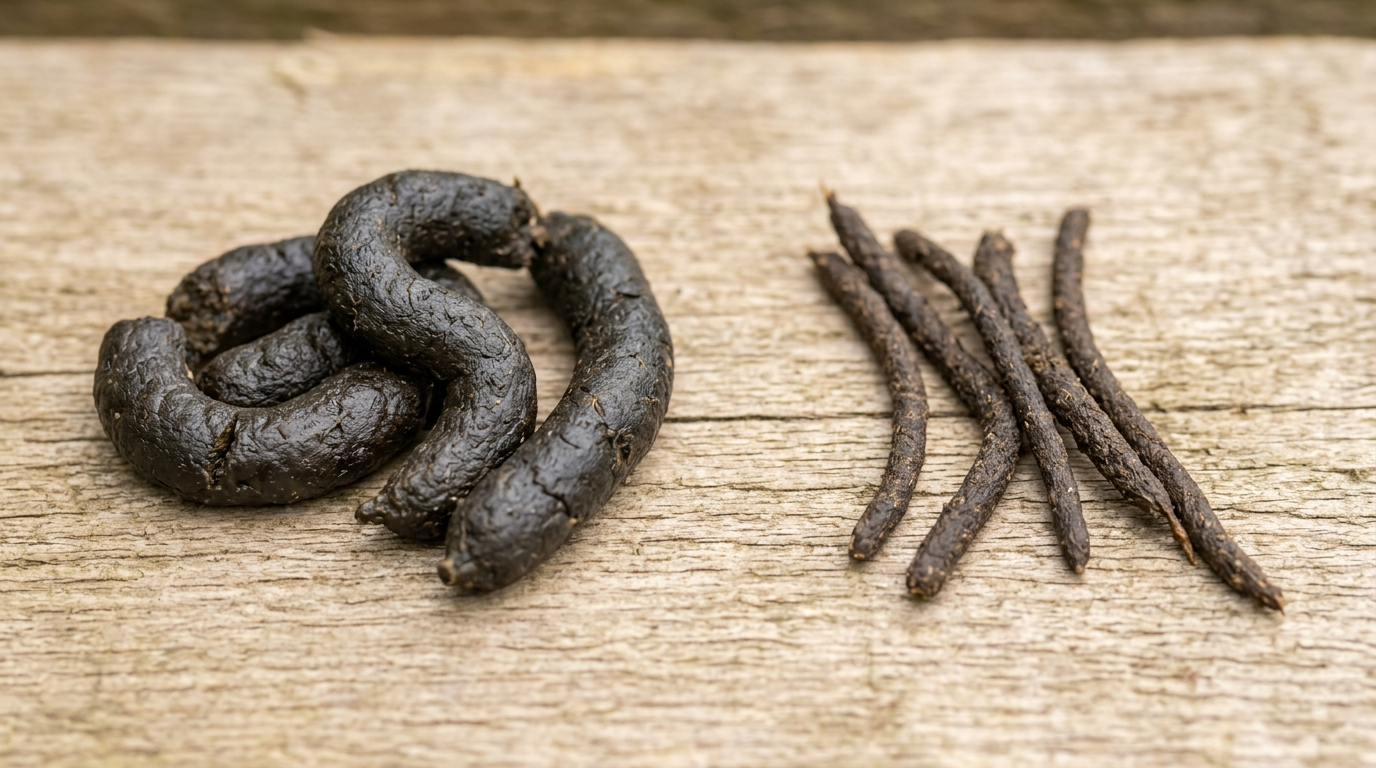
Marten droppings have a characteristic shape: long cylinders 6–10 cm long and about 1 cm in diameter, usually twisted and tapering at the ends. Inside, you can almost always see the bones of small rodents, fur, and sometimes fruit pits (in summer and autumn, martens eagerly eat cherries, sweet cherries, and berries). Fresh ones have a distinct, sharp musky smell — after a week they dry out and turn into gray, brittle “pencils.”
A marten marks its territory where it wants to be seen. If a pile lies on a roof tile, on the very top of a stump, or on a child's skateboard — it's no accident.
Weasel droppings are much smaller — 3–5 cm long and half a centimeter in diameter, also twisted but much thinner. Weasels feed mainly on voles, so their droppings are dominated by small bones and rodent fur; the smell is weaker. Fox droppings, for comparison, are significantly thicker (1.5–2 cm in diameter), with blunt ends and usually a higher content of feathers and remains.
§ 04Damage in the Garden
The next series of signals is things that shouldn't be there, but are. Most frequently reported by readers:
- Dug-up lawn at night — especially flowerbeds and places with soft, freshly moistened soil. Martens and weasels hunt for grubs and beetle larvae, which they sense by smell through several centimeters of soil. The damage looks as if someone had gone over it with a rake.
- Chewed cables in the car — a classic. The marten is attracted to soft, warm rubber insulation, especially the scent left by a foreign individual. Cars parked regularly under the same tree are particularly vulnerable.
- Torn-apart eggs in the chicken coop, sometimes disappearances of poultry or pigeons. A marten can kill much more than it eats in one entry — it's a predator's instinct that's hard to stop.
- Insulation pulled out from the attic, especially mineral wool and foam. The marten uses them to build a nest. Sometimes tracks lead all the way to a vent in the roof slope.
- Bite marks on bags of dog or cat food in the garage. Martens like fatty foods. Weasels tend to avoid pellets — they look for meat.
If a marten has chosen your car once — it will return. The scent left by previous visits acts like a magnet for other individuals, and during the mating season, also for rivals. Simply replacing the cables without securing the engine compartment is a waste of money.
§ 05Smell, Fur, Hiding Places
The last three signals work “as a package” and confirm earlier observations. The first is smell. The marten has strong scent glands at the base of its tail — its presence in the attic is eventually noticeable even from the ground floor, especially on warm days. The smell is musky, sweetish, for some simply “wild.” Stronger than a weasel's.
The second signal is fur. A marten loses individual hairs in the places it squeezes through — under roof joists, in the spaces between beams, in the narrow gaps of the chimney. The hair is dark brown with lighter guard hairs, long (3–5 cm), and distinctly stiff. In summer, the weasel has reddish-brown fur, in winter (especially in northern Poland), it turns white and resembles an ermine.
The third — hiding places. Most common: the attic near the chimney, the space above a suspended ceiling, piles of firewood, unfinished garages, abandoned farm buildings. A marten chooses a warm, quiet place with two exits (just in case) and close to a water source.
§ 06Marten vs. Weasel — A Quick Comparison
If you've gone through all five sections above, you most likely already know who you're dealing with. The table below gathers all the differences in one place for a quick check in the field. If you want to go deeper into the topic, we have a separate article Marten vs. weasel — what you should know about these mammals.
| Feature | Stone Marten Martes foina | Least Weasel Mustela nivalis |
|---|---|---|
| Body length | 42–48 cm | 17–23 cm |
| Mass | 1.1–2.5 kg | 60–200 g |
| Characteristic bib | white, forked, reaching the front paws | none (solid belly) |
| Summer coat | brown, shorter | reddish-brown, short |
| Winter coat | brown, denser | turns white in the north |
| Single track | 3–4 cm, 5 toes with claws | 1.5–2 cm, 5 toes with claws |
| Droppings | 6–10 cm, twisted cylinders | 3–5 cm, much thinner |
| Activity | nocturnal (10:00 PM–4:00 AM) | round-the-clock, lots of daylight |
| Typical hiding place | attic, chimney, garage | piles of stones, rodent burrows |
| Legal protection | game animal, closed season | strict protection |
§ 07What to Do Next
A short scenario for each situation. Start with the fact that none of these animals may be killed or harmed. The weasel is under strict species protection, the marten is a game animal with a closed season and requires hunting licenses for shooting. In practice, 99% of situations are resolved without harming the animal.
First: securing. Ventilation openings, gaps under roof tiles, unfinished eaves, open chimneys — everything a marten can enter through must be closed with stainless steel mesh (mesh size max. 2 cm). Do this when the marten is not inside — trapping an animal inside is a disaster for both the animal and the house.
Second: live traps. They work but require knowledge — choice of location, bait, check frequency (minimum twice a day). It's best to start with our separate article on live traps, where we described all variants along with the mistakes beginners most often make.
Third: deterrents. Ultrasonic ones are effective temporarily (the marten gets used to it after 2–3 weeks), scent ones (ammonium acetate, competitor's fur) work during the mating season. This is a supportive solution, not a standalone one.
Galloping above the ceiling at 3:00 AM, cylindrical droppings on the roof tiles, a dug-up lawn, musky smell, brown hair in a crevice — five indicators, all consistent. Most likely a stone marten. Time to secure the attic before it leaves a nest behind.
★Frequently asked questions
Is the marten protected in Poland?
The stone marten (Martes foina) is a game species with a closed season from April 1 to August 31. Only persons with hunting licenses can hunt it and only outside of this period. The least weasel (Mustela nivalis) is under strict species protection — it may not be killed, captured, or harmed under any circumstances.
What should I do if I have small children or pets?
Martens and weasels are cautious and do not attack humans or pets larger than themselves. The real risk concerns poultry and rabbits — here it's worth securing the coop with solid mesh (mesh size max. 2 cm) and shielding the runs. For dogs and cats, the presence of a marten usually means unnecessary stress and noise rather than a real threat.
Can I catch a marten myself with a live trap?
Yes, but with two caveats. First: the captured marten must be released in an appropriate place (several kilometers from buildings, near a forest) as soon as possible — it must not be kept in a cage for more than a few hours. Second: the trap must be checked at least twice a day, regardless of the weather.
How soon does a marten return after relocation?
If you relocated it closer than 5–7 km, the risk of return is very high — martens have excellent spatial memory. If further, they usually don't return, but their place may be taken by another individual from the area within a few weeks. Therefore, the trap alone, without simultaneously securing the attic, rarely solves the problem permanently.
Are marten droppings dangerous to health?
Yes — martens can be carriers of parasites (including nematodes, roundworms), and eggs can survive in their droppings. They should not be cleaned up with bare hands. Use protective gloves and a mask; it's worth pouring water with chlorine or a disinfectant over fresh droppings before removal. After finishing work — a thorough washing of hands and clothing.
Does catching martens make sense if more appear?
A trap without securing the attic is an endless game — new individuals will indeed appear quickly. Therefore, the effective strategy is securing first (meshes, vent plugs, eave guards), then potentially a trap for a specific individual. The order is of key importance.