Most people start with the same thing — panic and online shopping. An ultrasonic repeller, spray, scent granules, plastic traps. Three weeks later, the marten is still galloping across the ceiling, the weasel is still visiting the chicken coop, and your wallet is lighter by several hundred zlotys. The problem is not that these animals cannot be deterred. It is that most methods sold as effective — are not.
This guide gathers methods that actually work and have confirmation in the field or in research. It also openly says what is a myth (dog fur, human hair, urine) and what is illegal (poison, lethal traps, killing a weasel). We will start with the most important thing: before you buy or scatter anything, you must know who you are dealing with and what you are allowed to do regarding that animal.
§ 01Before you start deterring — what you really need to know
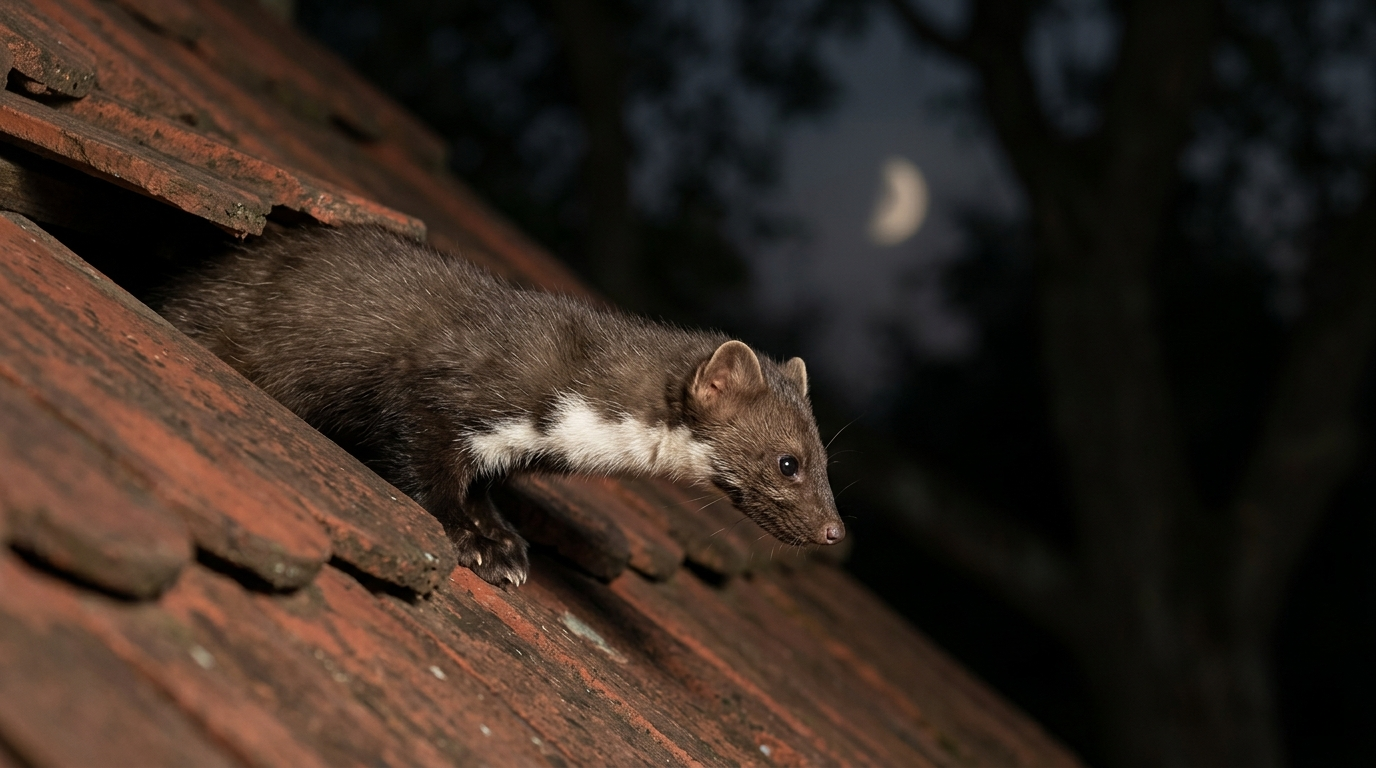
The first question you need to ask yourself is: is the marten protected? The answer looks different for each of the two species that are most often confused. The Beech marten (Martes foina) is not subject to species protection — it is a game species, with a closed season from April 1 to August 31. The Least weasel (Mustela nivalis) is subject to strict species protection. It must not be killed, captured, or harmed under any circumstances, regardless of how much damage it causes in the chicken coop.
In practice, for a homeowner, the difference looks like this: a marten can be deterred, the attic can be secured, and, as a last resort, it can be culled (by a person with hunting licenses, outside the closed season). A weasel can only be deterred and excluded from the building — without exceptions. A mistake costs a lot: killing a protected animal carries a fine, restriction of liberty, or imprisonment for up to 5 years (Art. 181 of the Penal Code).
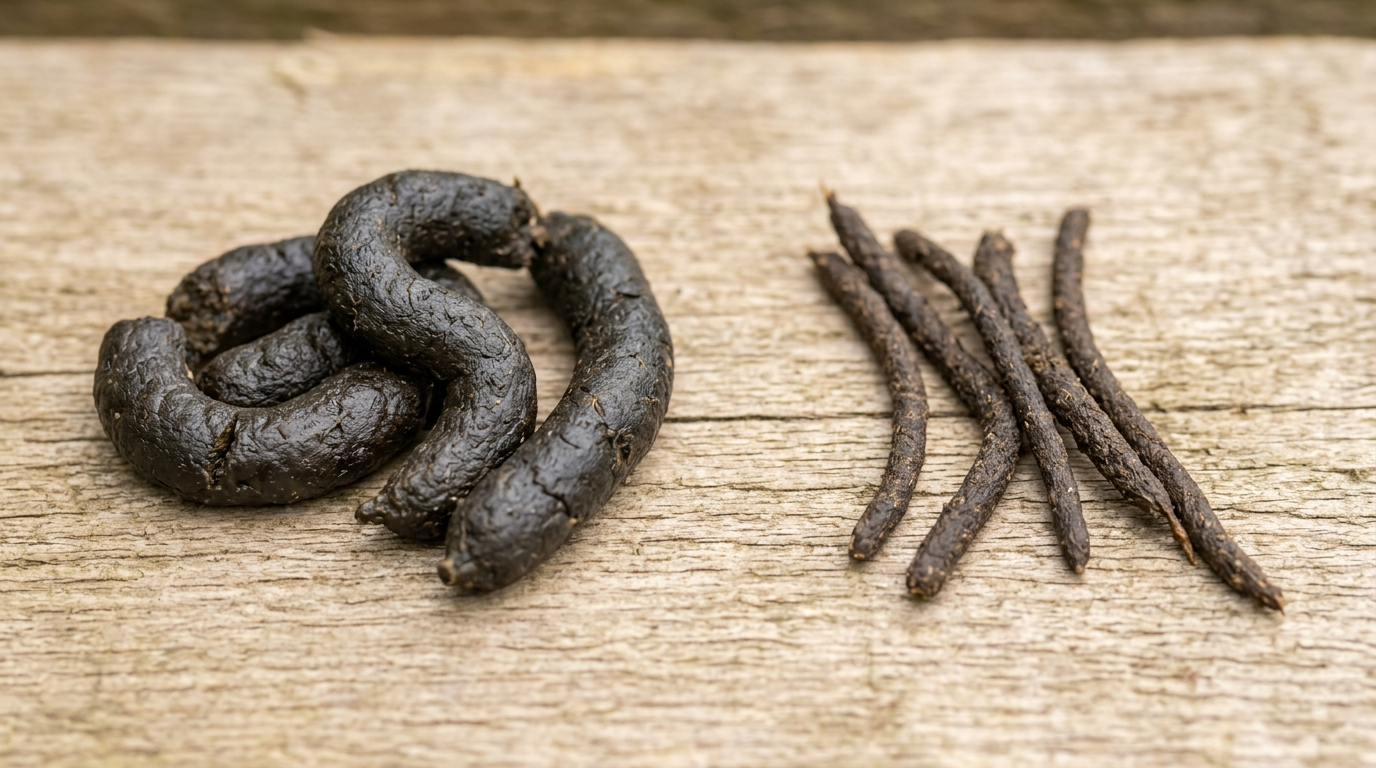
Beech marten — game species, closed season 01.04–31.08. Least weasel — strict species protection, ban on killing, capturing, and disturbing. Neither animal may be poisoned or caught in lethal traps. If you don't know who is in your attic, start with identification — you can find the guide at How to recognize the presence of a marten or weasel.
The second thing to get straight: deterrence does not mean expulsion once and for all. A marten has excellent spatial memory and territory is inherited within the population — if you drive out one individual today without securing the entry, another will take its place within a few weeks. An effective strategy is always deterrence + physical barrier, never deterrence alone.
§ 02First thing: find the entry
Before you spend a dime on anything, take a flashlight and walk around the house. A marten is surprisingly agile — it enters through any opening larger than 5 cm in diameter, a weasel even through a hole the size of a large coin. The most common entry routes for both species are very similar, so you are looking for one list of weak points.
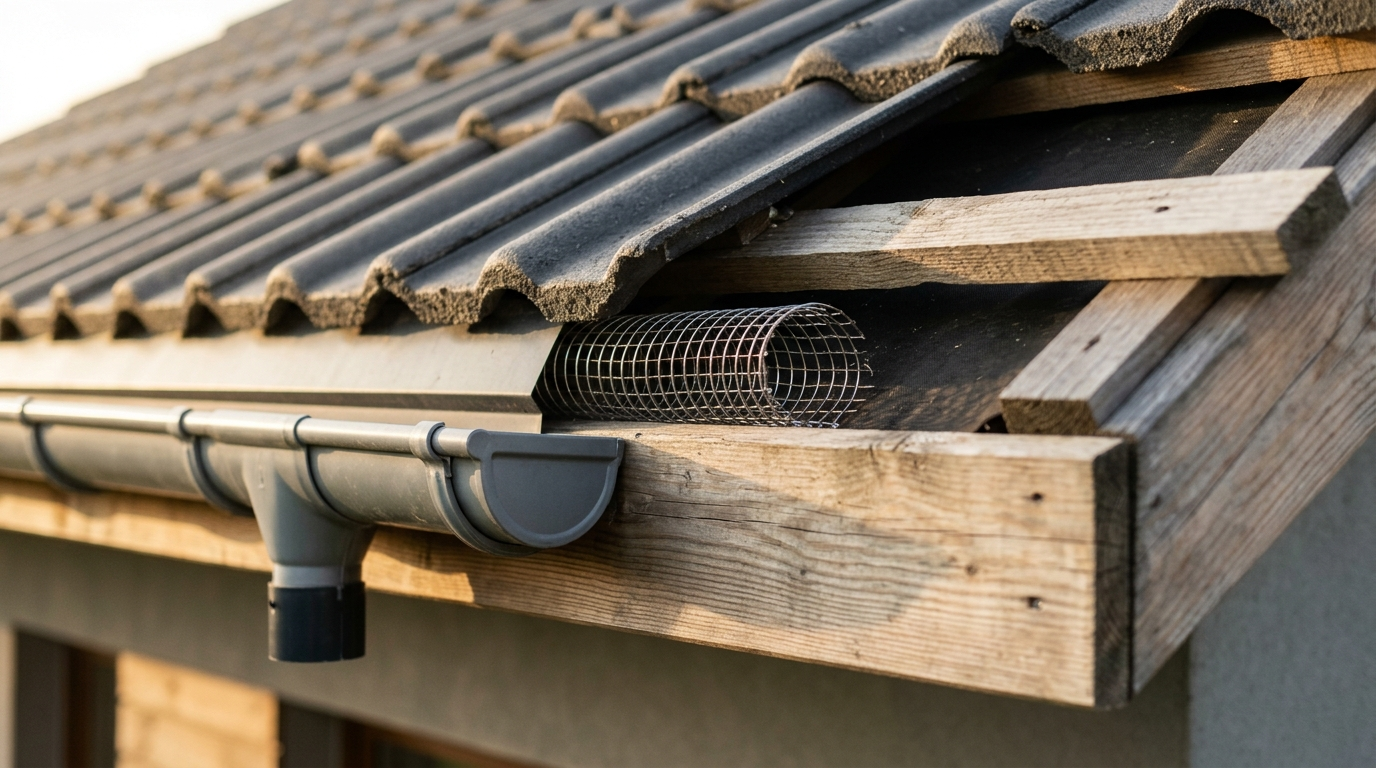
List of places that must be checked:
- Eaves area — gaps under the first row of tiles, places where the gutter flashing does not sit flush against the fascia board, lack of eaves comb.
- Ridge and ridge tiles — loosely laid ridge tiles on mortar that has crumbled over time from frost.
- Ventilation openings in the roof surface, in the gable, in the ventilation chimney — often without mesh or with plastic mesh that a marten chews through in seconds.
- Unfinished bay windows and dormers, contact points between different types of roofing, chimneys capped only with a board.
- Biological ladders — tree branches coming closer than 2 m to the roof, climbers (Virginia creeper, common ivy) leading to the eaves, a woodpile placed under a window.
- Garage and basement — ajar basement windows, lack of garage door thresholds, holes in the gate after old locks.
The best moment for a walk-through is dawn after the first night with frost. Water vapor from warm air escapes through every gap and condenses outside in the form of frost — it is visible to the naked eye. This is the same trick chimney sweeps use when looking for chimney leaks.
Without finding the entry, deterrence makes no sense. You can pour half a liter of repellent inside and buy three ultrasonic repellers — the marten will still return through the same hole known only to it or to no one.
§ 03Effective scent methods
Scent is a weapon that martens and weasels use themselves — and which can be turned against them. The key phrase is foreign individual. Mustelid predators are territorial, and the scent of another, larger predator can temporarily exclude them from a place. Temporarily — because we will return to that.
What actually works (and for how long):
- Fox or dog urine — sold in hunting stores in 250–500 ml bottles. Works during the mating season (March–April) when martens particularly avoid the presence of larger predators. Effectiveness: 2–3 weeks, then the individual gets used to it.
- Competitor's fur — commercially available as „wolf fur" granules. Works similarly to urine, in a similar time frame.
- Ammonium acetate and commercial ammonia-based preparations — irritate the sense of smell, work strongly for a few days, more weakly for up to two weeks. You must remember regular refreshing.
- Peppermint, eucalyptus, or camphor oil — a home trick that has short-term value. It won't hurt the marten's liver, but a strong scent on a cotton ball near the nest can move it a few meters away.
What does not work and is not worth spending money on: human urine (the marten is used to human scent and ignores it), naphthalene (toxic and ineffective in open spaces), mothballs, vinegar diluted in water. All these methods have been circulating on the internet for twenty years but have not passed any sensible test.
Any scent preparation works only until the individual learns that no real threat follows the scent. On average, this is 2–3 weeks. Therefore, scent methods make sense as an element of temporary exclusion (e.g., during the period when you are securing the eaves), and not as a final solution.
§ 04Effective sound and visual methods
This is where the area begins where sellers love to promise everything. The real picture is more modest, but not hopeless.
Ultrasound. This is the most frequently purchased device — and the most frequently disappointing. Research conducted in Germany (2018, BUND report) and Switzerland showed that ultrasonic repellers work on martens only partially and mainly in the first 7–14 days. After this time, the animals get used to them and ignore the device. Exceptions are models with random frequencies and motion sensor activation — these maintain effectiveness longer, up to about 2 months.
Motion sensor lamps. Effective for weasels at night in the chicken coop and garden, less so for martens (which act in the dark anyway and get used to it quickly). A good auxiliary solution, weak as a standalone.
Radio tuned to talk shows in the garage or attic. This is an old hunting method — the human voice acts as a deterrent for a few days until the animal notices that no one is coming out of the radio. It makes sense only in a very short time window, e.g., the night after letting an animal into a live trap.
A seller showing a 100% effectiveness chart in the third month of using ultrasound is selling a chart, not a device.
Vibrations. Some newer repellers combine ultrasound with ground vibration (attached to rafters). This is a direction of development that makes sense — martens avoid places where they feel „disturbing" vibrations. Still, however, an auxiliary method, not a standalone one.
§ 05Physical barriers — the only 100% certainty
After all the sections above, the conclusion is one: scent and sound are auxiliary weapons that buy time. The only method that provides 100% effectiveness is physically preventing entry. It sounds trivial, but in practice, it is 80% of the success and 100% of peace for years.
A set that usually suffices for a typical single-family house:
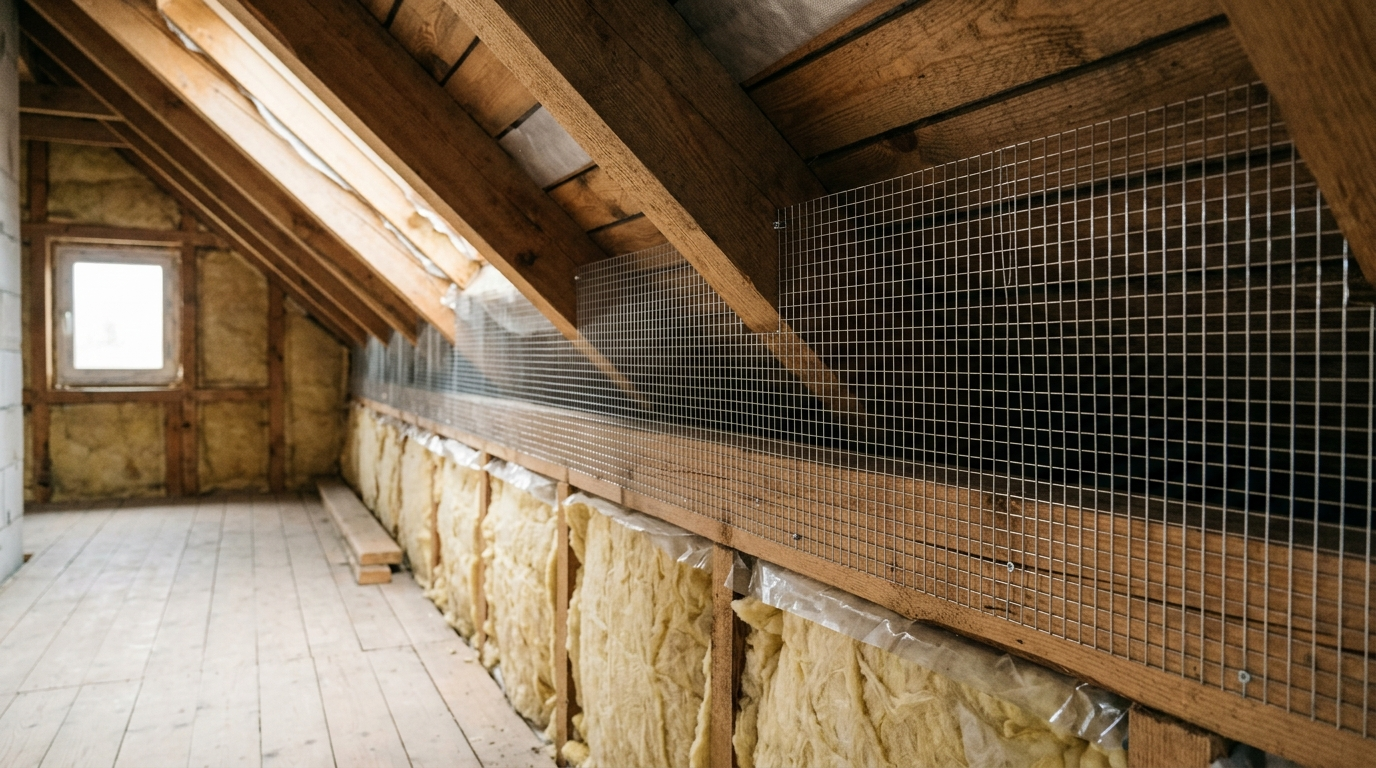
- Stainless steel mesh, mesh max 2 cm, wire min. 1 mm. Plastic is out of the question — the marten chews through it. The mesh is mounted from the outside of the eaves, along the entire length of the ridge at ventilation points, on ventilation openings in the gables.
- Eaves comb made of perforated sheet metal or PVC combined with mesh — closes the area between the first row of tiles and the fascia board.
- Smooth metal sheets on gutters and downpipes (so-called anti-climbing collars) with a width of min. 50 cm. The marten has nothing to grab onto and slides down. The same trick is used for smooth downpipes.
- Anti-bird and anti-marten spikes in places where mesh makes no sense (windowsills, cornices, parapet edges).
- Ferret-proof doors for the chicken coop — latching, with a threshold of min. 30 cm, mesh openings 1.2 cm, foundation dug 30 cm deep (the weasel digs in from below).
The cost of securing an average roof (mesh, comb, gutter flashing, roofing team labor) in 2026 is 2,500–6,000 PLN, depending on the length of the eaves and accessibility. This is a one-time expense that solves the problem for 15–20 years — which is the real lifespan of galvanized mesh outdoors.
Do the securing when the marten is not inside. The best time is June–July, after the young leave the nest and before the autumn return to winter shelters. Closing the animal inside means a dead marten under the insulation, a stench for several months, and the necessity to dismantle part of the ceiling.
§ 06What DOES NOT work or is illegal
This section must be read before all others. Too many „proven" methods are circulating that either don't work or are simply a crime. Let's start with the myths.
Dog fur. The most common advice on the internet — „scatter dog hair in the attic, the marten will run away". It won't. The fur itself, without the fresh scent of the animal, loses effectiveness within a few days and becomes neutral to the marten. What's more: the marten often uses fur as nesting material, so the effect can be the opposite of what was intended.
Human hair from the barber. The same mechanism — a short-lived effect, then nothing. The marten is used to human scent. If you leave hair near the house where you live, you send a signal: a human is usually here, but now they are gone. That is, an invitation.
Bicycles, plastic bottles on strings, mirrors in the attic. A marten gets used to any static element within one or two nights. These are methods that have circulated for generations and have no confirmation.
Human urine. Despite what we sometimes hear in local advice — it does not deter the marten. The marten has lived in our city, in our neighborhood, and next to our garage for generations. It knows this scent better than we do.
Poison for a marten, weasel, mole, fox, or any other wild animal is absolutely prohibited in Poland. Using poisons (including so-called „rat poison" in places accessible to wild animals) is punishable by a fine, restriction of liberty, or imprisonment for up to 5 years (Art. 181 and 35 of the Animal Protection Act). Lethal traps (grippers, snares, snap traps) are prohibited under the Nature Conservation Act. Hunting for a marten without hunting licenses and outside the hunting season is a crime under hunting law. Killing a weasel is a crime under species protection, the same penalty up to 5 years.
What's important: ignorance is no excuse. „My neighbor told me to", „they sold it in the store", „I thought it was for rats" — none of these explanations will work in court. Criminal liability is real and cases end in sentences.
§ 07If it has already moved in — how to encourage it to move out without harm
The most difficult scenario: a marten is already living in the attic, probably with young, and you've had enough of the galloping at three in the morning. Here, the order is of key importance, and a mistake can mean a dead animal sealed behind insulation.
Step 1: determine if there are young. The rearing season lasts from April to August. If you hear high-pitched squeaks, whimpering, small pitter-patter — there are young. In such a situation, you must not close the entry. Wait until the end of August when the young start leaving on their own. Closing earlier means the death of the entire litter.
Step 2: make the place unpleasant. A marten looks for silence and darkness. Give it the opposite conditions:
- Turn on a radio tuned to talk shows, discreetly hidden between rafters, for the whole day (the marten likes to sleep during the day).
- Leave an LED light shining constantly in the vicinity of the nest — the marten avoids light when trying to rest.
- Every few hours go up to the attic, make noise, tap a stick against the rafters. For us, a small inconvenience; for the marten, a reason to move.
- Scatter cotton balls soaked in ammonium acetate or a commercial repellent around the nest area — they work to reinforce the acoustics.
Step 3: watch the entry. Sprinkle a thin layer of potato flour under the opening and check in the morning. When you see tracks only leaving and for 2–3 nights there are no signs of return, you can close the entry. It is best to leave a so-called one-way door — the marten can leave, but not enter. This is a safe method that eliminates the risk of trapping the animal inside.
Step 4: secure permanently. After confirmed departure, remove the flap and install the mesh according to the description in section 5. Only now is the problem solved.
If the matter is more difficult (aggressive marten, access impossible without specialized equipment, suspicion of rabies, more than one individual), it is worth considering live traps — we described all variants in a separate article What traps to use for weasels and martens (soon). If, on the other hand, you are still not sure who exactly you have in your attic, return to the identification guide or review the article Marten vs Weasel — what's worth knowing.
Rearing season April–August — do not close the entry. Acoustics and light force the marten to move. A one-way door excludes the risk of trapping. Steel mesh after departure — and the subject is closed for 15 years.
★Frequently asked questions
How to effectively deter a marten?
Effective marten deterrence is always a combination of two elements: a temporary repellent (fox urine scent, ammonium acetate, motion sensor ultrasound) plus physically closing entries with stainless steel mesh (max 2 cm mesh). Repellers alone work for 2–3 weeks and then stop — without a physical barrier, the marten always returns. Start by inspecting the house, find gaps in the eaves and chimney, and only then buy anything.
Is the marten protected?
The Beech marten (Martes foina) is not subject to species protection — it is a game species with a closed season from April 1 to August 31. Only persons with hunting licenses can hunt, and only outside the closed season. The Least weasel (Mustela nivalis), however, is subject to strict species protection — it must not be killed, captured, or harmed under any circumstances. Poisoning and lethal traps are prohibited for both species.
What deters a marten the most?
Three things work most strongly: the scent of a larger predator (fox or dog urine, competitor's fur) during the mating season in March–April, a strong ammonia odor (ammonium acetate, commercial preparations), and unpredictable sound from a radio tuned to talk shows. However, all these methods have a limited duration of action (2–3 weeks, then habituation). The only method with 100% effectiveness over years is steel mesh closing the entries.
Does dog hair deter martens?
This is one of the most popular internet myths and unfortunately — it does not work. The fur itself, without the fresh scent of the animal, loses effectiveness within a few days and becomes neutral to the marten. In practice, martens often use fur as nesting material. The only thing that works scent-wise is fresh urine of a dog or fox, refreshed every 7–10 days. Fur scattered in the attic will do nothing but dirty the insulation.
Does the scent of urine deter martens?
Yes, but only the urine of a larger predator — fox, dog, or in some regions, wolf. Human urine does not work: martens have lived alongside humans for generations and this scent is neutral to them. Animal urine works most strongly during the mating season (March–April, with a second peak in July–August), when martens particularly avoid foreign territory. Effectiveness: 2–3 weeks, then you need to refresh or add another method.
Can I kill a marten on my own property?
No, even if the marten is destroying your car and attic. Hunting for a marten requires hunting licenses and is permitted only outside the closed season (01.04–31.08), using permitted hunting methods. Shooting with an air rifle in the garden, using poison, lethal traps — these are all crimes punishable by a fine, restriction of liberty, or imprisonment for up to 5 years. The effective and legal route is always: identification, deterrence, physical barrier, and as a last resort, a live trap and relocation.