The question „marten or weasel?" is asked on farms more often than you might think. Usually, it's when something has darted between the barn beams or when small, suspicious droppings are found on a stump. The answer has practical significance: each of these animals is handled differently, and confusing them can cost hundreds of dollars.
The beech marten (Martes foina) and the least weasel (Mustela nivalis) belong to the same mustelid family (Mustelidae), but that's about as much as they have in common as a dog and a fox. In this guide, we will go through all the important differences — from biological to legal — so that the next time you encounter one, the doubt will disappear in five seconds.
§ 01Related, but Not Alike
The mustelid family (Mustelidae) in Poland includes seven species: two martens (beech and pine), three weasels in the broad sense (least weasel, stoat, European polecat), the badger, and the otter. These animals vary greatly in size — from the least weasel weighing 60 grams to the otter reaching 10 kilograms — but they share several anatomical features: an elongated body, short legs, thick fur, and developed scent glands at the base of the tail.
The beech marten and the least weasel are the two most common species of this family found on Polish farms. The first chooses the house, the second rather the garden. The first hunts at night, the second around the clock. The first leaves behind almost immediately visible traces, while the second can live for several weeks without raising any suspicion. This accounts for the difference in the frequency of reports.
„Łasica" (weasel) comes from the Proto-Slavic łaska — meaning „grace, kindness" — because in folk beliefs, it was thought to have a protective role over the farm. „Kuna" (marten) comes from the Old Germanic chuni, meaning valuable fur. The names themselves reveal that humans have known these animals for a very long time.
§ 02Size and Weight — The First and Most Important Difference
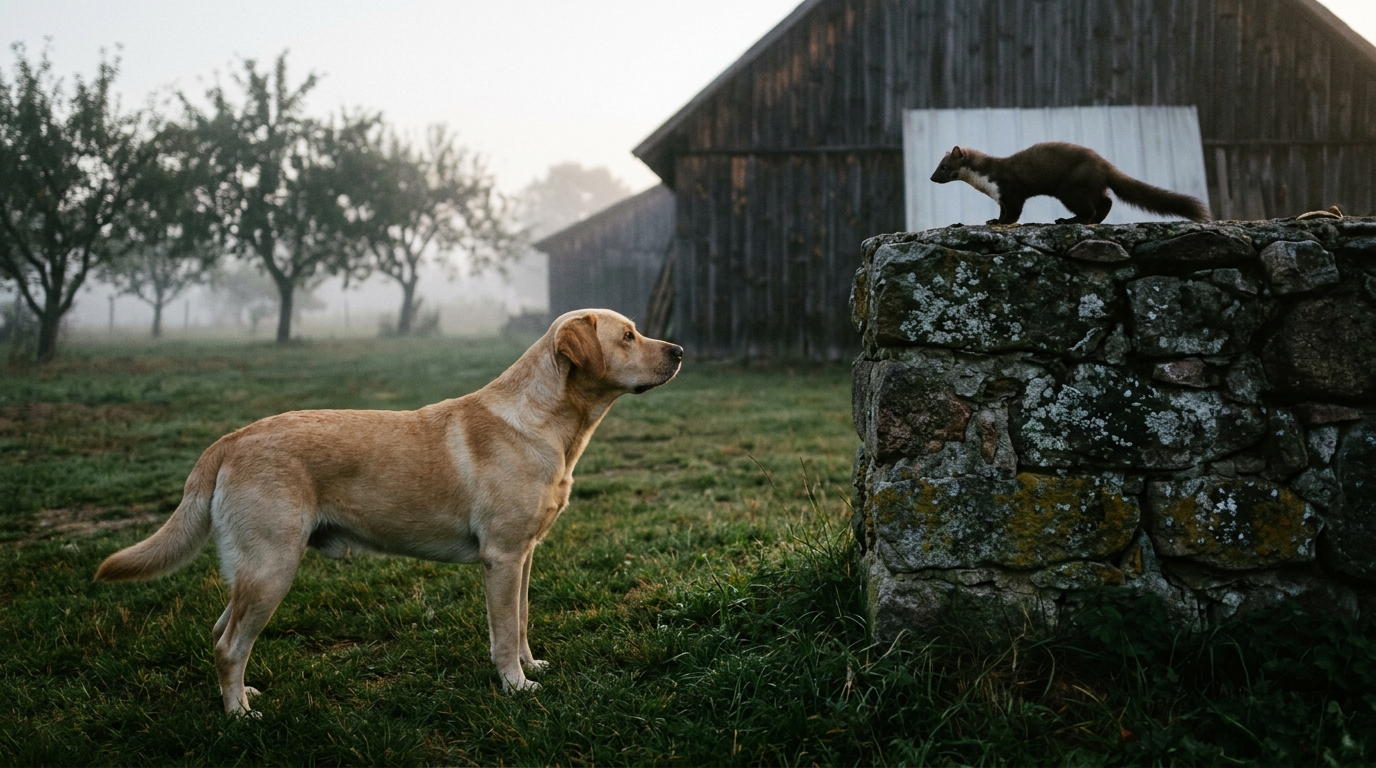
This is the largest, easiest-to-notice difference and is actually sufficient to resolve most doubts. The beech marten is an animal the size of a large cat: 42–48 cm of body length plus a 23–26 cm tail, weighing 1.1–2.5 kg. The least weasel is one of the smallest predators in the world: 17–23 cm of body length (males), females are even smaller — 14–18 cm, weighing only 60–200 grams.
Practical consequence: when a marten runs across the attic ceiling, it can be heard from the ground floor. A weasel does not weigh enough to cause a sound audible through a layer of insulation. If someone says they have „weasel noises above the ceiling" — it is almost certainly a marten.
Confusing a marten with a weasel is like confusing a cat with a mouse — it is only possible from a great distance in very poor light.
§ 03Appearance and Coloration
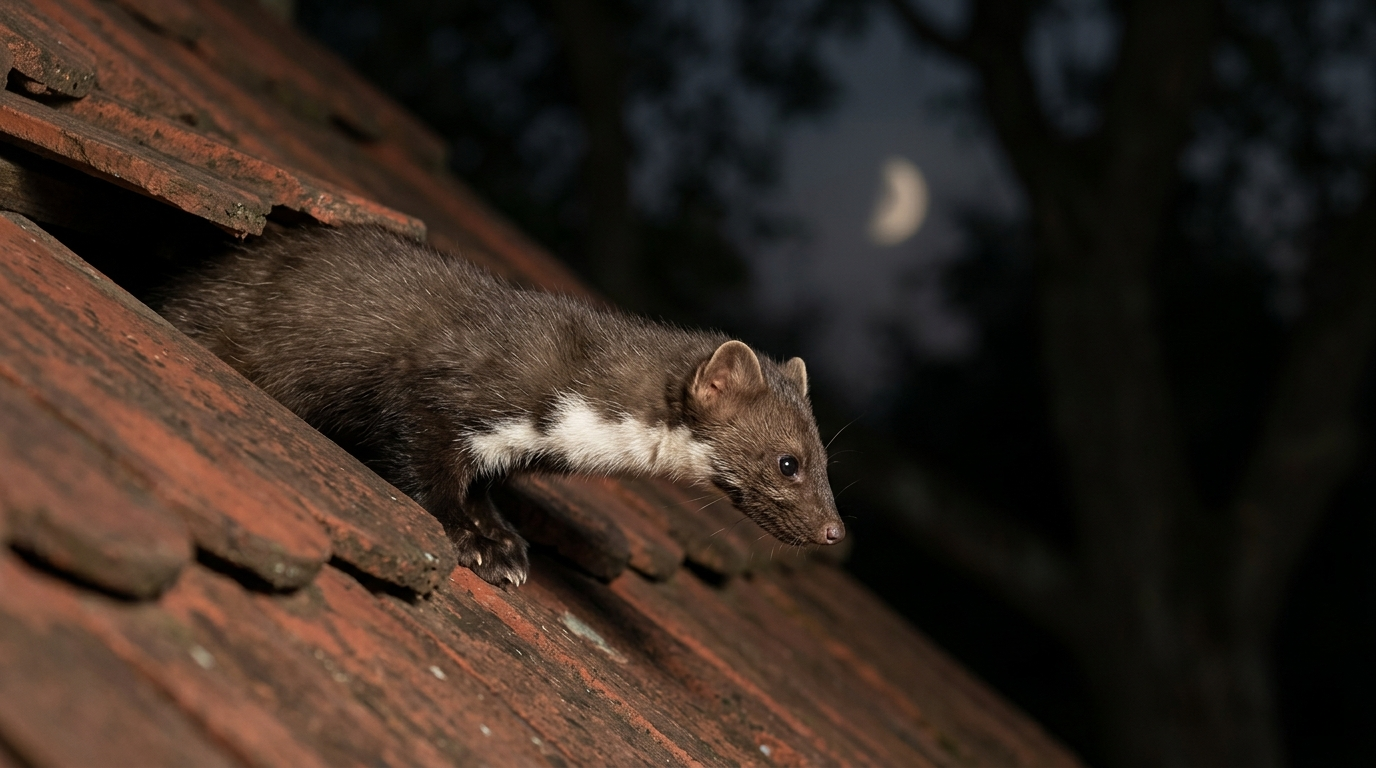
The second thing to check immediately after seeing the animal is the white bib on the chest. The beech marten always has one and it is bifurcated — the white patch splits symmetrically onto both front legs, reaching almost to the shoulders. This feature also distinguishes it from the pine marten, which has a yellowish-orange, undivided bib (it does not extend down the legs).
The least weasel does not have a bib. Its back is uniformly reddish-brown (in summer) or lighter, and its belly is creamy-white; the boundary between these colors is sharp, straight, and runs along the side. In summer, the weasel looks somewhat like a miniature, greatly elongated „jackdaw." In western and northern Poland, during harsh winters, some individuals turn completely white — then it is very easy to confuse it with a stoat (distinction: a stoat always has a black tail tip, a weasel does not).

The third difference is the tail. In the marten, it is long, bushy, almost as long as the body, with distinct long hairs. In the weasel, it is short (3–8 cm), thin, smooth, without bushiness, and uniformly colored. If you see an animal with a „saber" behind it — it's a marten. If it has a tiny, „needle-like" tail — it's a weasel.
§ 04Diet and Hunting Method
Here, the difference is even more interesting. The least weasel is a narrowly specialized rodent hunter — especially voles, which it catches in their own burrows. Its slender body is literally designed for this niche: it goes where no other predator can enter. Hence its completely different behavior around buildings — a weasel stays on a farm as long as there are mice there. When they disappear, the weasel does too.
The beech marten is a typical opportunist: it will eat anything edible. Small mammals (rodents, moles), birds and eggs, insects, lizards, fruit (in summer and autumn — cherries, sweet cherries, berries, apples), carrion, and garbage. Near humans, it also readily reaches for dog or cat food left out for the night. This wide repertoire makes it much more resilient to environmental changes — which is why it moves into cities.
The marten is much more dangerous for poultry. A weasel can also kill a chicken, but rarely — it prefers smaller prey that it can hunt and eat in peace. A marten can kill all the chickens in a coop in one visit, even though it will only eat one. This is a hunting instinct that cannot be turned off.
§ 05Lifestyle and Territory
The beech marten is strictly nocturnal. Peak activity is between 10:00 PM and 4:00 AM; during the day, it sleeps in a hiding place. It is also strongly territorial — a pair of individuals (male + female) occupies an area of 100–250 hectares and defends it against other martens. Within its territory, a marten follows fixed paths and regularly marks them with droppings in visible places. For this reason, if we remove one marten, its territory is quickly taken over by another from the neighborhood — reclaimed territory cannot remain empty for long.
The least weasel is active at all times of the day, with short breaks for rest. It does not have a fixed territory in the same sense as a marten — it moves according to food availability, so its range „shifts" along with the rodent population. It is an extremely mobile animal — in one day, it can cover several kilometers, checking one burrow after another.
Practical consequence: if „something ran by yesterday, nothing today, something again tomorrow" — it's likely a weasel. If it's „the same sound from the attic every day, at the same hours" — it's a marten.
§ 06Living Near Humans
This is where the difference is most apparent. The beech marten is a species that has become synanthropic in recent decades — meaning it consciously chooses to be near humans. Attics, unfinished garages, abandoned outbuildings, stork nests on poles, and even cars parked under the same tree — these are luxury real estate for a marten. Warm, dry, usually with two exits, and close to food sources (trash cans, gardens, bird feeders).
A weasel does not inhabit buildings permanently. It may temporarily use an available hiding place (woodpile, stone pile, abandoned burrow), but it does not build a nest in the attic, pull out insulation, or chew through cables. When mice appear on a farm, a weasel might come — but after two weeks, it's gone.
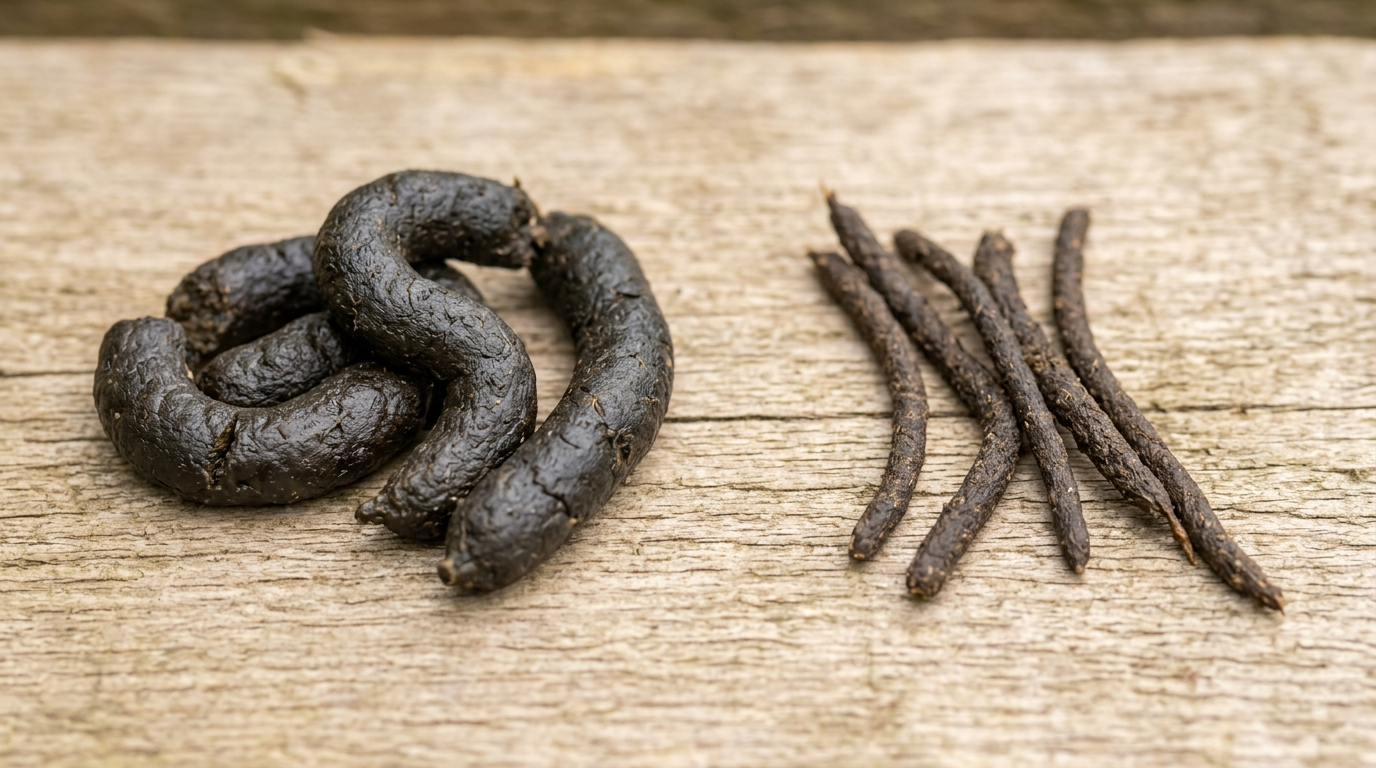
So if your problem is regular noise, a nest, damage, and a characteristic smell — you almost certainly have a marten. If it's one or two brief encounters in the garden and rodents have suddenly decreased — congratulations, you have a weasel in the neighborhood and you should be rather pleased. How to recognize the tracks of each is described in detail in the guide How to recognize the presence of a marten or weasel in the garden.
§ 07Protection Status — Not Just a Detail
A point that most often surprises readers. The least weasel is under strict species protection in Poland. It must not be killed, captured, injured, or disturbed under any circumstances — even if it has broken into a chicken coop. One may only secure structures (nets, plugs) and close off access.
The beech marten is a game species with a closed season from April 1st to August 31st. Only persons with hunting licenses may hunt it. For an ordinary homeowner, this means that without cooperation with a hunting club, it cannot be shot or killed. However, it is legal for anyone to capture a marten using a live trap and relocate it, provided this is done humanely and without delay.
| Aspect | Beech marten | Least weasel |
|---|---|---|
| Legal status | game species with closed season | strict protection |
| Can be shot | only by a hunter, outside closed season | NO, under no circumstances |
| Live trap | YES, with immediate release | YES, but must be released immediately after capture |
| Poisons | ABSOLUTELY NO | ABSOLUTELY NO |
| Securing the facility | YES, recommended above all | YES, recommended above all |
The use of poison or harmful traps (e.g., leg-hold traps) on both species is prohibited. In the event of an inspection by the Environmental Protection Inspection, the fine for killing a weasel can reach several thousand zlotys — this is not a joke and not a marginal regulation.
★Frequently asked questions
Do martens and weasels interbreed?
No. They belong to different genera (Martes and Mustela) and are too genetically different to produce viable offspring. It's a bit like asking if a cat interbreeds with a fox — there is a relationship, but the reproductive barrier is complete.
What about the stoat, ferret, and polecat?
These are other members of the mustelid family. The stoat is similar to a weasel but larger (up to 35 cm) and always has a black tail tip. The European polecat is larger than a weasel (40 cm), with a characteristic mask on its face and dark fur. The ferret is a domesticated form of the polecat; it does not occur in the wild, although wild populations of escapees do appear.
Can a marten or weasel attack a dog or cat?
In practice — very rarely and only in self-defense. A marten is smaller than a typical dog and does not seek confrontation. With a cat, it may enter a fight over territory or a hiding place, but more often both animals simply avoid each other. A weasel is too small to threaten anything larger than a mouse.
Is a weasel beneficial for a farm?
Yes — very much so. One weasel can eat several thousand mice and voles per year. It's natural rodent population control, much more effective and cheaper than poisons. Hence the traditional folk kindness toward this species — in many regions, it was even believed that the presence of a weasel on a farm brought good luck.
How can I tell if I have a marten or a weasel?
The fastest method: by size and noise. If you hear an animal at night above the ceiling (galloping, thumping, scratching) and there is damage (cables, insulation, eggs) — it's a marten. If you see a glimpse of a small, reddish-brown animal in the garden and mice have decreased — it's a weasel. A full comparison of tracks and droppings can be found in the articles Marten tracks and signs and How to recognize the presence of a marten or weasel in the garden.
Can a marten attack a human?
Practically no. A marten is a very skittish animal — seeing a human, it flees. An attack only happens in extreme situations: an animal cornered, injured, or sick (watch out for rabies — very rare, but possible). General rule: do not try to catch a marten with your bare hands.