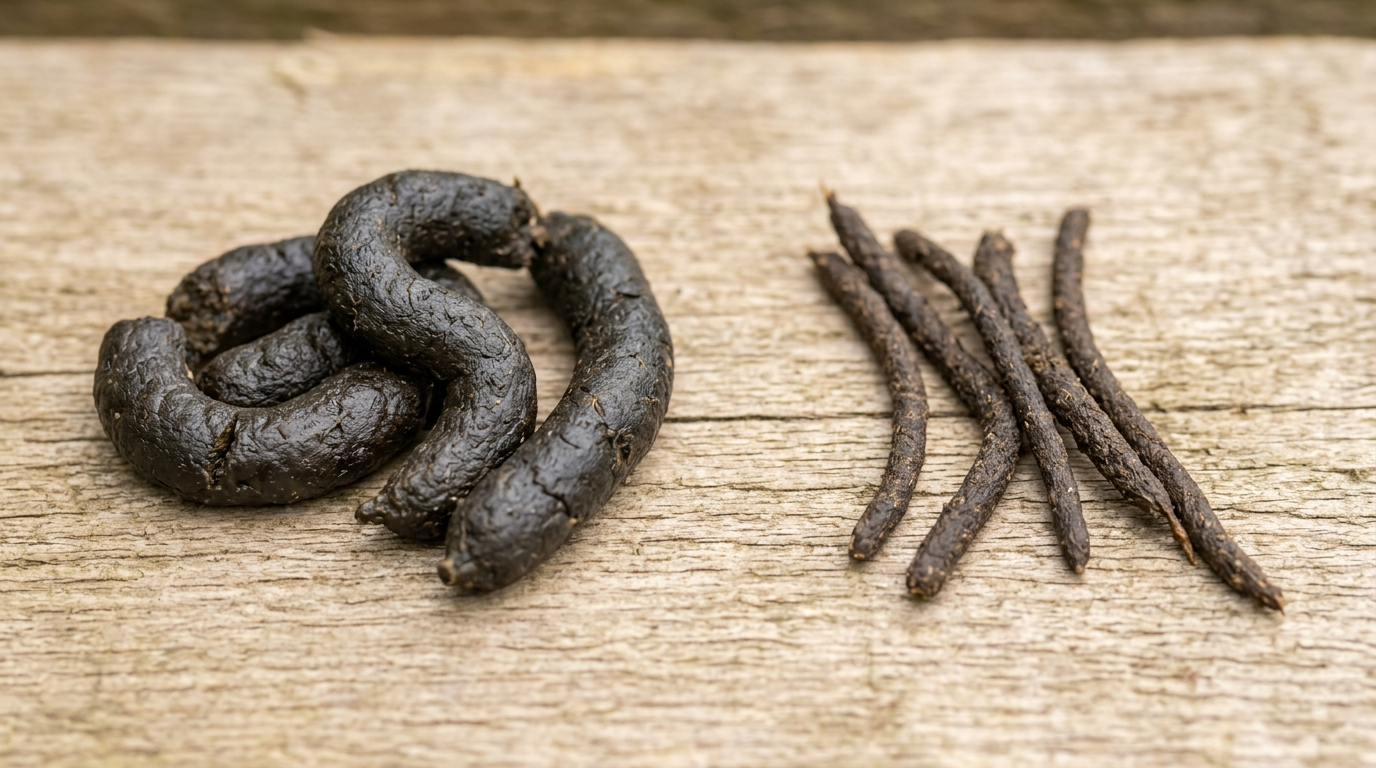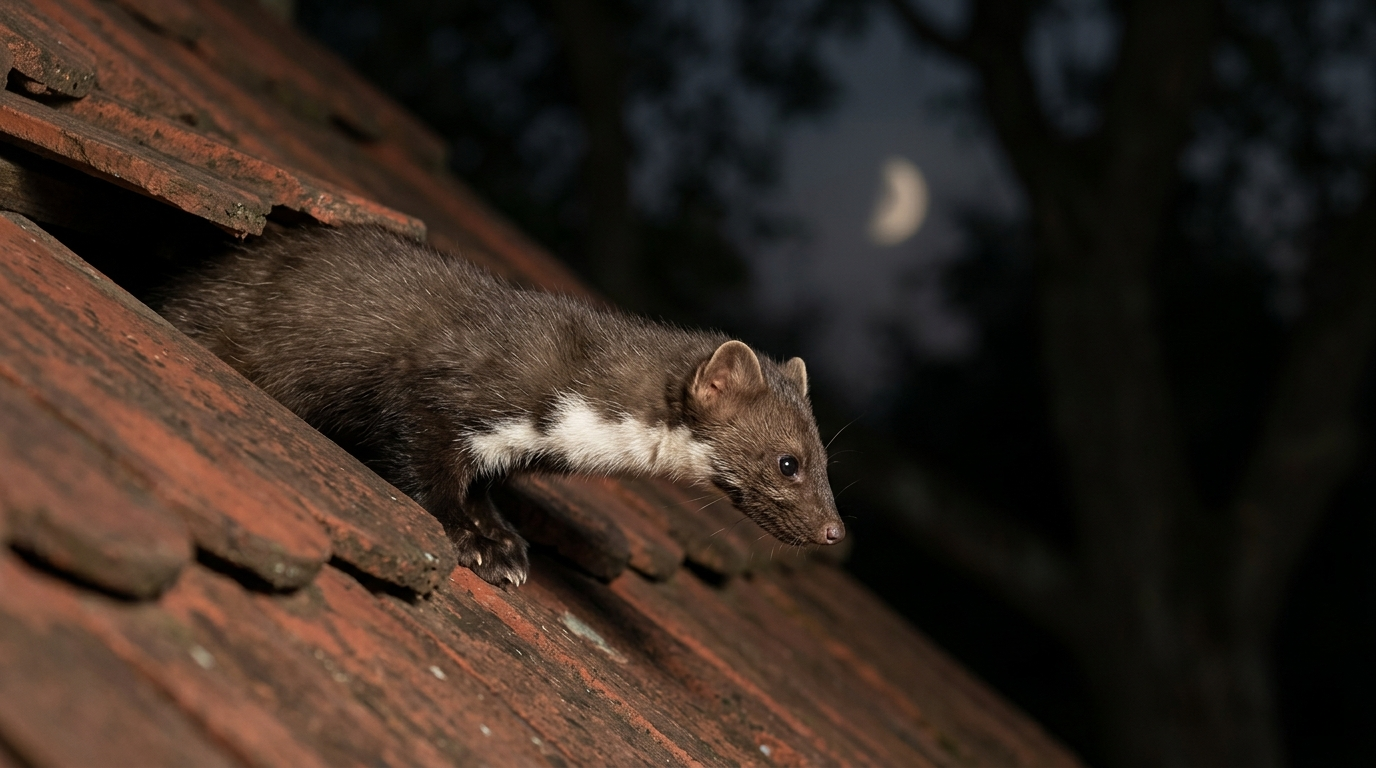
Most people, when hearing the word „marten”, have one animal in mind. Meanwhile, two species live in Poland that are indistinguishable to the untrained eye, but for a biologist, they represent two completely different chapters of a textbook. Martes foina — the stone marten — is the one that wakes you up at three in the morning above the ceiling. Martes martes — the pine marten — is the one you will probably never see, even though it lives 200 meters from your house.
This guide gathers all the differences — from the color of the throat patch to the status in hunting law — in one place. After reading it, you will recognize who you encountered on a camera trap photo, who made a mess in the garage, and who darted across the forest path. This is also the first article in our series on animals similar to martens — where we organize the mustelid family from the ground up.
§ 01Two species, one name — a brief overview
In the mustelid family (Mustelidae), the genus Martes includes two species in Europe: the pine marten (Martes martes) and the stone marten (Martes foina). Both have the same stocky, elongated silhouette, the same short legs with five toes armed with non-retractable claws, and the same long, bushy tail that makes up almost half of the body length. From twenty meters away, in the misty dawn at the forest edge, even a zoologist would hesitate before giving a definitive answer.
However, the differences are real and — once you learn to look for them — immediately visible. Five are key: color and shape of the throat patch, silhouette, environment, lifestyle, and legal status. You can determine the first three in the field. The fourth and fifth — from a map and calendar. In this article, we will go through all of them one by one.
In Polish literature, the name „kamionka” also appears for the stone marten and „tumak” for the pine marten. Both are historical, used mainly in hunting and ethnography. In scientific texts, you will exclusively encounter Martes foina and Martes martes — and we also adhere to this convention on the portal.
§ 02The throat patch — the first and most reliable difference
If you have only one second to distinguish them — look at the chest. The throat patch (bib), the light spot on the chest and neck, is present in both martens but looks completely different. This is the most reliable, most repeatable, and least lighting-dependent difference between the species.
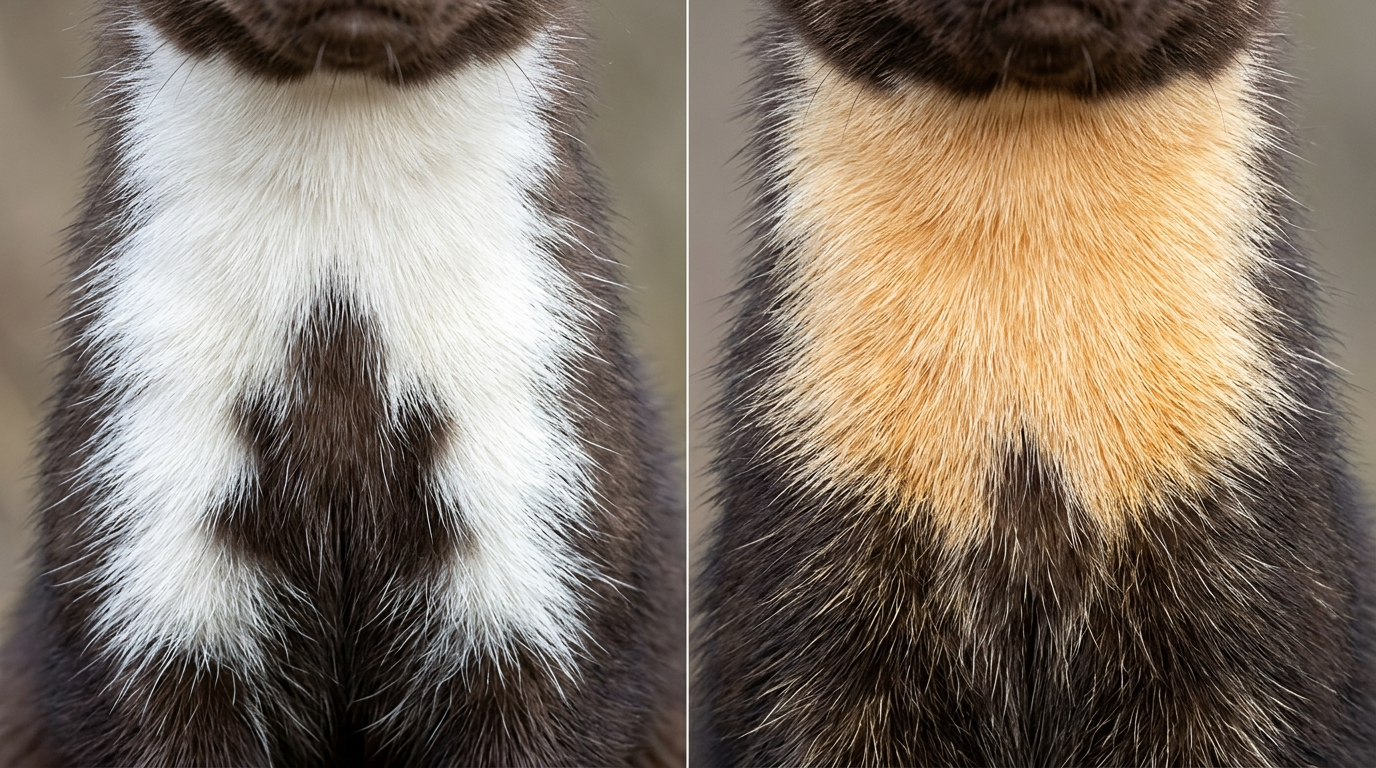
The stone marten has a pure white throat patch, sometimes with a slight creamy tint, but never yellowish. It is bifurcated — in the lower part, it splits into a „V” or „Y” shape and clearly extends onto the front legs, sometimes as far as the wrists. The contrast with the rest of the fur is strong, the spot is clean and well-defined.
The pine marten has a creamy-yellow throat patch, often clearly orange or rusty in adults. It is solid — it does not fork and does not extend to the legs; it ends on the chest, sometimes barely below the larynx. The edges are more blurred, the contrast is weaker, and the spot looks like a natural color transition rather than a sewn-on patch.
White split onto the legs — stone marten. Orange wedge on the chest — pine marten. This one difference is enough in 95% of field situations.
In camera trap photos, the throat patch can be overexposed by the infrared flash and look brighter than it actually is. In such cases, look not at the color itself, but at the shape and reach of the spot: bifurcated and extending to the legs = stone marten; solid and ending on the chest = pine marten.
§ 03Size, silhouette, tail
The second, though more difficult difference in the field, is the body build. The pine marten is on average slightly more slender and lighter, while the stone marten is stockier and „sturdier.” However, the differences are subtle and largely overlap: a large pine marten can be heavier than a small stone marten, so dimensions alone are never enough for a definitive diagnosis.
- Stone marten (Martes foina) — body length 42–48 cm, tail 22–26 cm, weight 1.1–2.3 kg. Clearly stockier silhouette, slightly shorter legs, head wider in the cheek area.
- Pine marten (Martes martes) — body length 45–58 cm, tail 22–27 cm, weight 0.8–1.8 kg. Slenderer silhouette, longer legs, narrower head, „more triangular.”
- The tail in both species is bushy, but in the pine marten, it often appears longer relative to the rest of the body — because the pine marten itself is more slender.
- The paws of the pine marten are clearly furred on the soles (an adaptation to long winters in the forest and running on snow); in the stone marten, the soles are naked or very sparsely furred — this is an important feature visible in tracks.
- The nose in the stone marten is light pink to flesh-colored, while in the pine marten, it is dark — black or dark gray. This is another quick identifying feature from close up.
The question „which marten is larger” does not have a single answer. The pine marten is on average longer, but the stone marten is heavier for the same length. In practice: if the animal looks sturdily built and „squat” — bet on the stone marten; if it seems long, light, and „snake-like” — it is most likely a pine marten.
§ 04Environment — forest vs. human
Here the difference is deepest and most practical. Both species evolved in the forest, but one of them has made a spectacular ecological leap over the last two hundred years — and settled in our homes.
The pine marten is a classic inhabitant of continuous deciduous and mixed forests, with a preference for old-growth with many tree hollows. It most readily occupies abandoned squirrel or jay nests or holes pecked by woodpeckers — high up in an old beech, oak, or spruce. Where does the pine marten live? Throughout Poland, but population density is significantly higher in large forest complexes: Białowieża, Knyszyn, Borecka forests, the Carpathians, Sudetes, Pomerania, and Masuria. Managed forests with single-age monocultures are impoverished for it.
The stone marten is a synanthropic species — associated with humans. It originally inhabited rocky, open areas of southern Europe: scree, cliffs, ruins. During the 19th and 20th centuries, it utilized rural and later urban buildings as a substitute for these niches. Today you will find it in the attics of farms, in barns, in abandoned buildings, but also in garages in housing estates, under the roofs of shopping malls, and in city parks. The border of its natural range was the line of northern Germany and southern Poland — today it has already reached Scandinavia.
In most of Poland, both species co-occur, but in different micro-niches: the pine marten in the deep forest, the stone marten on the outskirts of villages and in cities. Contact is rare, and crossbreeding is exceptional (only individual hybrids are known in captivity, almost non-existent in the wild).
§ 05Lifestyle and behavior
Both species are active mainly at night and dusk, both are opportunistic predators (rodents, birds, eggs, insects, fruit). But their relationship with humans is diametrically different — and it is this relationship that practically determines which one you will see or which one you will have a problem with.
The pine marten is extremely skittish. It reacts by fleeing just to human scent on a path, clearly avoiding settlements, roads, and noise. Observing it in nature borders on a miracle — most documentary photos come from camera traps or nature reserves. It treats humans as a threat and does not approach voluntarily. That is why there are practically no complaints about a pine marten in the attic — if such a story does happen, it is in a remote forester's lodge or an abandoned house deep in the forest.
The stone marten, on the contrary, has become accustomed to the presence of humans over centuries. It is not afraid of lights, sounds, cars, or dogs. During the rearing of young (April–July), it can be clearly aggressive in defending its litter — attacking dogs, hissing at those entering the attic, and defending the nest with shrill barking. It is the protagonist of all the stories about „noises from the attic” that we wrote about in the guide how to recognize the presence of a marten or weasel in the garden.
The pine marten flees, the stone marten stays. That is, in one sentence, the entire difference between a wild and a synanthropic life strategy within the same genus.
§ 06Conservation status and hunting law
The most frequently overlooked but practically most important difference. A mistake here costs not only nerves but also serious legal consequences — because both species are protected in completely different ways.
The pine marten (Martes martes) in Poland is covered by partial species protection under the regulation on animal species protection. It must not be killed, captured, disturbed during the breeding season, nor can its hiding places be destroyed. It is also listed in Annex V of the EU Habitats Directive as a species requiring monitoring.
The stone marten (Martes foina) is a game animal with a closed season from April 1 to August 31. Hunting it can only be carried out by persons with hunting licenses, during the season (September 1 – March 31), and exclusively by methods permitted by the Hunting Law. In practice, there is little culling — shooting is not allowed within built-up areas, and the marten itself is a difficult target.
Killing a pine marten — even out of the belief that it is a stone marten „causing damage on the farm” — is a prohibited act. It is punishable by a fine, and in cases deemed intentional — criminal liability under the Nature Conservation Act. If you have doubts about the species, do not shoot and do not capture. First a photo from a camera trap, then a decision.
§ 07Comparison table
All the differences in one place — for a quick check in the field or when looking at a camera trap photo. If you are interested in a broader overview of mustelids, read marten vs weasel — what you should know about these mammals.
| Feature | Stone marten (M. foina) | Pine marten (M. martes) |
|---|---|---|
| Body length | 42–48 cm | 45–58 cm |
| Weight | 1.1–2.3 kg | 0.8–1.8 kg |
| Throat patch — color | white, sometimes creamy | creamy-yellow to orange |
| Throat patch — shape | bifurcated, extends to front legs | solid, ends on chest |
| Tail | 22–26 cm, bushy | 22–27 cm, bushy, relatively longer |
| Soles of paws | naked, poorly furred | clearly furred (dense in winter) |
| Nose | light pink / flesh-colored | dark — black or dark gray |
| Environment | buildings, cities, villages, rocks | continuous deciduous and mixed forests, old-growth |
| Typical hiding place | attic, chimney, garage, barn | hollow, squirrel nest, rot hole |
| Lifestyle | synanthropic, bold towards humans | extremely skittish, avoids humans |
| Conservation status | game species, closed season 1.IV–31.VIII | partial protection (all year) |
★Frequently asked questions
What does a stone marten look like?
The stone marten (Martes foina) is a medium-sized mustelid: 42–48 cm body length plus 22–26 cm of bushy tail, weight 1.1–2.3 kg. Dark brown fur, stocky, sturdily built silhouette, short legs with five toes and non-retractable claws. The most reliable identifying feature is the white, bifurcated throat patch on the chest, which splits and extends to both front legs. The nose is light pink, and the soles of the paws are nearly naked.
How does a pine marten differ from a stone marten?
Three key differences. Throat patch: in the stone marten, it is white and bifurcated, extending to the legs — in the pine marten, it is creamy-orange, solid, and ends on the chest. Environment: the stone marten lives near humans (attics, cities, villages), the pine marten — deep in continuous deciduous and mixed forests. Status: the stone marten is a game species, while the pine marten is under partial protection. Dimensions overlap — the pine marten is on average longer, the stone marten heavier at the same length.
Does a pine marten live in a house?
Practically no. The pine marten (Martes martes) is extremely skittish and avoids humans, noise, and settlements. If you hear galloping above the ceiling, have chewed wires in your car, or damaged insulation in the attic — it is 99% likely a stone marten, not a pine marten. Exceptions include abandoned foresters' lodges, old huts deep in the forest, or hunting shacks — sporadic settlement by the pine marten can occur there.
Which marten is larger?
It depends on how you measure. The pine marten is on average longer (45–58 cm vs 42–48 cm), but the stone marten is heavier at a comparable length (1.1–2.3 kg vs 0.8–1.8 kg) — because it has a stockier, more massive silhouette. In practice: if the animal looks „squat” and sturdily built — it is a stone marten; if it looks slender, light, and „snake-like” — it is a pine marten. A measurement alone without context of qualitative features is not enough.
Is the pine marten protected?
Yes. The pine marten (Martes martes) in Poland is subject to partial species protection and is listed in Annex V of the EU Habitats Directive. It must not be killed, captured, or have its hiding places destroyed. This is a significant difference from the stone marten, which is a game species with a closed season from April 1 to August 31. If you are in doubt about which species you are dealing with — treat it as protected and do not take any invasive actions.
Do pine and stone martens crossbreed?
In nature, practically no. Despite overlapping ranges, both species occupy different micro-niches (deep forest vs. buildings), are territorial towards each other, and although breeding seasons overlap, encounters between species are rare. Individual hybrids have been recorded in captivity, but in nature, these are exceptions without population significance. Genetically, Martes foina and Martes martes diverged about 4 million years ago and are now distinct evolutionary lines.