Most readers who write to us asking „is this a marten?" actually saw something else. Sometimes a polecat, sometimes a stoat in its summer coat, sometimes a ferret that escaped from a neighbor, and in extreme cases — a squirrel glowing orange in the sunlight. This atlas shows seven mustelid species found in Poland and the three most common mistakes from outside the family, along with an identification key based on four features: size, throat patch, tail, and environment.
The mustelid family (Mustelidae) is exceptionally diverse in Europe. From the least weasel weighing just a few dozen grams to the twenty-kilogram badger — all share a similar structural „template": an elongated body, short legs, thick fur, and bright eyes. No wonder that in the twilight of a gazebo or in the headlights on a driveway, they look almost identical. Only a calm look at proportions and details decides who really visited the home.
§ 01Why we confuse animals — a brief overview of the family
Confusion arises from three things. First: all members of the mustelid family share a similar structural „template" — elongated body, short legs, pointed muzzle, long tail. Second: most observations occur at dusk or night, in a very short time (1–3 seconds). Third: in Polish popular culture, only two names are common — „marten" and „weasel" — and they are applied to every observation, regardless of the actual species.
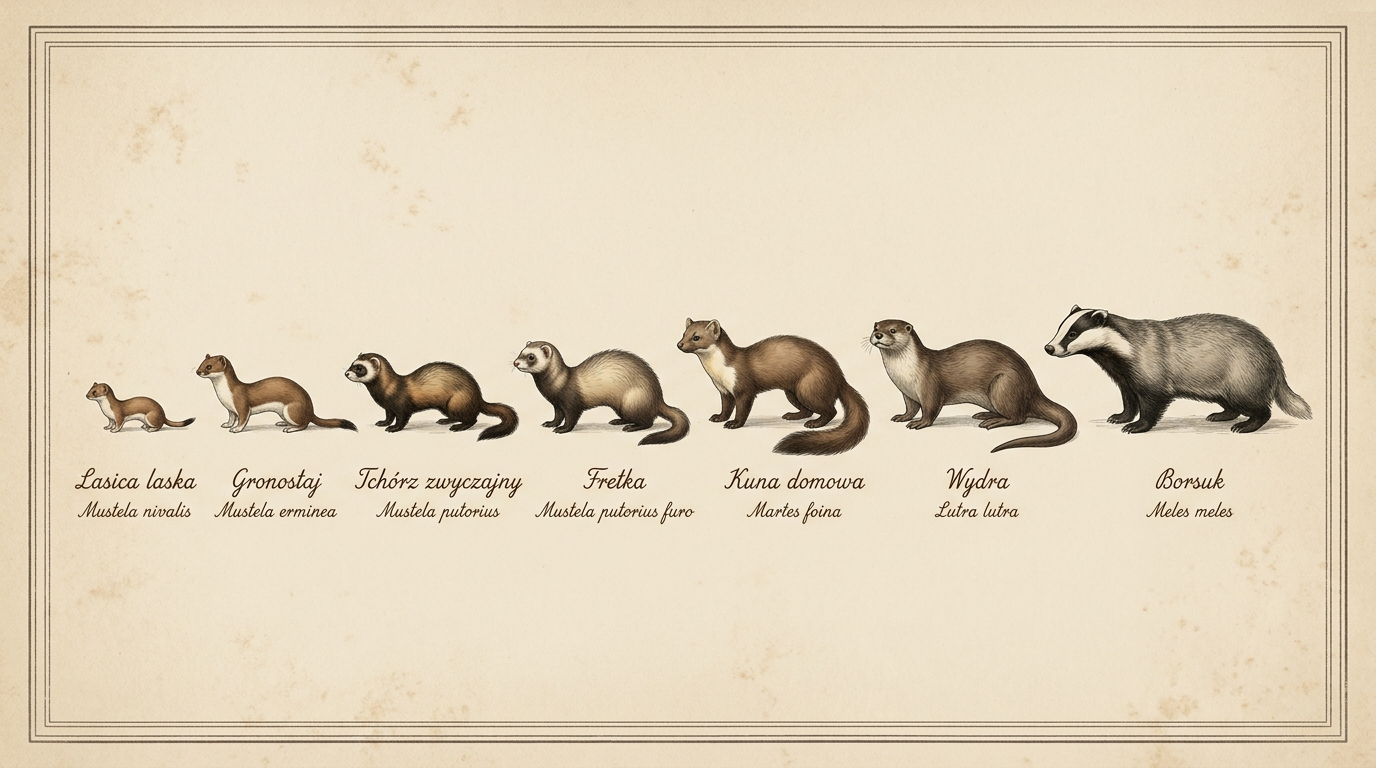
In Poland, seven mustelid species live permanently: the stone marten (Martes foina), pine marten (Martes martes), least weasel (Mustela nivalis), stoat (Mustela erminea), European polecat (Mustela putorius), Eurasian otter (Lutra lutra), and European badger (Meles meles). Among non-native but established species is the ferret (Mustela furo), which is the domesticated form of the polecat. In total, eight silhouettes, any of which can realistically be mistaken for another.
Step 1 — size: mouse-sized (weasel) / cat-sized (marten, polecat, ferret) / medium dog-sized (otter, badger). Step 2 — throat patch: white bipartite (stone marten), yellowish solid (pine marten), absent (the rest). Step 3 — tail tip: black (stoat always, marten often) / uniform (weasel, polecat). Step 4 — environment: water (otter), sett (badger, polecat), trees (pine marten), buildings (stone marten).
§ 02Pine marten vs stone marten
The most common mistake within the Martes genus. Both martens have nearly identical dimensions: 42–48 cm body length plus 25 cm tail, a mass of 1.1–2.5 kg, brown fur, and a bushy tail. Three things set them apart: the color of the throat patch, the environment, and — to a lesser extent — behavior toward humans.
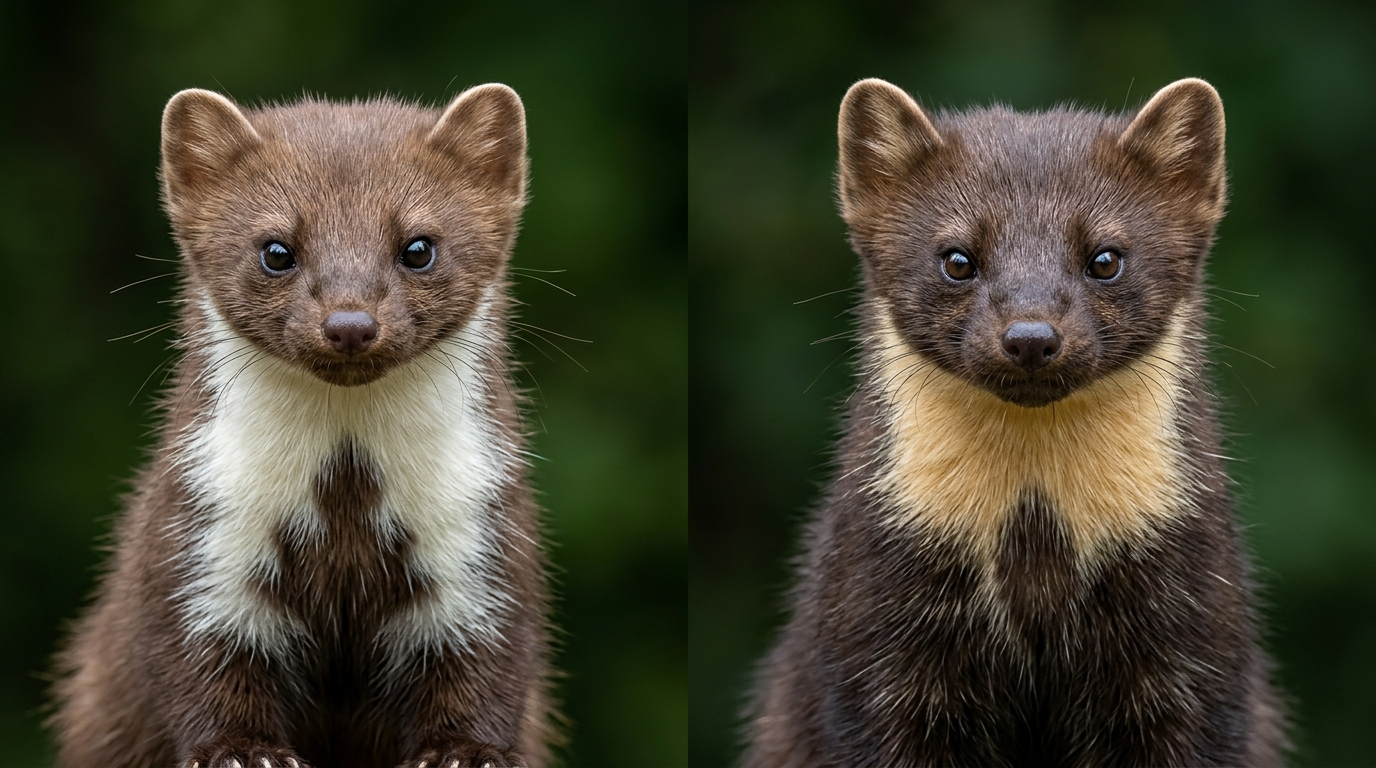
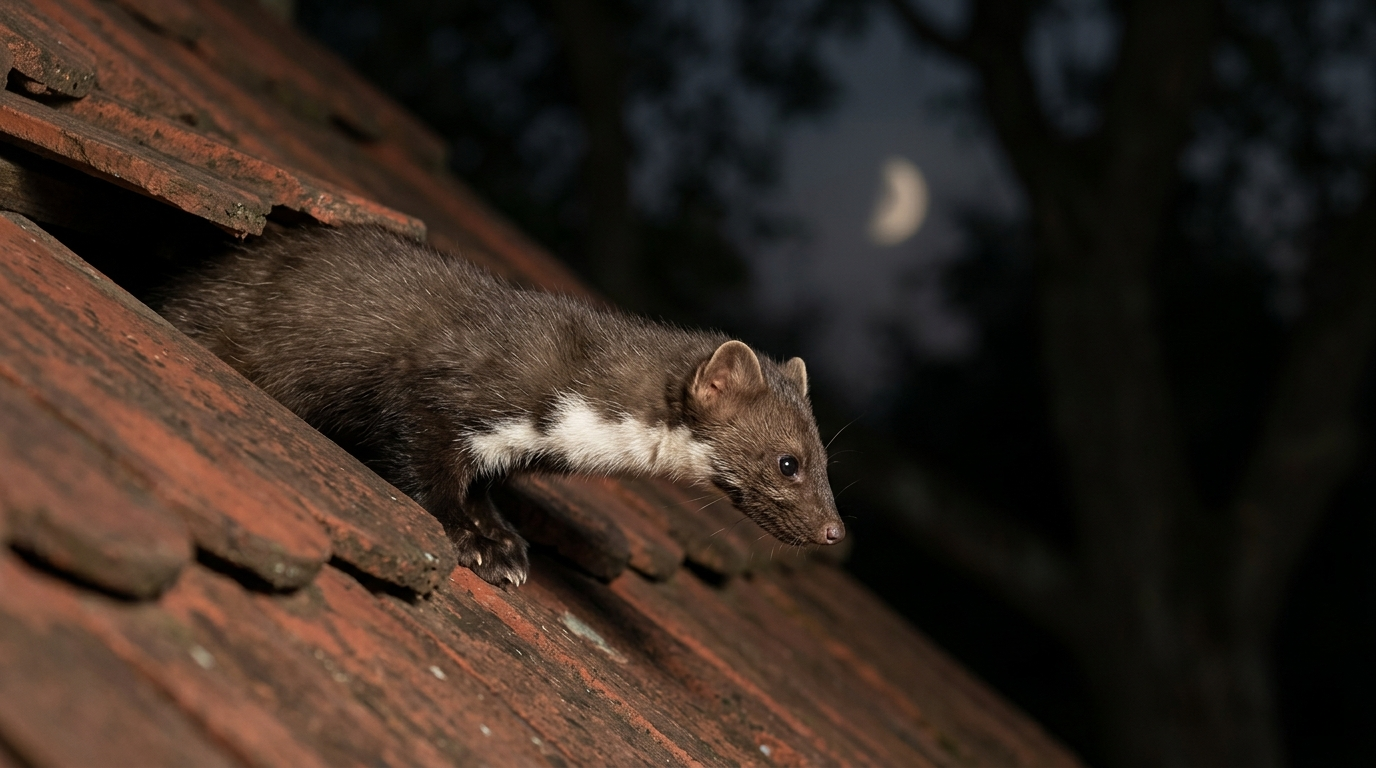
The most reliable feature is the throat patch (bib). In the stone marten, it is snow-white, reaches down to the base of the front legs, and is clearly divided into two bands running along the inner side of the limbs. In the pine marten, the patch is creamy-yellow, sometimes orange, solid, and ends on the chest with a rounded edge. The Polish name „yellow-throat" used for the pine marten comes exactly from this.
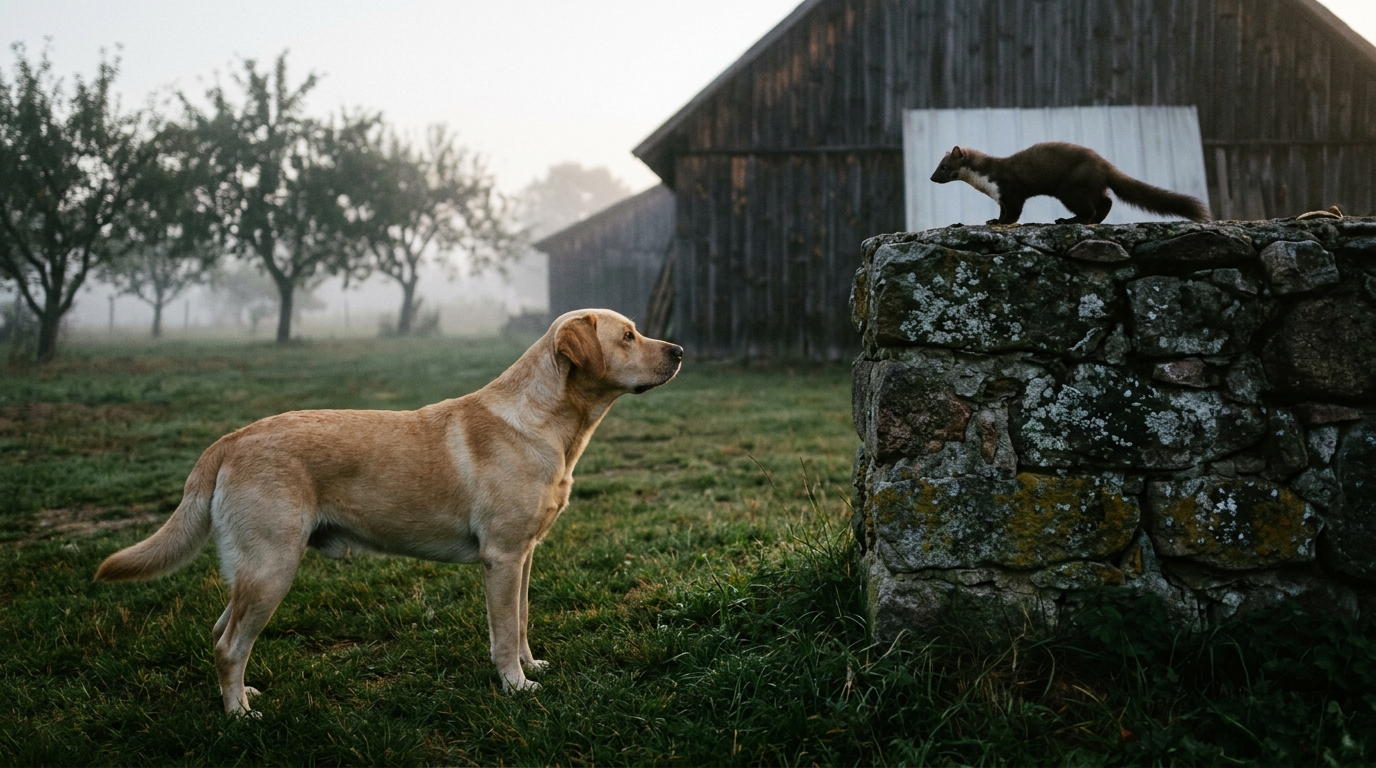
The environment is the second signal. The pine marten is a typical forest dweller — preferring old spruce and beech stands, hollow trees, and the nests of squirrels or birds of prey. It consistently avoids humans. The stone marten took the opposite path — it chose the proximity of buildings, attics, chimneys, garages, and woodpiles. If you see a marten near a house, in the city, or near a road — in 95% of cases, it is a stone marten.
In hand, the difference is further visible by the inside of the ears (pine marten has lighter, creamy edges) and by the underside of the paws — in the pine marten, dense fur is visible between the pads (adaptation for snow), while in the stone marten, the undersides are almost bare. These two features are 100% decisive.
§ 03European polecat — the black animal similar to a marten
„A black animal similar to a marten" — this is one of the most frequent inquiries that hits our inbox. In 90% of cases, the answer is: European polecat (Mustela putorius). It is the only native mustelid with such dark, almost black coloration, and the only one that truly looks black in a flashlight beam.
The polecat is smaller than a marten — 35–46 cm body length plus 13–19 cm tail, mass 0.5–1.5 kg. Its fur is two-layered: the undercoat is pale cream, almost white, while the long guard hairs are dark brown to black. This creates a characteristic „two-tone" effect — when the animal moves, the light underside shines through. The most recognizable feature is the black mask on the face: dark patches around the eyes and light bands below the eyes and at the base of the ears.
If an animal ran across your path at night in the headlights and looked „black" but had a white „hook" behind its ear — it wasn't a marten. It was a polecat.
The second decisive feature is the scent. The polecat has the most highly developed scent glands of the whole family — in a threat situation, it emits a sharp, pungent odor that lingers in the area for several hours. A marten smells musky and sweetish; a polecat — unambiguously unpleasant. In fact, the old Polish name for it essentially meant „the stinking one".
The polecat chooses a different environment than the marten: thickets near water, wetlands, the banks of drainage ditches, abandoned farms. It swims excellently, dives well, and often hunts frogs — something a marten never does. If a „marten" appeared by your pond and disappeared into the water, it was almost certainly a polecat.
§ 04Least weasel and stoat — the smallest mistakes
The smallest mustelids in Poland. The least weasel (Mustela nivalis) measures only 17–23 cm in body length with a mass of 60–200 g — in terms of size, it's more like a mouse than a cat. The stoat (Mustela erminea) is larger: 22–32 cm and 150–350 g. Both are rarely confused with martens but often with each other — and both with young polecats.
The decisive feature is simple: the tip of the tail. A stoat always, in every coat and at every age, has a black-colored tail tip — a short, distinct brush 3–5 cm long. This is the field identifier that is 100% decisive, regardless of the season. The least weasel has a uniformly reddish tail, or whiter in winter, without any black tip.
The second difference is the line of separation between the back and the belly. In the stoat, it is straight and sharp — as if drawn with a ruler. In the weasel, it runs irregularly, with „bays" and indentations. In summer, both species are reddish-brown on the back and white on the belly; in winter, the stoat across all of Poland turns completely white (except for the black tail tip), while the weasel only turns white in the northern and eastern parts of the country.
The predator most often confused with a weasel is indeed the stoat — due to their identical silhouette, behavior, and coloring. Less commonly, a young polecat (it already has a mask) or a male American mink (larger, darker, found near water). The comparison „stoat vs marten" is a false question — they cannot be confused, as they are separated by 1.5 kilograms of mass.
§ 05Ferret — the domesticated polecat
The ferret (Mustela furo) is a domesticated form of the polecat — not the marten, as is sometimes heard. Bred for over two thousand years (first for rabbit hunting in ancient Rome, today mainly as a companion animal), it has retained most of the features of its wild ancestor but gained huge variability in color and — crucially — the loss of fear of humans.
In the nature of a Polish garden, we encounter two types of ferrets: escapees (usually light — creamy, white albino, silvery) and so-called wild-colored ferrets, which look almost identical to the polecat. You will recognize the former immediately — no wild mustelid is that light. The latter require paying attention to behavior.
A ferret, unlike a polecat, does not run away at the sight of a human. It often approaches on its own, can be lured with food, or tries to enter the house. A polecat will disappear in a second. The second signal is condition: an escapee usually has fur in worse condition (matted, thinning in places), may be emaciated, and sometimes a collar or its mark on the neck fur is visible.
- Coloration: ferrets can be white, cream, silver, wild-type — a very wide palette. Polecats have one „pattern".
- Behavior: a ferret does not run away, sometimes approaches humans. A polecat disappears immediately.
- Condition: escapees often have fur in poorer shape, are frequently emaciated, and may be marked.
- Route: a ferret hangs around human buildings and feeders. A polecat travels at night along thickets and water.
If a ferret allows you to approach and pick it up — it is almost certainly a domestic animal that escaped its owner. Contact a shelter or a local ferret breeders' group. Left in the wild, it will perish within a few days — it cannot handle the winter, predators, or hunting for its own food.
§ 06Otter and badger — the largest relatives
Two of the largest representatives of the family in Poland. The Eurasian otter (Lutra lutra) reaches 60–90 cm in body length plus a 35–45 cm muscular tail, weighing 6–11 kg. The European badger (Meles meles) is in a different league entirely — 60–90 cm long, mass 10–20 kg, body stocky, low, bear-like. They can only be confused with a marten from a great distance or in a very brief flash.
| Species | Length | Weight | Throat Patch | Environment |
|---|---|---|---|---|
| Least weasel | 17–23 cm | 60–200 g | none (white belly) | meadows, fields, stone piles |
| Stoat | 22–32 cm | 150–350 g | none (white belly) | meadows, forests, water edges |
| Polecat | 35–46 cm | 0.5–1.5 kg | none (black fur) | thickets near water, wetlands |
| Ferret | 35–50 cm | 0.7–2.0 kg | none (various colors) | buildings (escapee) |
| Stone marten | 42–48 cm | 1.1–2.5 kg | white bipartite | near humans, attics |
| Pine marten | 42–48 cm | 0.9–2.2 kg | yellow solid | old forests, hollow trees |
| Otter | 60–90 cm | 6–11 kg | none (light throat) | rivers, lakes, ponds |
| Badger | 60–90 cm | 10–20 kg | none (black/white stripes) | mixed forests, setts |
An animal similar to an otter in Polish conditions is practically only the American mink (Neogale vison) — an invasive species, smaller (35–45 cm), darker, with a distinct light chin. An otter has a wider snout with prominent whiskers, shorter legs, and a streamlined, „fish-like" silhouette. Moving in water, it cannot be mistaken for anything else — a marten is characterized by a gallop, an otter by undulating swimming.
An animal similar to a badger in Poland is most often a raccoon dog — not a mustelid, though similar in silhouette. A badger is unmistakable: low, stocky, with white stripes running from the snout through the eyes to behind the ears. It lives in multi-generational setts, whose tunnel systems can be dozens of meters long. It cannot be confused with a marten except in a very ambiguous glimpse through bushes.
Yes, but only if you live near a body of water (no further than 200–300 m from a river, lake, or breeding pond). An otter occasionally visits gardens for fish from garden ponds — this is a classic conflict situation, especially with koi carp ponds. The otter is under strict species protection.
§ 07Mistakes from outside the family — squirrel, rat, raccoon dog
Three species which, despite no kinship with martens, most often end up in our inbox as „I think I saw a marten". They share one common trait: in the wrong light and during a very brief observation, they look surprisingly similar.
First mistake: red squirrel (Sciurus vulgaris). The question „marten vs squirrel" is asked surprisingly often — for two reasons. First, the squirrel in Poland comes in two color varieties: red and black-brown. The latter, in the shade of a tree or on a roof, looks much darker than a classic „redhead". Second, a squirrel has a similarly bushy tail. Differences: a squirrel jumps vertically (from trunk to trunk), a marten runs horizontally; a squirrel is diurnal, a marten is nocturnal; a squirrel has tufts of hair on its ears, a marten does not.
Second mistake: brown rat (Rattus norvegicus). It sounds improbable, but in the evening light of a flashlight, a large rat (up to 30 cm plus tail) racing along a wall is sometimes taken for a young marten or a weasel. Distinguishing features: a rat has a bald, scaly tail (marten and weasel — bushy), a clearly pointed snout, and moves with a „sliding" motion, without galloping jumps.
Third mistake: raccoon dog (Nyctereutes procyonoides). Related to canids, but it looks like a cross between a badger and a fox. In Poland, it is an invasive species, becoming more common. It has nothing in common anatomically with a marten, but at night, when only the outline and bushy tail are visible, it is sometimes taken for a „large marten". However, a raccoon dog is much taller at the shoulder (25–30 cm) and has a typically canine snout with a black mask.
- Black squirrel: diurnal, jumps in trees, tufts on ears.
- Brown rat: bald tail, sliding movement, lacks bushiness.
- Raccoon dog: canine silhouette, black mask on face, taller at shoulder.
- American mink: dark, near water, light chin.
- Muskrat: in water, laterally flattened tail, a rodent.
The clue „similar to a marten — crossword" most often refers to three answers in Polish crossword puzzles: polecat (tchórz), weasel (łasica), or stoat (gronostaj). Less commonly ferret, sable, or mink. It's the same mechanism as in the field — the human brain sees „something brown, fast, long" and reaches for the first associated name.
If you want to dive deeper into the topic, we recommend two more articles: Marten vs Weasel — What's worth knowing about these mammals and the practical guide How to recognize the presence of a marten or weasel in the garden. When observing at night — remember the four steps of the key: size, throat patch, tail tip, environment. In 90% of cases, these are enough for a correct diagnosis.
★Frequently asked questions
What animals are similar to martens?
In Poland, the stone marten and pine marten (Martes foina and Martes martes) are most often confused with the European polecat, the ferret (an escapee from breeding), the stoat in its summer coat, a young otter, and the American mink. Among non-mustelids — the squirrel in its black color variety, a large brown rat, and the raccoon dog. The identification key is based on four features: size, throat patch color, tail tip, and the environment where the animal was seen.
What is the difference between a marten and a polecat?
The stone marten has a white, bipartite throat patch reaching the front legs and uniformly brown fur. The polecat (Mustela putorius) is smaller (35–46 cm vs 42–48 cm), has two-tone fur — a light undercoat shining through dark guard hairs — and a characteristic black mask on the snout with white patches behind the ears. A polecat smells much stronger (a sharp, pungent odor) and, unlike a marten, swims well and hunts frogs.
What is that black animal similar to a marten?
With a 90% probability, it is the European polecat. It is the only native mustelid that looks black in low light — its long guard hairs are dark brown to almost black. Other dark candidates for confusion include: the American mink (near water, light chin), the squirrel in its black color variety (in trees, diurnal), or a very large brown rat (bald tail, sliding movement). The presence of white bands on the polecat's face is the deciding factor.
Is a stoat the same as a weasel?
No. They are two separate species of the same genus Mustela. The stoat (Mustela erminea) is larger (22–32 cm, 150–350 g) and always has a black brush at the end of its tail — regardless of the season or age. The least weasel (Mustela nivalis) is smaller (17–23 cm, 60–200 g) and has a uniformly colored tail without a black tip. In summer, both are reddish-brown on the back and white on the belly; in winter, the stoat turns white across all of Poland, while the weasel does so only in the north and east.
Is a ferret a domesticated marten?
No — the ferret (Mustela furo) is a domesticated form of the European polecat, not the marten. Bred by humans for over 2000 years (originally for rabbit hunting in ancient Rome). It shares nearly identical dimensions and most anatomical features with the wild polecat but differs in coloration (a palette from white, cream, and silver to wild-type), lack of fear of humans, and usually poorer condition in animals that have escaped their owners.
How many mustelid species live in Poland?
There are seven native species living permanently: stone marten, pine marten, least weasel, stoat, European polecat, Eurasian otter, and European badger. Additionally, the ferret (escapees or feral individuals) and the invasive American mink are encountered. The latter displaces the native European mink (which is practically extinct in Poland). From the entire family, only the stone marten and polecat have „game" status — the other five native species are under species protection.