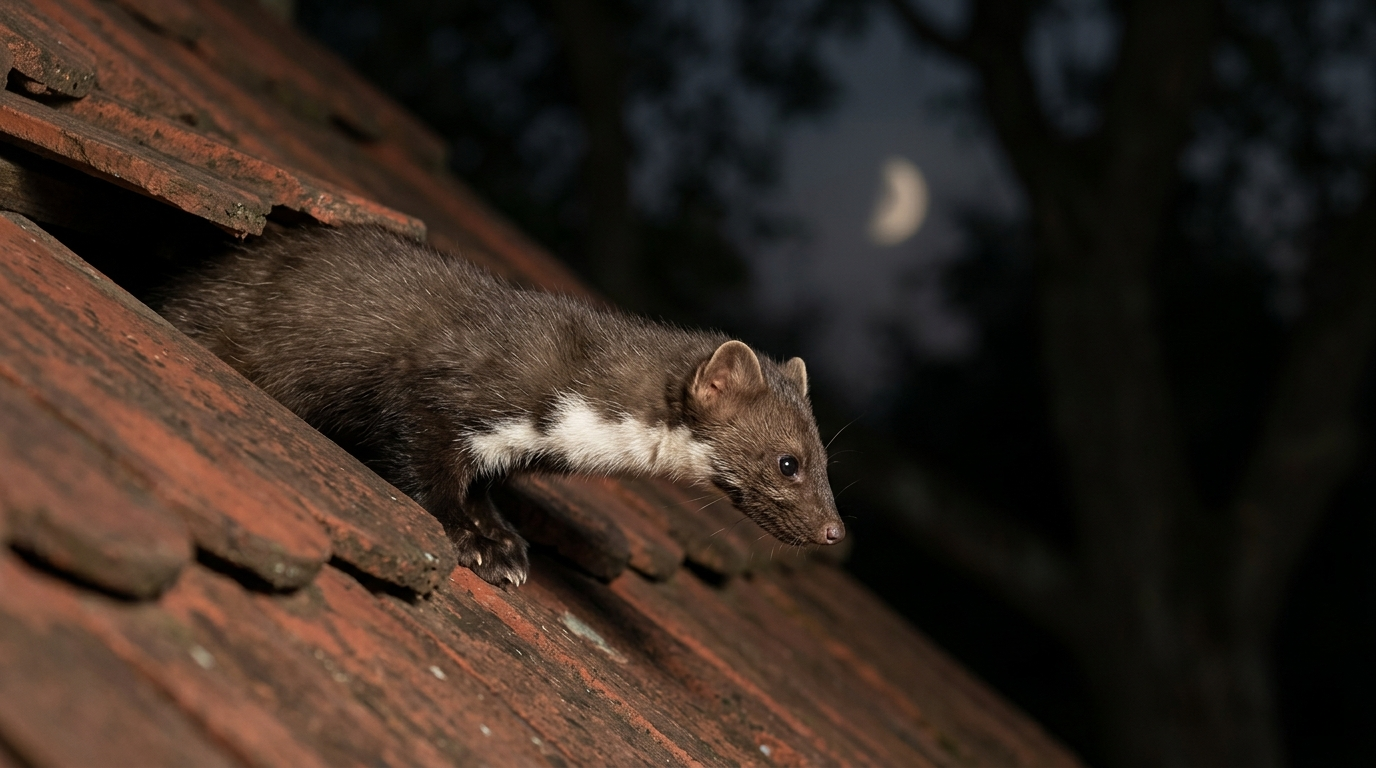
The question „what does a marten eat" usually arises when only feathers remain in the chicken coop or a pile of cherry pits lands on the roof tile. The answer is simpler than it seems and more surprising than one might think — the beech marten (Martes foina) eats almost everything that can be caught, dug up, stolen, or found in a trash can.
This guide gathers the full menu of the marten in one place — from its basic meat-based diet, through seasonal preferences for fruit, to behaviors that most often result in conflict with humans. If you're wondering what the marten eats in your attic or why it left dead birds in the chicken coop that it didn't even eat — it's all below.
§ 01What does a marten eat — a short answer
The beech marten is an opportunistic omnivore. In practice, this means it doesn't have a single favorite food — it eats whatever is currently easiest to obtain. One week it may feed mainly on voles caught in the orchard, the next — on cherries from that same orchard, and the following — on leftovers from a neighbor's composter.
The full list of what martens eat includes: small mammals (mainly rodents), birds and their eggs, insects, earthworms, snails, carrion, fruits, berries, nuts, and near humans — also pet food, kitchen scraps, poultry, and farm rabbits. An average adult marten needs about 150–250 g of food per day, though it can eat more in winter and less in summer.
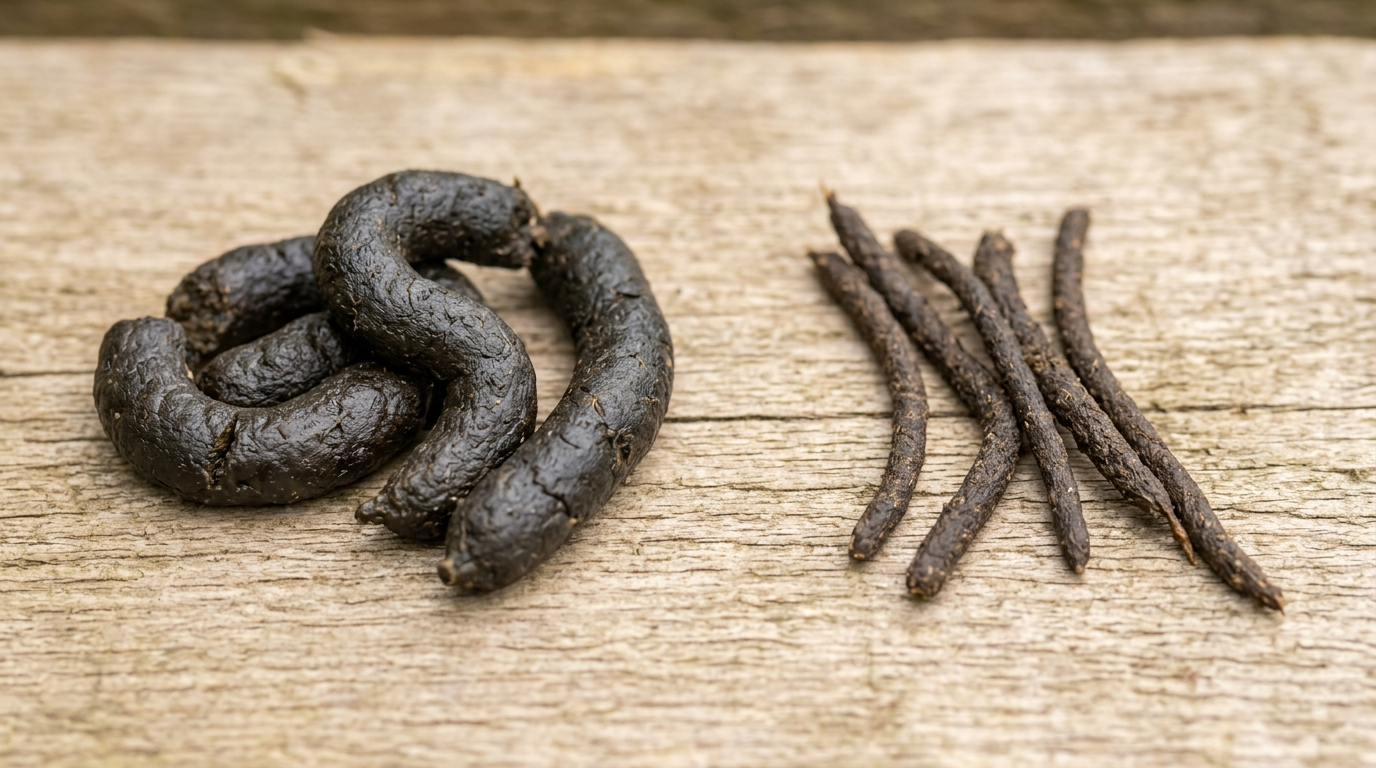
The fastest way to assess what a marten eats specifically at your place is to look at the droppings on the roof tile. Cherry pits? July, fruit diet. Small bones and fur? Rodent hunting. Feathers? Nestling season or a visit to the chicken coop.
§ 02Small mammals — the basis of the diet
Despite all this omnivorousness, meat remains the basis of the marten's diet. Small mammals make up 50 to 70% of the annual menu — depending on the region, season, and availability of other foods. This is what the marten is evolutionarily built for: an agile, persistent, almost cat-like hunter with excellent smell and reflexes.
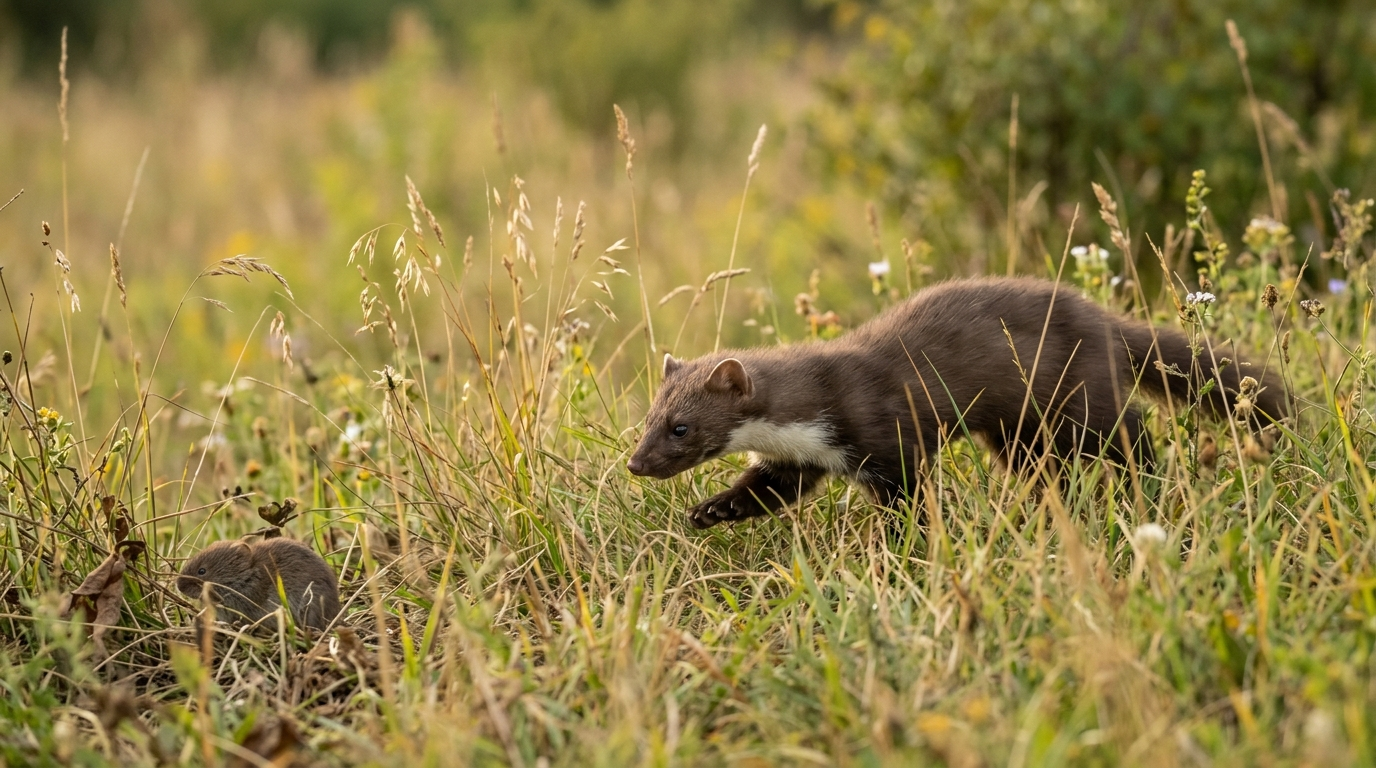
The most common victims are field voles, house mice, wood mice, young rats, shrews, moles, and in orchards, also edible dormice and garden dormice. A marten can also attack larger prey — a young hare, a rabbit, and in urban conditions, a full-grown rat weighing up to 400 g. The prey usually dies from a single, precise bite to the neck.
If you ask what a marten hunts most eagerly — the answer is: whatever is most abundant in the area. In agricultural parts of Poland, it will be voles; in small towns, mice and rats; in forested areas, dormice. You can find more about tracking the predator itself in the guide How to recognize the presence of a marten or weasel in the garden.
§ 03Birds, eggs, and poultry
The second significant food group consists of birds — and this is where most conflicts with humans begin. The marten is an excellent climber and easily reaches nests; it robs the eggs of tits, blackbirds, thrushes, pigeons, and jackdaws. During the breeding season (April–June), eggs and nestlings can make up 20–30% of the diet.
A marten can take all the eggs from a nest in one day, carrying them one by one to its hiding place. Very often, in its pantry in the attic, there are several to a dozen whole, undamaged eggs — a typical sight after a visit to a chicken coop or dovecote.
A marten in a chicken coop is not hunting. It is a slaughter. The killing instinct is triggered by every wing movement and does not switch off as long as something is still moving.
And here we come to the most dramatic element. A marten in a chicken coop can kill all the birds, even if it only eats one. This is not malice or a „desire to destroy" — it is a built-in mechanism: every wing movement in a confined space triggers an attack. In nature, victims escape, so the „kill everything that moves" instinct only works briefly. In a closed chicken coop — there is no way to stop.
For the same reason, rabbit hutches, dovecotes, and pheasant pens require solid mesh with a maximum opening of 2 cm and a full enclosure from the top. An open chicken coop is not food for one day for a marten — it is a breeding catastrophe in one night.
§ 04What martens eat in summer — fruit and berries
In summer, the marten's diet changes dramatically. From late June to October, fruits and berries can make up as much as 40–50% of the menu. It is during this period that gardeners with orchards begin to find piles full of pits on their roof tiles — it's not birds, it's a marten.
The undisputed marten delicacy is cherries and sour cherries. A marten can climb a trunk vertically and eat fruit directly from the branches, spitting out the pits. Second place is taken by blackberries and raspberries — especially those growing wild near fences. Third — apples, pears, and plums, usually those already fallen, overripe, and sweeter than those ripening on the tree.
- Cherries and sour cherries — absolute favorites; pits in droppings are the surest sign of a marten's summer presence.
- Blackberries, raspberries, blueberries — eagerly collected from wild bushes and backyard thickets.
- Apples, pears, plums — mainly fallen fruits in an advanced stage of ripeness.
- Grapes — in home orchards, especially those near the fence.
- Hazelnuts and beech nuts — in autumn, as a diet supplement before winter.
The fact that what a marten likes to eat also includes fruit surprises many people accustomed to the image of a predator. Meanwhile, sweet fruit sugar is a fast, easy source of energy for the marten — especially for females feeding young in July and August.
§ 05Insects, carrion, trash
Where hunting is not energetically profitable, the marten reaches for food literally from the ground. Insects, earthworms, snails, and grubs make up a quiet but constant part of the diet — especially in spring and autumn when the soil is soft and beetles and their larvae are easy to dig up.
It is precisely the hunting for grubs that explains a significant part of the night-time lawn damage that garden owners attribute to moles or wild boars. Characteristic holes a few centimeters in diameter, scattered across the turf in one night — this is often the trace of a marten following the scent of cockchafer larvae.
The second category of „easy food" is carrion. A marten will not refuse a dead hedgehog, a pigeon run over on the road, or a fish washed up by the water. Carrion is particularly important in winter when fresh prey is scarce and more energy is needed.
The third category — and the cause of most urban problems — is trash and pet food. A marten will eagerly search through open bio-waste bins, open composters, and bowls left out for cats in the yard. It pulls meat scraps out of bags, reaches for dog food left in the garage, and opens unsecured containers. Where humans make it easy, the marten doesn't hunt — it literally approaches the table.
An open composter with meat scraps is an open invitation for a marten. If a neighbor has a dog fed with wet food left on the porch — you have a marten in the neighborhood, whether you've seen it or not.
§ 06What a marten DOES NOT eat
Many myths have grown around the marten's diet — most of them repeated by generations of poultry farmers. The loudest and most persistent: the marten drinks the blood of its victims. This is false. A marten is not a „vampire," it doesn't suck blood, and it doesn't feed on bodily fluids. The impression of a „bloodless" hen comes from the fact that the marten bites the neck and severs large vessels — blood spills widely, even though the animal doesn't drink it.
Second myth: a marten eats everything it kills. Also false. As described in the section about the chicken coop, in a situation of excess prey, a marten kills all but usually consumes only one — at most two. It leaves the rest (or tries to carry them to its pantry if it is close enough).
Third myth: the marten attacks cats and dogs. Under normal conditions — no. An adult cat weighs 3–5 kg, which is 2–4 times more than a marten; a dog even more. A marten is too cautious to risk a fight with a larger opponent. Exceptions are kittens and very small miniature dog breeds left unattended outdoors at night — here the risk realistically exists, but it is rare.
What will a marten actually not touch? Raw vegetables (with few exceptions like corn), bread and dry food without fat, spicy seasonings. A live trap with a carrot will never work — with a piece of chicken liver, wet cat food, or a fresh egg — very well.
§ 07Seasonal diet changes
A marten's diet changes seasonally by 50–70% — this is one of the reasons why this species handles human-altered environments so well. Each season brings a different „dinner set."
Winter (December–February) — the most difficult time. No fruit, fewer birds, most reptiles and amphibians in hibernation. Rodents (house mice, rats near buildings), carrion, and whatever can be found in composters and bins dominate. It is in winter that a marten most often moves into an attic and stays close to humans — warm, dry, and near a food source.
Spring (March–May) — an explosion of eggs and nestlings. The diet literally changes to eggs of tits, blackbirds, thrushes, and nestlings of all species. Simultaneously: the first insects, earthworms after the first warm rains, and young rodents emerging from burrows. This is a period when the marten has an excess of food and raises its young (usually 3–5 per litter).
Summer (June–August) — the fruit season. Cherries, sour cherries, blackberries, raspberries. The diet is 40–50% plant-based, although small mammals still make up half of the „meat" pillar. Females feeding young are particularly eager to reach for sweet fruits.
Autumn (September–November) — storage time. Fallen fruit, nuts, last berries, still plenty of rodents before winter. The marten feeds intensively and stores fat; in November, it usually weighs 10–15% more than in spring. This is also when it starts looking for a winter shelter — often your attic.
The beech marten is an omnivore with a strong meat pillar (50–70% small mammals throughout the year), which seasonally adds fruit, eggs, insects, and carrion. It kills more than it eats. In contact with humans, it quickly learns to use composters, chicken coops, and pet bowls — and that is usually the beginning of conflict.
★Frequently asked questions
What does a marten eat?
The beech marten (Martes foina) is an opportunistic omnivore. The basis of its diet is small mammals — voles, mice, young rats, moles — which make up 50–70% of its annual menu. It supplements this with birds and their eggs, fruit (cherries, sour cherries, blackberries, apples), insects, earthworms, carrion, and near humans also leftovers from composters, pet food, and farm poultry.
What is a marten's favorite food?
The indisputable marten delicacy is cherries and sour cherries. A marten can climb vertically up the trunk of a fruit tree and eat the fruit straight from the branches. Second on the list of favorite foods are blackberries, raspberries, and blueberries, and among meat-based foods — fresh liver and chicken eggs. The latter are also the most effective bait in live traps.
Do martens drink blood?
No. This is a myth passed down through generations. A marten does not drink the blood of its victims and is not a „vampire." The impression of a „bloodless" hen in a coop comes from the fact that the marten kills with a precise bite to the neck, severing large blood vessels — the blood spills widely, but the animal does not consume it. From the prey, the marten eats meat and organs; it is not interested in the blood.
What does a marten eat in winter?
In winter, a marten's diet consists mainly of rodents (house mice, brown rats, voles overwintering in haystacks), carrion, and whatever it finds near humans — composters, open bio-waste bins, dog and cat bowls, unsecured food in the garage. Since fruit and insects are missing and birds are much scarcer, this is when martens most often move into attics.
Can a marten eat a cat?
Under normal conditions — no. An adult cat weighs 3–5 kg, which is 2–4 times more than a marten (1.1–2.5 kg), so fighting it would be too risky for the predator. Real, though rare, risks apply to very small kittens left unattended by their mother at night outdoors, and miniature dog breeds. Adult cats and larger dogs treat the marten more as a curiosity than a threat — and vice versa.