Saturday · May 9, 2026 · Vol. I, Nº 01
★ Spring observation season · 52°13′N 21°00′E · 14°C / pochmurno
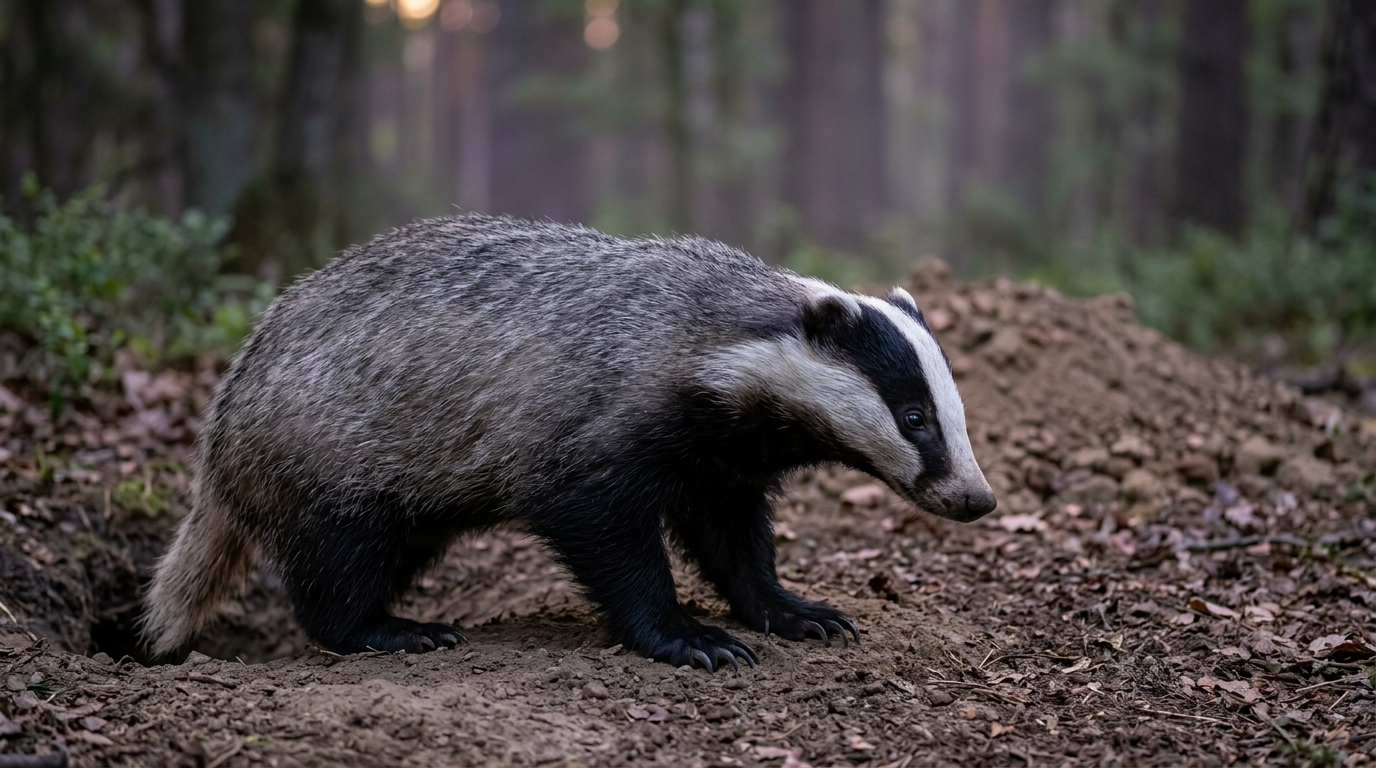
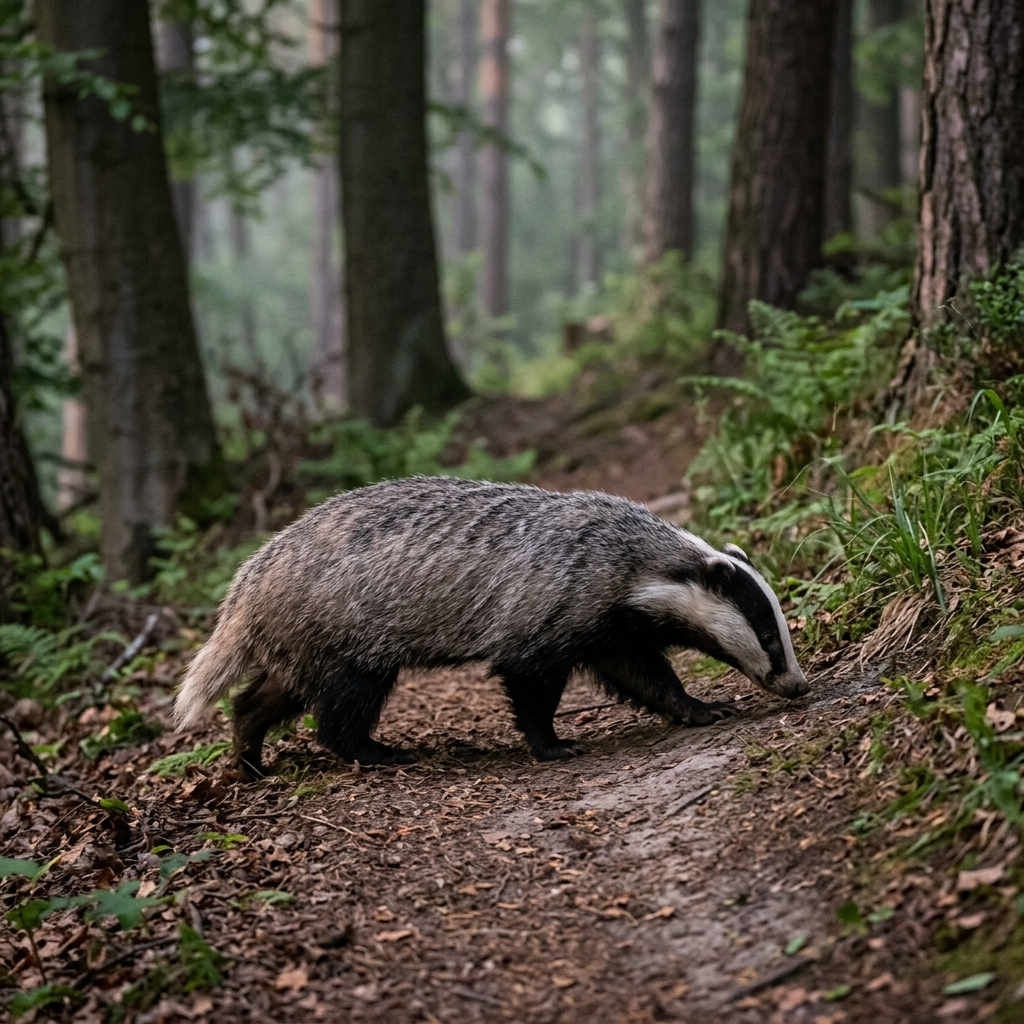
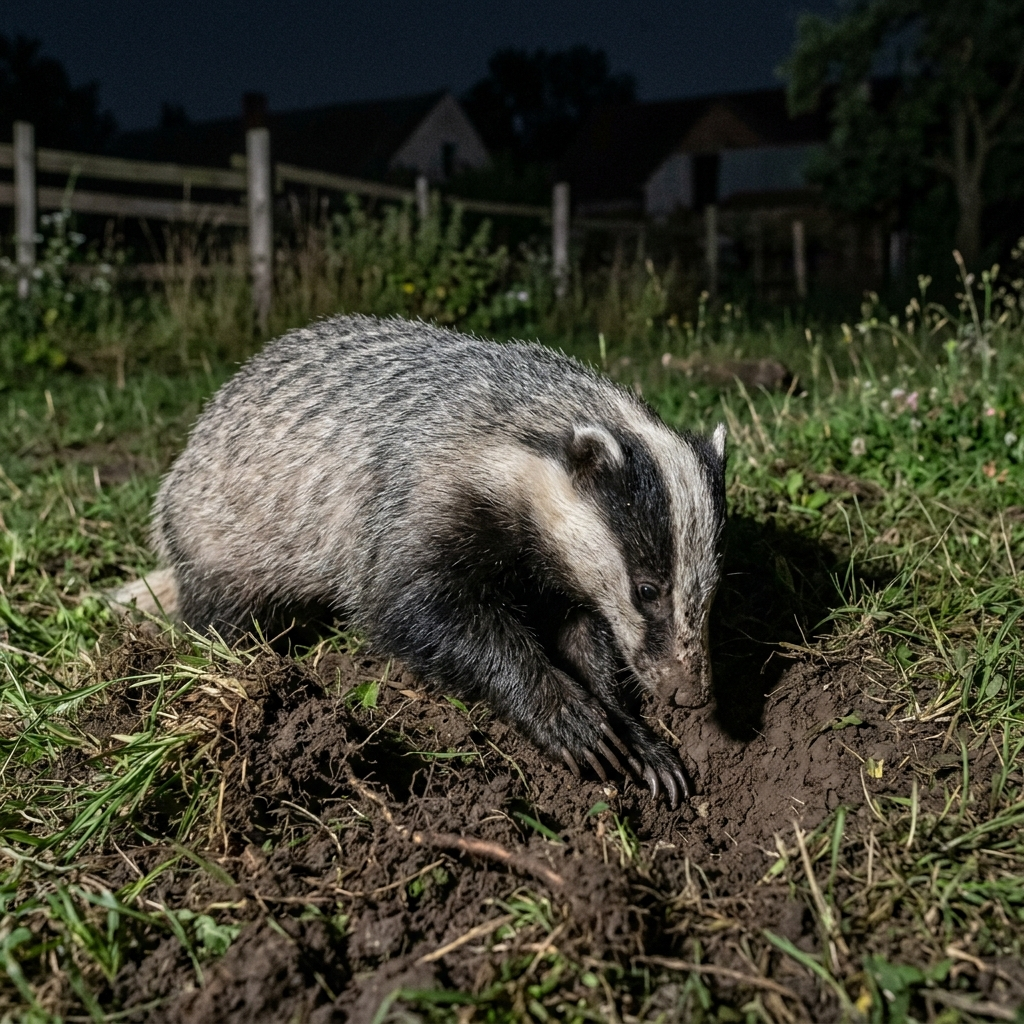
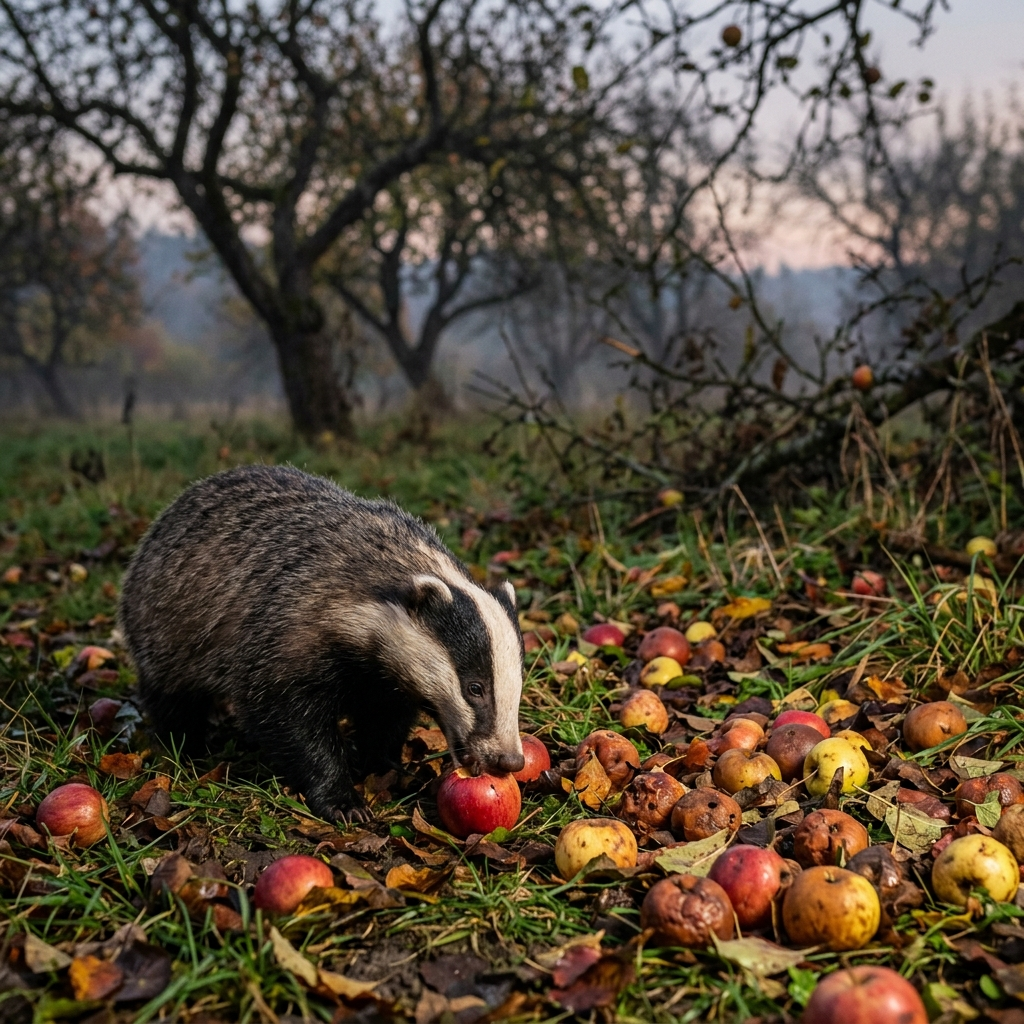
European badger Meles meles emerging from a burrow at dusk, characteristic white longitudinal stripes on a black face, stocky grey-silver silhouette, low posture, strong paws with long claws
PLATE Nº 01 Meles meles

SPECIES PROFILE · Mustelids

European badger

Meles meles · Linnaeus, 1758

Europe's largest mustelid — a stocky builder of underground cities, an omnivore with extremely patient reproductive biology.

The European badger is the largest European representative of the mustelid family — stocky, low-slung, weighing up to 17 kg (exceptionally up to 22 kg in autumn) and possessing an unmistakable signature of white longitudinal stripes on a black face. It is an animal with biology extremely tailored for one thing: digging and living underground. It builds multi-generational burrow systems ("badger cities") used for 100 years or more. Omnivorous, with earthworms constituting up to 60% of its dietary biomass. Active at night, falling into torpor in winter — and possessing one of the strangest reproductive biologies among Polish predators: delayed embryo implantation.

60–90 cm
body length
11–20 cm
tail length
8–17 kg
weight (up to 22 in autumn)
up to 5 cm
claw length
up to 50 entrances
in a badger city
300+ m
of tunnels in a sett
2–5 cubs
per litter
80–100 thousand
individuals in PL
LC Least Concern Hunting species in PL with a closed season from April 1st to August 31st (Ministry of Environment Regulation from March 11, 2005, as amended); seasonal harvest approx. 5,000–10,000 individuals per year Stable or increasing — PL population approx. 80,000–100,000 individuals; expansion into suburban areas and forest complexes recovering after DDT

In short

Classification

Kingdom Animalia
Phylum Chordata
Class Mammalia
Order Carnivora
Family Mustelidae
Genus Meles
Species M. meles

The badger (Meles meles), along with the stone marten, polecat, and otter, is one of the most important Polish mustelids — and simultaneously the most anatomically distinct. Where the marten is slender and agile, the badger is stocky, low, and powerful — adapted not for chasing through canopies, but for digging, weight-bearing, and pushing. The Polish population is estimated at 80,000–100,000 individuals, with a stable or increasing trend. Unlike the fox, the badger does not hunt in the classic sense — it is an opportunistic omnivore whose main food consists of earthworms, field rodents, eggs, insects, roots, and fruit. It is characterized by a nocturnal-crepuscular lifestyle, winter sleep in the torpor phase (not true hibernation!), and reproductive biology with delayed embryo implantation — mating occurs between February and May, but the embryo does not implant until December. Conflicts with humans mainly concern undermining foundations of barns and summer houses or damaging gardens in search of grubs. The badger is a game species in Poland with a closed season from April 1st to August 31st.

01

Appearance and Characteristic Stripes

Unmistakable for any other Polish mammal — stocky silhouette, black and white stripes on the face, massive digger's paws.

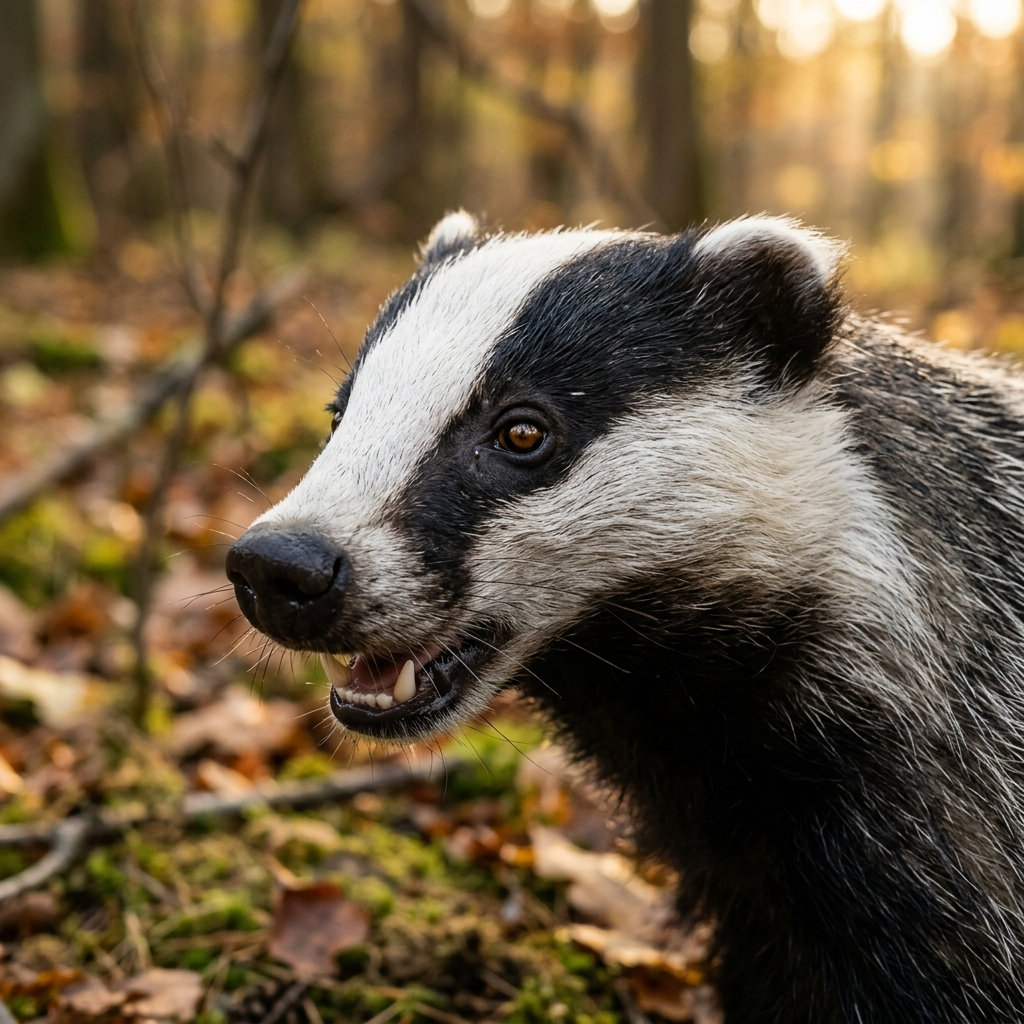
The badger is the most recognizable Polish mustelid. The white longitudinal stripes running from the nose over the eyes to the shoulders on a black facial background do not occur in any other European mammal — a single glance is enough to diagnose the species even in poor light. The rest of the silhouette is equally characteristic: low, stocky, wide — the anatomy of a digger, not a runner.

Body length 60–90 cm + short hairy tail 11–20 cm. Weight is highly seasonal: in spring, badgers weigh 8–12 kg after emerging from torpor; in autumn — before the cold season — they accumulate fat reserves and can reach 15–17 kg, with exceptional males reaching 22 kg. This is the largest European mustelid, approaching the weight of a fox, though anatomically completely different — lower, wider, and more massive.

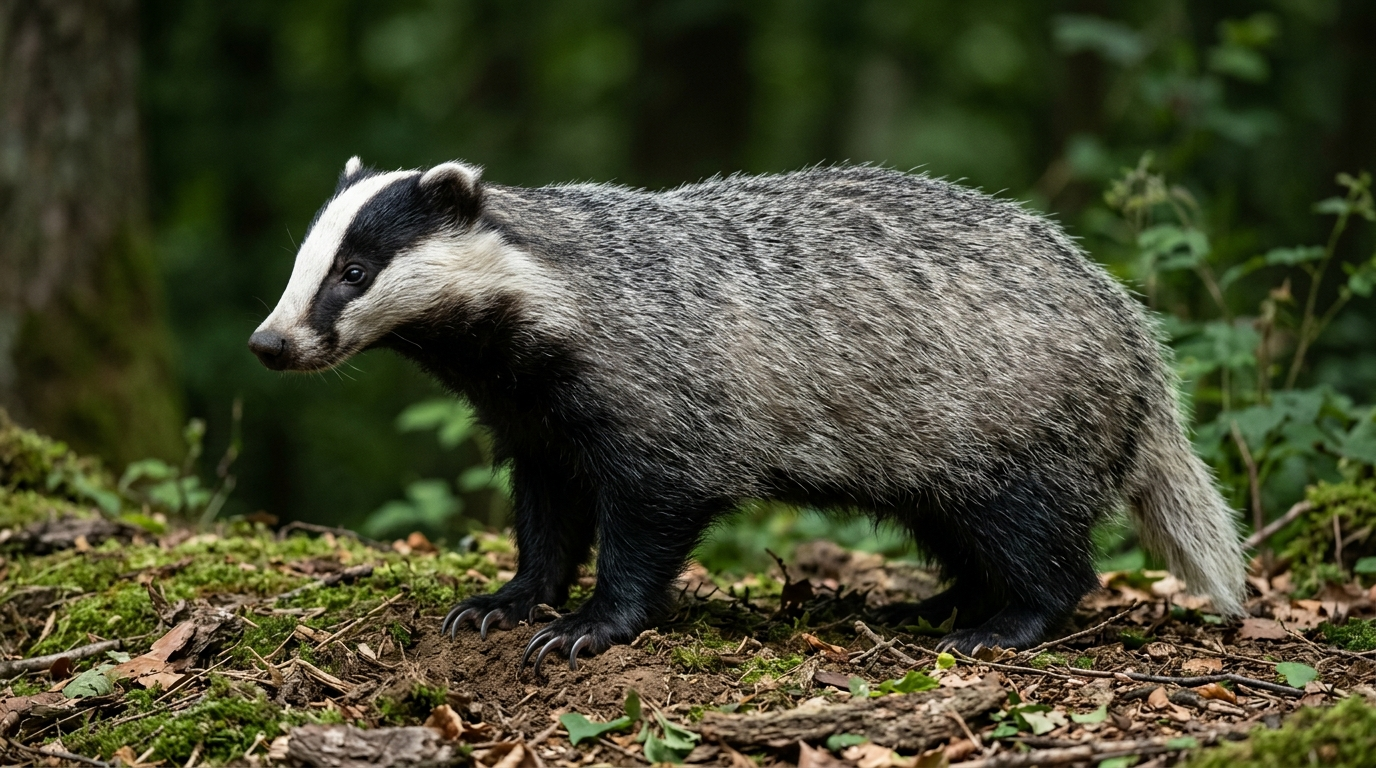
The side silhouette is characteristic: a wedge-shaped body tapering towards the front, with thick, short legs and a high-carried rump. The back fur is grey-silver with black and white hairs giving a grizzled, peppery effect. The belly and legs are black or very dark — a contrast with the back that is particularly visible up close. The face is black with two white stripes running from the nose, through the forehead, over the ears to the shoulders. The forehead and ears are white, surrounded by the black band passing through the eye.

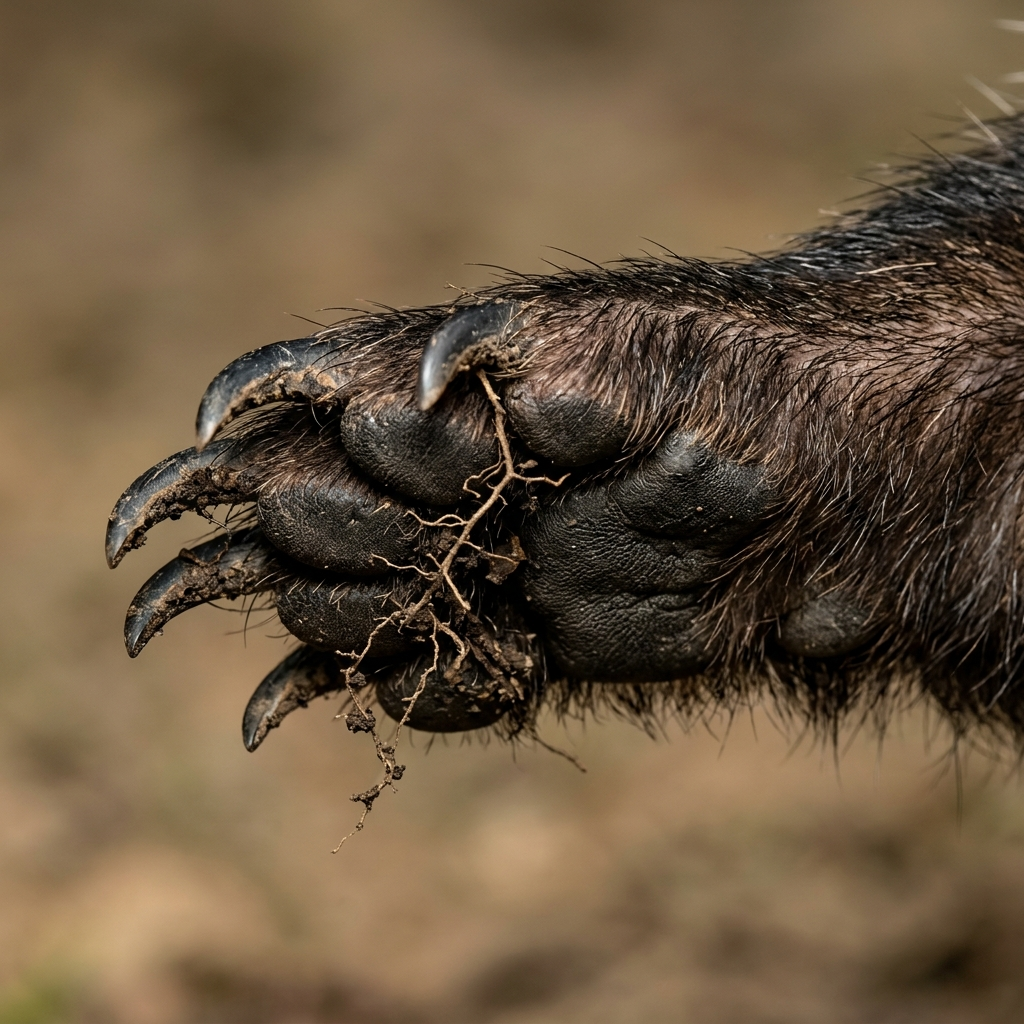
The paws are the anatomical signature of a digger: wide, short, with five toes (NOTE — this differs from cats and dogs, which leave four toe prints). The claws on the front paws are extremely long — up to 5 cm — and do not retract or blunt like a cat's. These are working tools: the badger uses them to dig 300+ m of tunnels in clay and sand. The hind paw claws are shorter but also massive. Sexual dimorphism is weak — males are slightly larger and heavier than females, but practically indistinguishable in the field.

Why the badger is so heavy in autumn

The badger does not hibernate in the full sense — it falls into torpor (winter sleep with lowered temperature and metabolism), but in mild winters, it can actively leave the sett for foraging. Seasonal weight gain mechanism: in the August–October period, the badger forages intensely during 8–10 hours of nightly activity, accumulating subcutaneous and intra-abdominal fat constituting up to 30% of its body weight. This reserve allows it to survive 3–4 months of low food availability (frozen soil, lack of earthworms, hidden rodents). Dramatic weight loss occurs in spring — badgers emerge from torpor 30–40% lighter than in November. Thus, summer weight is a real indicator of health, while autumn weight is an emergency reserve.

Badger anatomy — side silhouette with described features: facial stripes, stocky body, wide paws with long claws
Fig. 01Badger silhouette in profile — key diagnostic features: white facial stripes, stocky body, long front claws.
02

The Sett — A Multi-generational Fortress

Badger cities are the most complex underground structures built by Polish mammals — used for 100 years or more.

The sett is the central element of badger biology — without it, there is no badger. It is not a temporary shelter like that of a fox, but a multi-generational home inherited, expanded, and maintained by successive generations. Polish setts documented by archaeologists have been used continuously for 100, 200, and in isolated cases, 300+ years.

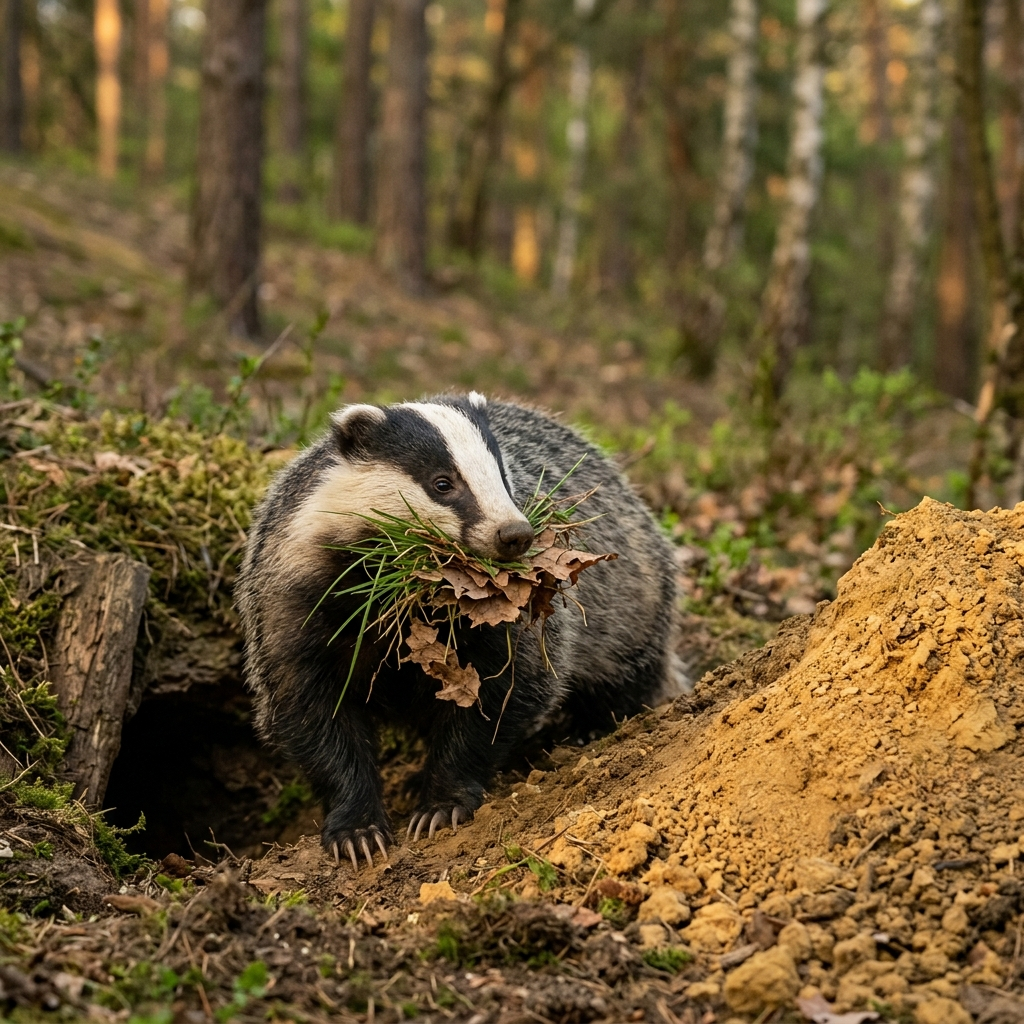
A badger city (sett, badger stronghold) is a system of tunnels and chambers dug in the soil — most often on a slope, in deciduous or mixed forest, in clay-sandy soil (hard enough not to collapse; soft enough to be dug). A typical system has 10–25 entrances, in exceptional cases up to 50. Tunnels stretch over 300 meters in total, at a depth of 1–4 m. Living chambers (5–10) are lined with dry grass, leaves, and moss — badgers regularly change the bedding: they carry the old out backwards (leaving a characteristic worn gutter at the entrance) and bring in fresh material in their teeth or by pressing it against their belly with their front paws.

The social structure of the sett is unique among Polish mustelids. Badgers live in clans (3–12 individuals) occupying a shared sett complex, but sleep individually — each has "their own room," sometimes on a different level of the system. The clan recognizes members through mutual scent marking from anal glands (squat marking — a badger sits on another individual, rubbing its rear). This behavior builds a shared clan scent, crucial for distinguishing "friends" from strangers.

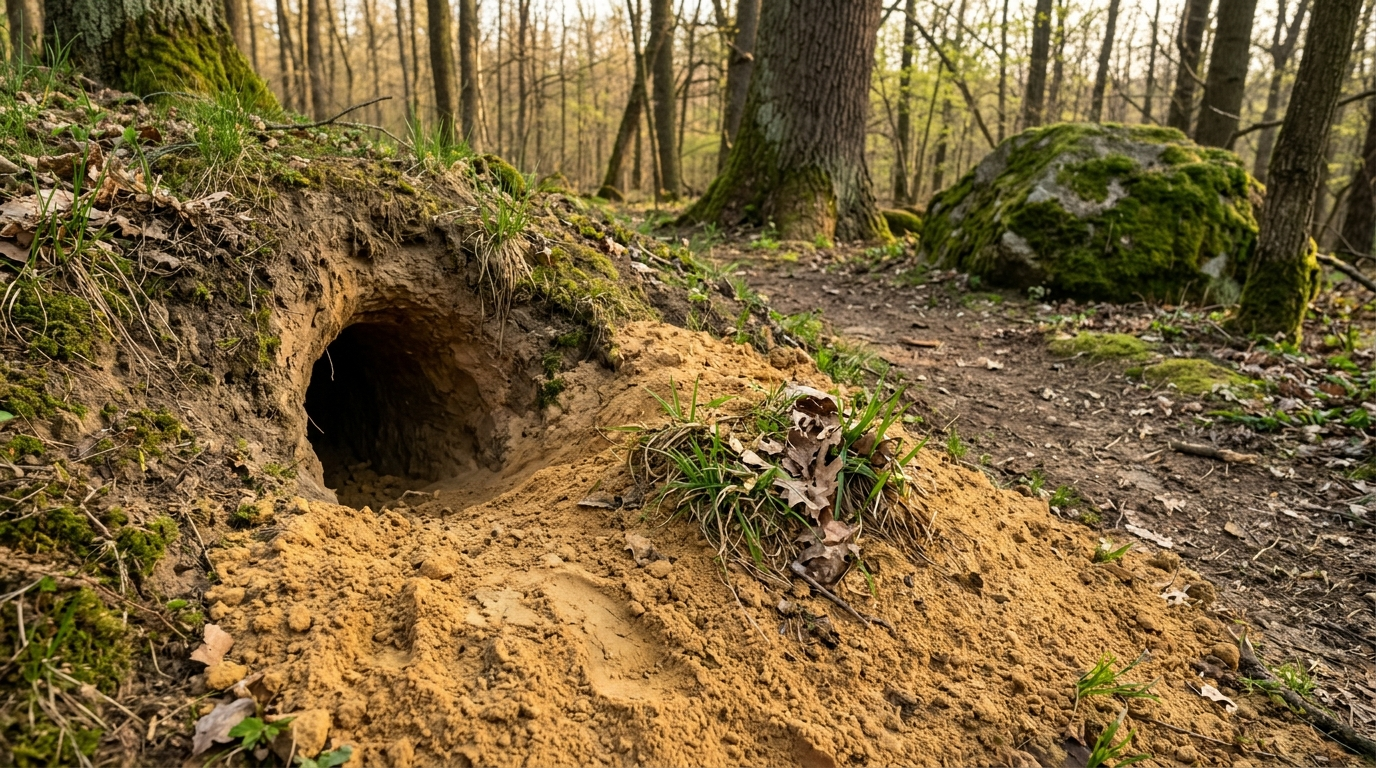
Recognizing a badger sett in the field: (1) entrance holes 25–30 cm in diameter, oval, taller than wide; (2) a mound of excavated earth (tip-pile) in front of the entrance — often containing fragments of old bedding, bones, or fur; (3) worn paths leading from each entrance, merging into main trails; (4) worn gutters at the most used entrances — a 30–40 cm wide channel in the ground; (5) fresh bedding brought out in front of the entrance (dry leaves, grass) — an indicator of an active sett; (6) latrines 10–50 m from the sett (see the Tracks section).

Badger sett under foundations — what to do

Badgers regularly dig under the foundations of barns, garages, and summer houses — especially in places where the earth is dry (under floors) and they can enter from the side of a slope. Structural consequences are real: loosening of the substrate, wall cracks, floor collapses. What you can do: (1) DO NOT fill in an active sett during the closed season (April 1st – August 31st) or at other times if animals are inside — this is an offense; (2) check for activity (fresh tracks, bedding, paths) before any work; (3) contact the local hunting club managing the area — they may take action during the hunting season; (4) prevention: deterrent netting buried 60 cm into the ground with an outward fold blocks digging; (5) badgers dislike very damp places — drainage and gutters directing water under foundations discourage them.

Entrance to a badger sett on a forest slope — oval hole, mound of excavated earth, fresh leaf bedding in front of the entrance
Fig. 02Active entrance to a badger sett — oval hole, excavated earth mound, fresh bedding brought out front.
03

Omnivorous Diet

Earthworms make up 60% of biomass, but the complete menu changes season by season — from chicks in spring to apples in autumn.

The badger is the most omnivorous Polish mustelid. Earthworms constitute up to 60% of the biomass of food obtained, but this is not a specialization like the otter's with fish — it is opportunism within a single category. The rest of the menu includes field rodents, chicks and eggs, insects (especially grubs), roots, tubers, and fruit. The weekly variation in the menu is dramatic.

Earthworms (mainly Lumbricus terrestris) are the key food from spring to autumn — especially after rain, when they come to the surface. The badger then forages on meadows and pastures, walking calmly and winding earthworms onto its tongue. One night of good foraging = 200–400 earthworms = equivalent to 200–400 g of biomass. During drought periods, earthworms go deep, and the badger must switch to alternative sources — then the diet diversifies dramatically.

Second key source: field rodents — field voles, common voles, harvest mice. The badger digs them out of burrows (hence the characteristic broad excavations in meadows and fields) or catches them on the surface. Chicks and eggs of ground-nesting birds (partridges, pheasants, skylarks, duck nests) — season April–June. Beetle grubs and other beetle larvae — the badger rips up clumps of turf in lawns and gardens (frustrating for landowners, but crucial for the ecosystem — the badger reduces pest populations).

Plant food constitutes 20–40% of the diet depending on the season. In spring — young shoots, first roots. In summer — forest fruits, wild raspberries, blackberries, blueberries. Autumn — the peak of the fruit season: apples, pears, plums falling in orchards (badgers regularly visit abandoned village orchards), corn in fields (characteristic broken stalks with eaten cobs), acorns, and beech mast. Roots and tubers are eaten year-round — couch grass, clumps of underground roots of meadow plants. The badger does not hunt actively in the sense of a chase — it is a gatherer and digger.

Badgers in orchards and corn — damage and its scale

Agricultural conflicts with badgers are real but local. Most common cases: (1) apple/pear orchards — badgers regularly visit fallen fruit, but damage to trees is non-existent; (2) corn — they break stalks and eat cobs, damage can reach 5–15% of the yield on the edges of fields adjacent to forests (where a sett is within 500 m); (3) strawberries, raspberries in gardens — incidents; (4) lawns and flowerbeds — ripping up turf in search of grubs, the most common urban complaint. Strategies: an electric fence 30 cm above the ground + 50 cm high effectively protects corn; lawns — maintaining healthy turf without excess grubs (badgers avoid "dry" patches); orchards — acceptance, as badgers clear fallen fruit of pathogens.

04

Reproduction and Delayed Implantation

Mating Feb–May, but the embryo waits 7–10 months before implantation — one of the strangest reproductive biologies of Polish mammals.

The badger has one of the most unusual reproductive biologies among Polish predators. Mating occurs in February–May, but the fertilized egg cell does not implant immediately — it remains in the uterus in a phase of embryonic diapause (delayed implantation) for 7–10 months. True implantation only occurs in December, and the young are born in February–March after a short, approximately 7-week true gestation.

The mechanism of delayed implantation is quite widespread among mustelids (also occurring in the stone marten), but in the badger, it is most extreme. Evolutionary function: synchronization of births with the optimal season. Mating can happen at any time in spring or summer, but births always fall in February–March — a time when the chamber is warmest due to bedding, and by the time the young emerge outside (April–May), the soil will have thawed and earthworms will have appeared. The badger does not consciously control the timing of implantation — it is handled by the hormonal system in response to photoperiod (day length).

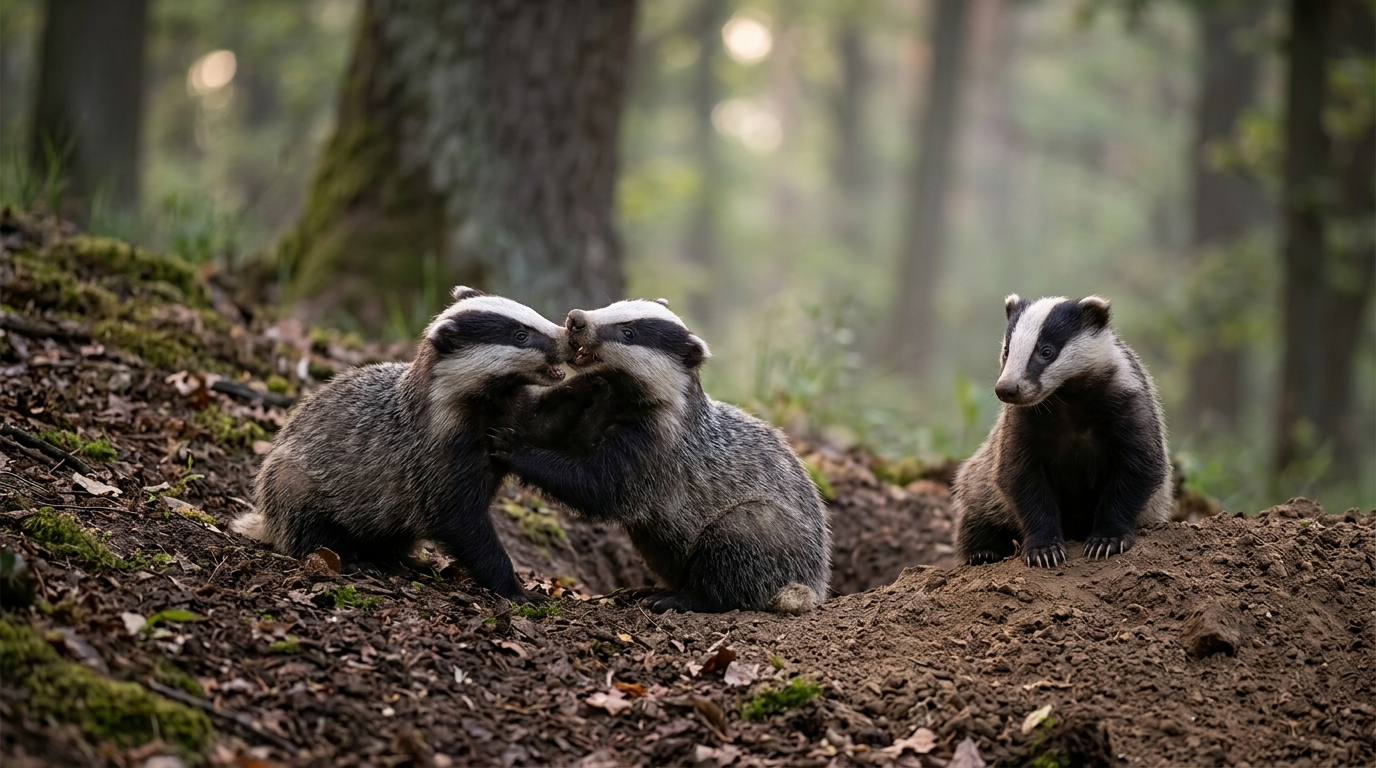
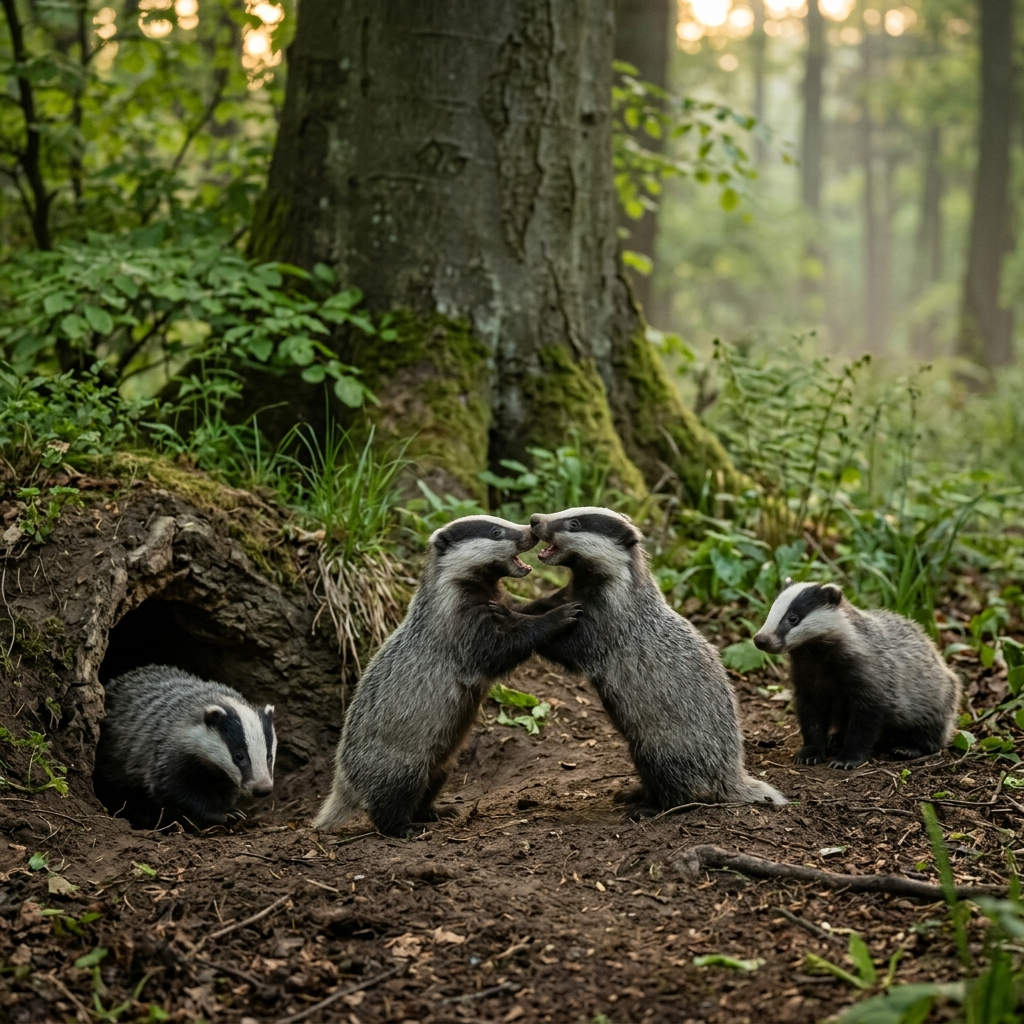
Litters consist of 2–5 cubs (typically 3), born in February–March in a deep chamber of the sett. Newborns weigh 75–135 g, are blind, deaf, with pink bodies covered in sparse greyish down. They open their eyes in the 4th–5th week of life. First emergence from the sett occurs at 8–10 weeks of age, which is the second half of April or May. This is the time of most frequent cub sightings — playing in front of the sett entrance at dusk.

Nursing lasts 12–16 weeks; meanwhile, the mother gradually introduces solid food — brought earthworms, prey fragments, fruit. Young remain with the mother for the first year of life; some daughters remain in the clan even in the second year, forming multi-generational family groups. Males typically disperse in the second year in search of vacant territories. Sexual maturity: 12–15 months. Longevity: 6–8 years in the wild, in exceptional cases up to 14 years (records from telemetry collars).

Why delayed implantation survived evolutionarily

Embryonic diapause costs the female: carrying arrested blastocysts for 7–10 months requires a small but constant metabolic investment. The benefits outweighed it: (1) timing flexibility for mating — a female can mate whenever she is in the active season, even if she became ready for reproduction in late summer; (2) birth synchronization with the optimal season — regardless of when mating occurred, cubs are always born during the warmest period inside the sett and emerge when earthworm availability is at its maximum; (3) possibility of additional mating — a female already pregnant (with an arrested blastocyst) can mate again later in the season, adding further embryos before shared implantation (a phenomenon called superfætation documented in badgers).

Three young badgers in front of a sett entrance in spring — full coloration with white stripes visible, playing with each other
Fig. 03Badger cubs at 10 weeks — first emergence from the sett, full coloration with white stripes visible.
05

Tracks and Signs of Presence

The badger is a master of territory marking — leaving diagnostic tracks, latrines, and paths easier to find than the animal itself.

Direct observation of a badger is difficult — it is a nocturnal, cautious, quiet animal. But its signs of presence are abundant and diagnostic: tracks in the mud, latrines by paths, worn gutters, hair on fences, characteristic rips in the turf. Reading badger territory is a classic art of tracking.

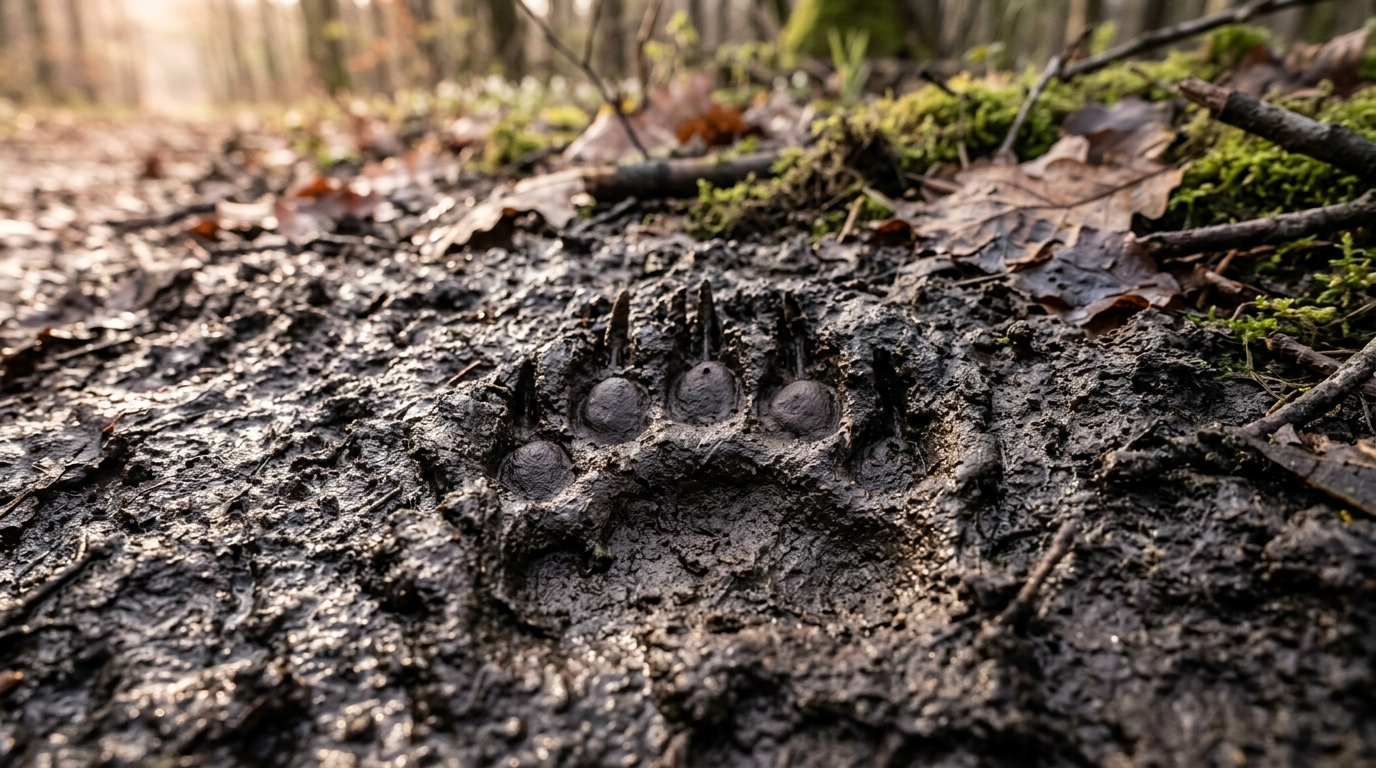
Badger tracks are easily recognizable and do not belong to any other Polish mammal of this size. The print has 5 toes (NOTE — cats and dogs have 4 visible toes), with long claws clearly imprinted in front of the toes, print diameter 5–7 cm. The front paw leaves a wider track with longer claws than the hind paw. Gait pattern at a normal walk: front and hind tracks close together, step length 25–35 cm. When running: a typical mustelid gallop with four prints in a group. Best surfaces for tracks: fresh mud around watering holes, overgrown forest paths, fresh snow, sandy soil on the edges of forest complexes.

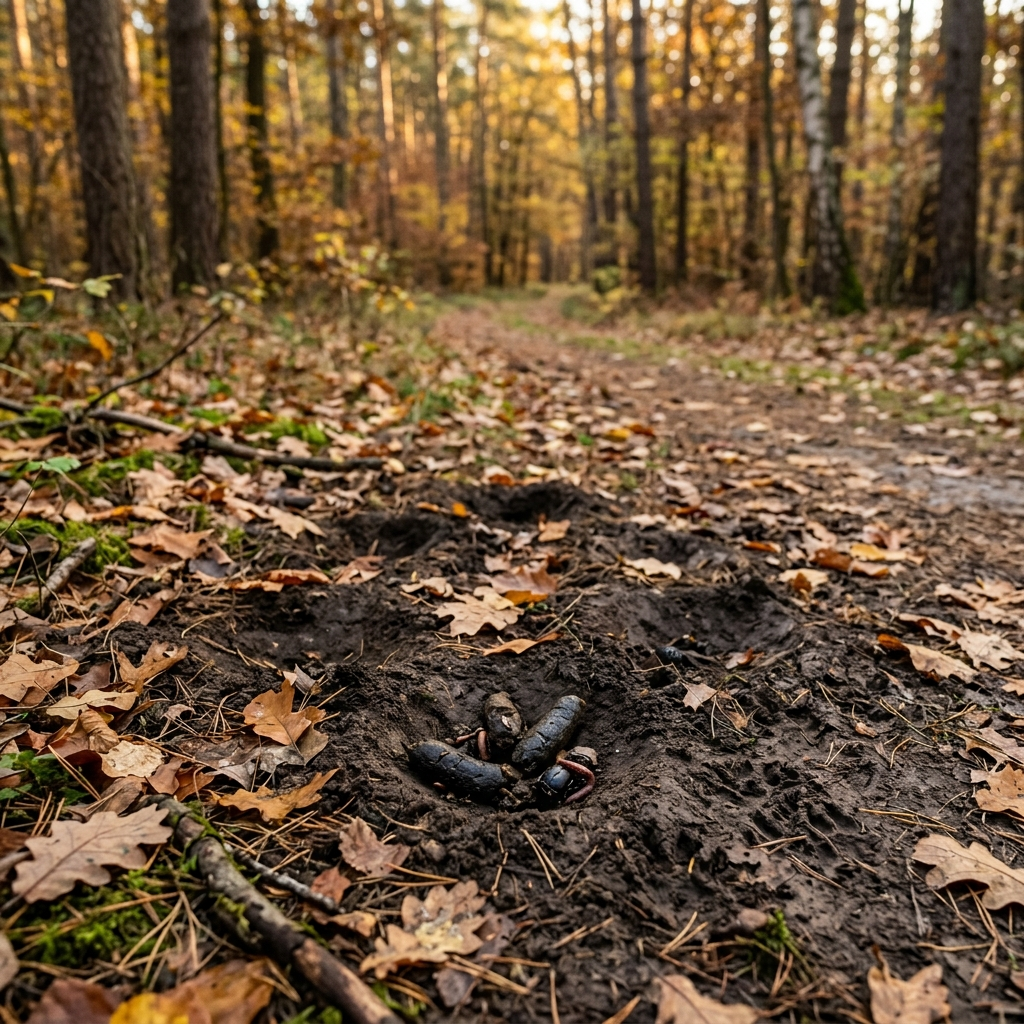
Badger latrines are the most diagnostic sign of presence. The badger does not bury droppings like a cat, but designates special defecation areas — several (5–20) shallow pits located in groups along paths, usually 10–50 m from the main sett entrances or on the borders of the clan's territory. Function is threefold: (1) hygienic — separating waste from the sett; (2) territorial — marking clan borders (intruders "read" latrines); (3) communicative — messages between clan members (who was there, when). Latrine content — cylindrical droppings with remains of undigested earthworm segments, beetle fragments, fruit pits.

Other signs: (1) Worn paths leading from setts — badgers use the same trails for generations; (2) Gutters — channels worn in front of the most used sett entrances (30–40 cm wide); (3) Hair on low fences (up to 30 cm) — stiff, black-and-white hairs from the back left behind when squeezing through; (4) Turf rips — clumps of grass turned upside down, characteristic of foraging for grubs; (5) Clumps of fresh grass in front of sett entrances — old bedding brought out. Voice: the badger is quiet, but during mating season and in clan confrontations, one can hear grumpy "huk-huk", growling, and the high-pitched squealing of cubs.

How to read a badger latrine

A badger latrine is a key element of clan territory management. Practical conclusions for a tracker: (1) an active sett has fresh latrines 10–50 m away — check if they are moist, how many pits, if they contain fresh earthworm remains (characteristic segments); (2) clan territory border — latrines are often located on the line separating two badger clans and can be used by both clans as a "mailbox" — in such places, you will find droppings from different animals next to each other; (3) seasonality — latrines are used intensely during the mating season (II–V), less so in winter; (4) diet diagnosis — dropping content indicates what the badger ate in the last 24h: shiny beetle shell fragments = grubs; pits = fruit season; narrow segments = earthworms after rain.

Badger track in the mud — five toes with clear imprints of long claws, diameter approx. 6 cm
Fig. 04Fresh badger track in mud — diagnostic 5 toes and clear imprints of long claws.
06

Badger and Humans

Most conflicts concern setts under foundations and garden damage — but there are also positive aspects that are easy to overlook.

Badgers and humans have coexisted in the Polish landscape for millennia, but modern conflicts have a specific character: it is not about attacks on people or pets (the badger is harmless), but about infrastructure — foundations, gardens, and crops. On the other hand, badgers perform a range of positive ecological functions that are rarely noticed.

Main sources of conflict: (1) Undermining foundations of barns, garages, and summer houses — badgers choose places with dry earth under floors and dig tunnels, risking settlement of the structure; (2) Damaging gardens and lawns — ripping up turf in search of grubs (the most urban complaints come from estates bordering forests); (3) Corn damage — breaking stalks, in a 50–100 m belt from forest complexes damage can reach 5–15% of the yield; (4) Orchards and fruit gardens — mostly consumption of fallen fruit, rarely direct damage to trees; (5) Road collisions — badgers die on roads, but a collision with a passenger car can damage the chassis and bumper.

Positive ecological functions: (1) Control of field rodents — badgers consume hundreds of voles annually, reducing agricultural pest populations; (2) Control of beetle grubs — in managed forests, badgers limit infestations of grubs that eat the roots of seedlings; (3) Clearing orchards of fallen fruit — removing rotten apples reduces populations of fungal pathogens; (4) Ecosystem engineer — abandoned badger setts are used by foxes, raccoon dogs, wild cats, small mammals, and insects — the badger creates permanent infrastructure for the entire zoocenosis.

Badger and domestic animals: minimal threat. Badgers do not hunt cats or dogs — they are not active predators, and their teeth and claws are adapted for digging, not for killing larger prey. Conflict between dogs and badgers can occur if a dog (especially a dachshund or terrier) enters a sett — then the badger defends itself effectively and can seriously injure the dog. Domestic guard dogs (watchdogs in rural areas) tend to deter badgers rather than attack them. Poultry — a badger may attack a henhouse with an unsealed floor if it has access to eggs and chicks, but this is much rarer than visits by marten or fox.

Badger under the barn — what to do legally

If you discover an active badger sett under your building: (1) do not fill it in, flood it with water, or use toxic smoke — during the closed season (April 1st – August 31st), this is an offense under hunting regulations; at other times, you could be accused of animal cruelty if animals are inside; (2) assess activity — check for fresh tracks, bedding, paths; if active, assess structural risk (cracks, settling); (3) contact the local hunting club — the badger is a game species, and the leaseholder may organize removal or culling outside the closed season; (4) long-term prevention: once the sett is abandoned (winter if the clan moved), bury netting 60 cm into the ground with an outward fold, install drainage under foundations, and ensure foundations have no construction gaps.

07

Legal Status and Hunting

A game species in Poland with a closed season — a management model that differs from the rest of the EU and requires legal precision.

The badger is a game species with a closed season in Poland — a model rarer in the EU than one might think. Most Western European countries (UK, Ireland, Netherlands, Belgium) treat the badger as a partially or fully protected species, while in Poland, it is harvested seasonally as part of hunting management with a limit of 5,000–10,000 individuals per year. Game status does not mean a lack of protection — the closed season protects females during pregnancy, birth, and cub-rearing.

Legal status: game species according to the Regulation of the Minister of the Environment of March 11, 2005, regarding hunting periods for game animals (as amended). Hunting season: September 1st – March 31st (excluding setts, where hunting is additionally regulated). Closed season: April 1st – August 31st — a total ban on hunting, intended to protect pregnant and nursing females and cubs in their first months of life. Seasonal harvest in PL: 5,000–10,000 individuals per year (depending on district hunting plans), not threatening the stable population of 80,000–100,000 individuals.

Harvesting methods regulated by hunting law: stalking, hunting from a high seat, or hunting with a terrier/dachshund (earth dog) are permitted — with many restrictions. Forbidden: filling in setts, using poisons, gas, snares, or non-selective traps. Earth-dogging (norowanie) is most controversial — sparking emotional debates even within the hunting community; some hunting clubs choose not to use this method. Trend: in recent years, support has grown for selective stalking/high seat hunting at the expense of earth-dogging.

Factors affecting the population: (1) Hunting harvest — controlled and monitored, does not threaten the population; (2) Road collisions — significant unintentional mortality, locally important; (3) Diseases — bovine tuberculosis (Mycobacterium bovis) sporadically, of marginal importance in PL; in the UK, it is a key topic of hunting policy (controversial badger cull program as a TB vector); canine distemper incidentally; (4) Habitat loss — fragmentation of forest complexes, but badgers adapt well to the mosaic of the cultural landscape; (5) Rodenticide poisoning through rodent prey — bioaccumulation in the liver, local mortality. IUCN: LC (Least Concern) globally, population stable or increasing in most of its range.

08

What It Might Be Confused With

The stripes on the face are the badger's unmistakable signature — but in the field, it is sometimes confused with a raccoon dog or a young wild boar.

Mistakes in badger identification are rare but characteristic. The most common involve the raccoon dog (both stocky, nocturnal, living in burrows, and both can undermine foundations) and young wild boars (piglets) in low light (both appear as low, dark silhouettes in the undergrowth). Diagnostic key: the pattern on the face.

Badger vs. Raccoon Dog: key difference — face pattern. The badger has white longitudinal stripes running from the nose to the shoulders on a black background. The raccoon dog has a black mask with dark circles around the eyes, like a raccoon, on a white/grey face background — no longitudinal stripes. Silhouette: the badger is much stockier and lower, with thicker legs; the raccoon dog is more proportional, with longer legs and a bushy tail. Fur: badger is grey-silver with a peppery effect; raccoon dog is rusty-grey with black hair tips. Track: badger has 5 toes with clear claws; raccoon dog has 4 visible toes, the track is more dog-like.

Badger vs. Piglet (young wild boar): confusion is possible in the evening in the undergrowth when only the outline is visible. A piglet has characteristic longitudinal light stripes on a dark body background ("melon stripes") — but these are horizontal stripes along the sides of the body, not longitudinal stripes on the face. The badger is lower and stockier; the piglet is proportionally slimmer with a distinct snout. Track: badger has five toes, piglet has a cloven hoof. Acoustics: piglet is loud (grunting, squeaking), badger is quiet. Most common context for confusion: crepuscular activity in mixed forests, both species in local thickets.

FeatureBadgerRaccoon DogPiglet (young wild boar)
Facial patternwhite longitudinal stripesblack mask with eye ringspale snout, no pattern
Body patterngrey-silver, uniformrusty-grey, uniformpale horizontal stripes on sides
Silhouettestocky, low, wedge-shapedcompact, proportionalslimmer, with snout
Weight8–17 (up to 22) kg5–10 kg5–25 kg (depending on age)
Tailshort hairy 11–20 cmbushy, longshort, thin, with tuft
Track5 toes with claws4 toes, dog-likecloven hoof
Acousticsquiet, rare "huk-huk"quiet, sometimes screechingloud grunting
Activitynocturnal-crepuscularnocturnalround-the-clock, peak at dusk
POLAND
2026
— Field correspondence —

One letter from the field, every month.

The latest species profiles, seasonal guides and field observations delivered straight to your inbox. No spam, no clickbait — just solid content once a month.

2,847 readers · 0% spam · unsubscribe with one click