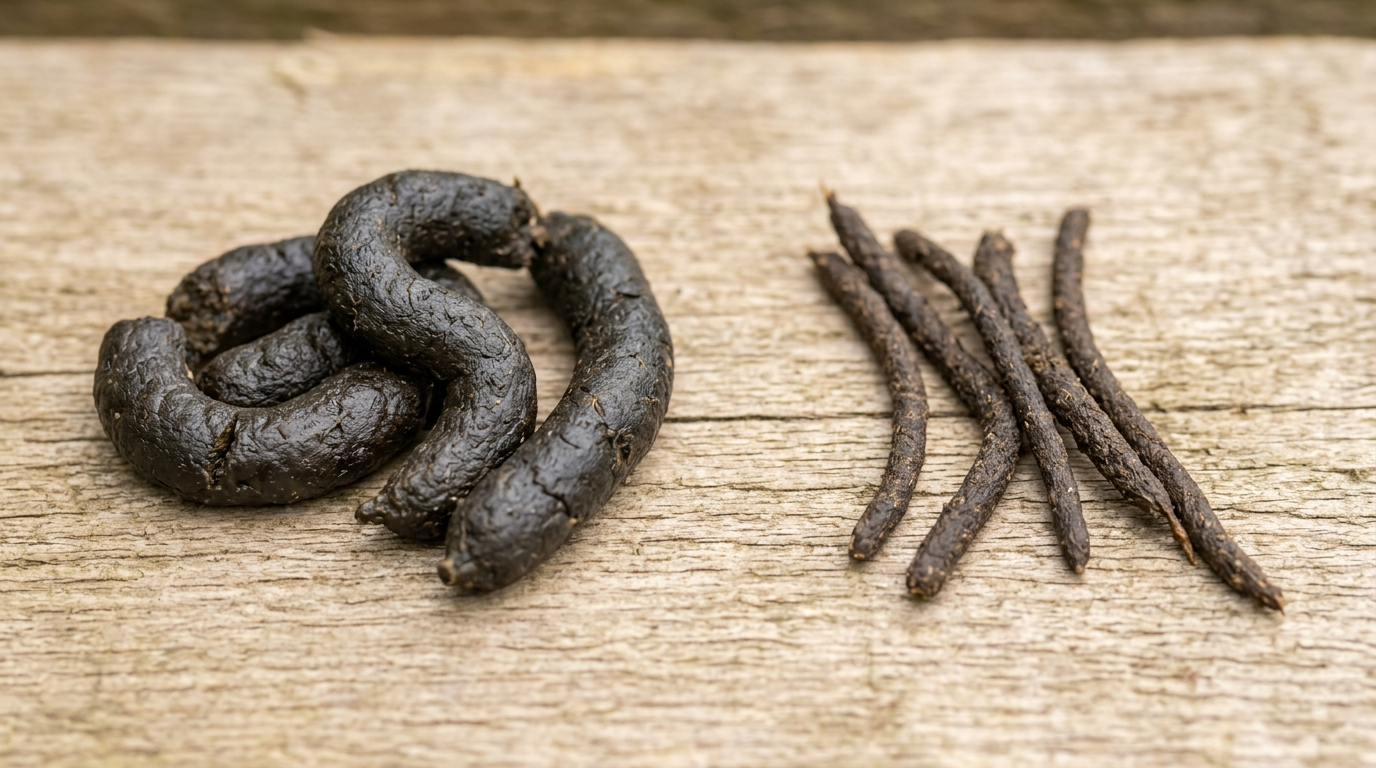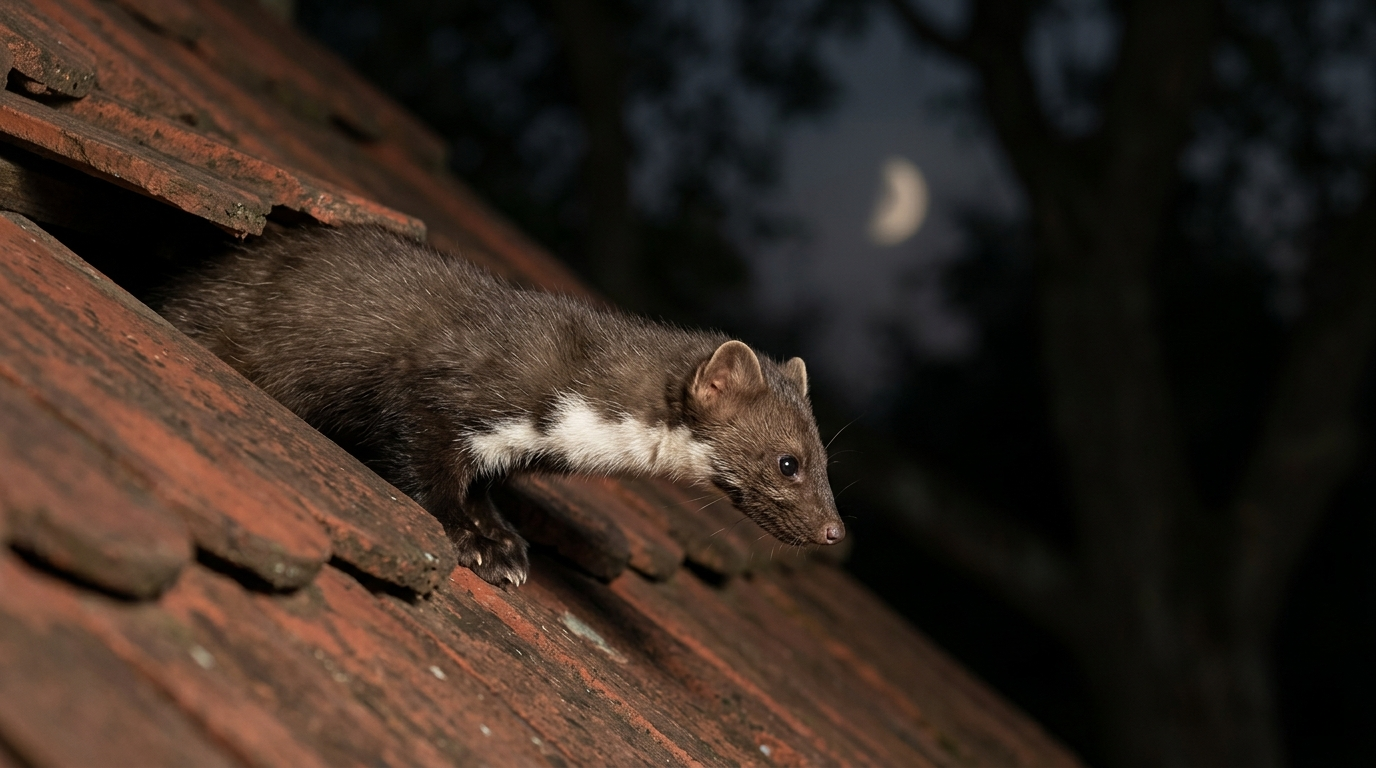
The question does a marten attack a dog returns in the comments under every text about mustelids. It is usually backed by a specific image: a dog waking up the household with barking in the middle of the night, a scuffle behind the barn, a tooth mark on the muzzle in the morning. The short, honest answer is: the stone marten (Martes foina) almost never attacks a dog of its own initiative. The asymmetry of mass, experience, and niche ecology leaves no room for it.
However, situations in which a real encounter occurs are repetitive enough that it is worth describing them specifically — including which dogs are more vulnerable, what injuries are encountered in veterinary clinics, and what to do when a household member finds a blood stain on the fur in the morning. The starting point is the predator's ethology described in the text Stone Marten Habits; then comes clinical specifics and a few practical rules of neighborhood.
§ 01Will a Marten Attack a Dog — Quick Answer
Of its own initiative — almost never. The stone marten is an opportunistic predator weighing 1–2.5 kg, hunting prey many times smaller than itself: rodents, birds, eggs, insects, and seasonally fruit. A dog, even a small one, falls into the category of animals that a marten avoids — not because it is "afraid," but because evolutionarily there is no reason to attack an opponent several times heavier, noisy, and moving in a group with a human.
Telemetry and camera trap observations from Central Europe provide a clear picture in this regard. An encounter between a marten and a dog in the field ends in 95% of cases with the marten escaping into the first available narrow passage — under a joist, onto a roof, into a ventilation hole, or up a tree. The dog stays on the ground, the marten looks down, and both go back to their business. Conflict is not a natural scenario, but an exception to the rule.
It's a different story when a marten is cornered — in a cage, in a garage, in a trap, near a nest with young, or in a state of illness. Then, what always works for mustelids kicks in: determination in self-defense, disproportionate to body size. A marten does not negotiate. It attacks immediately, aims for the head, and does not let go until the attacker retreats.
A dog meets a marten once every few months. A dog fights a marten once every few years, and most often in circumstances where a human unknowingly set the stage: locked the animal in a confined space or allowed the dog near a nest with young.
§ 02Real Asymmetry of Forces — Why the Marten Avoids Conflict
All "marten vs. dog" scenarios begin with one number — body mass. An adult stone marten in Polish conditions weighs 1.2–2.5 kg (males up to 2.5 kg, females up to 1.5 kg). Meanwhile, even the smallest dog like a Yorkshire Terrier weighs 2–3 kg, a medium companion breed (cocker, beagle) — 12–15 kg, a German Shepherd or Labrador — 25–35 kg, and large guard dogs exceed 40 kg. The asymmetry is usually ten to twentyfold.
However, mass alone does not decide everything — three other factors are equally important. First: jaw grip reach. A dog weighing 15 kg has canines with the length and strength to break a marten's spine with the first bite; a marten can at most scratch such a dog on the muzzle. Second: condition in a fight. A dog has significantly larger oxygen reserves — after ten seconds of intense scuffling, a marten begins to lose speed, while the dog is just getting started. Third: social context. A dog is almost never alone — there is a human nearby, a second dog, a flashlight, a shout.
| Dog — Category | Weight | Real Risk from Marten |
|---|---|---|
| Puppy (any breed) | 1–4 kg | high — comparable mass, lack of experience |
| Small breed (Yorkie, Papillon) | 2–6 kg | increased — eye, muzzle injury, infection |
| Medium breed (Cocker, Beagle) | 10–20 kg | low — mainly bite marks, wound infection |
| Large breed (Labrador, Shepherd) | 25–35 kg | minimal — marten escapes, possible abrasions |
| Very large (Mastiff, Guard dogs) | 40+ kg | negligible — marten does not enter contact |
In practice, this means that the larger the dog, the more often it poses a risk to the marten, and not vice-versa. A medium-sized guard dog can kill a surprised marten with one bite to the neck — and it is after such events that questions come to us not about a marten attack, but about whether the dog caught something. The distance in the ecological niche between these species is so large that encounters are usually moments of tension, not combat. We write about the differences between the marten itself and its closest relative in the text Marten vs. Weasel — What's Worth Knowing.
§ 03When an Encounter Actually Occurs
Despite the clear asymmetry and evolutionary tendency to avoid, encounters do happen. In practice, three specific situations recur in which a marten abandons the escape strategy and attacks first — regardless of the opponent's size.
Situation one — a marten caught in a confined space. A garage with the door down, a cellar with the door closed, a live trap, a utility room where a dog enters with its owner in the morning. A marten that has no escape route will switch to aggressive defense in 100% of cases. This is the only scenario in which dog injury statistics become clinically significant — because the marten has the time and reason to aim for vulnerable spots.
Situation two — a female defending her young. In the period from March to July, a female with a nest in the attic, in a woodpile, or in the cellar treats a dog approaching the hiding place as an existential threat. The attack then usually occurs from above (from a beam, a roof, a branch), which additionally gives the marten a momentary advantage — the dog does not expect an opponent from that side and will not have time to react before the first bite. Hence the warning from the text on stone marten habits: during the breeding season, do not bring dogs into the attic or near the nest.
Situation three — a sick, injured, or weakened individual. A marten with rabies (rare, but it happens), a chronic infection, a broken leg, or secondary poisoning by rodenticides behaves atypically: it appears during the day, does not react to noise, and does not escape. A dog meeting such an individual is not meeting a "normal marten" — it is an animal that has lost its ability to assess risk. Any bite from an individual behaving strangely should be treated as potentially life-threatening (see section 05).
A marten caught in a live trap should never be left near a dog or in a room to which a dog has access. A cage with a hissing marten and a curious Shepherd is a scene that in 90% of cases ends in a wound for the dog or a broken cage. Move the trap to a place where no other animal has access to it and handle the relocation according to the procedure from the guide on traps for martens and weasels.
§ 04Which Dogs Are More at Risk
The statistics for marten injuries in Polish veterinary clinics are heavily skewed toward several specific groups of dogs. It is not about the breed per se, but about three overlapping factors: body mass under 6 kg, lack of experience in combat, and physical weakness related to age or illness.
Puppies — regardless of their eventual breed — are in a weight category in the first months of life where a marten can realistically win an encounter. A three-month-old Labrador weighs 8–10 kg, but its bones are soft, reactions slow, and defensive instincts undeveloped. In contact with an adult, defending marten, a puppy can suffer serious face and neck injuries, including the risk of eye damage. This is the most vulnerable group — and the one most often brought in for consultation after a scuffle.
Small companion breeds — Yorkshire Terriers, Miniature Pinschers, Papillons, Chihuahuas, Maltese — at a mass of 2–6 kg, remain in the risk category even as adults. They benefit from experience but lose out on mass. In my consulting practice, I have seen two scenarios: a Yorkshire Terrier let into the garden in the morning meets a nursing marten by the woodpile, or a Papillon runs into a garage where a marten had been locked in overnight. In both cases, the muzzle injury required stitches.
Older and sickly dogs — regardless of breed — are the third high-risk group. A twelve-year-old dog with arthrosis, hearing loss, or reduced reflexes does not make the key evasive move when a marten attacks from above. The first bite usually decides it. This also applies to dogs after surgeries, on steroids, or with weakened immunity.
The safest dog in contact with a marten is a healthy, adult, medium-sized dog, kept on a leash and not awakened in the middle of the night in a garage from which the marten has no way to escape.
For completeness — breeds that encounter martens most often in the field (Fox Terriers, Jagdterriers, Dachshunds) were bred as earth dogs and have a pre-programmed attack reaction toward mustelids. Paradoxically, they are the ones who most often kill martens — and they are the ones who most often end up at the vet after a fight. Not because of size, but because they do not let go.
§ 05Specific Risks After a Bite
From a veterinary point of view, a dog being bitten by a marten differs from being bitten by another dog in several significant ways. First and most important: the marten aims for the head. Small, sharp canines sink into the area of the muzzle, eyes, ears, and neck — areas with a high risk of complications even with shallow wounds.
Three main categories of hazards, in order of probability:
- Bacterial infections — the most common real problem. The marten's mouth contains a wide flora: Pasteurella multocida, Bartonella, streptococci, and anaerobes. A puncture wound from a canine may look innocent 6 hours after the event, and after 24–48 hours turn into a painful subcutaneous abscess. Hence the rule: every marten bite wound requires veterinary consultation within 24 hours, even if it looks minor.
- Eye and muzzle injuries — in defense, a marten jerks its head sideways, canines leaving narrow, deep wounds near the eye, lips, and gums. Risk of corneal damage, eyelid perforation, or tearing of ear cartilage. In puppies and small breeds, such injuries usually require stitches and antibiotic cover. The eyeball itself is rarely affected, but any suspicion requires inspection under a slit lamp.
- Rabies — very rare in Poland, but theoretically possible. The stone marten is not the primary vector (foxes, raccoon dogs, and bats dominate), however, in regions where the latest outbreaks were confirmed within the last 5 years (Masovia, Lublin, Subcarpathia), the risk should not be ignored. A dog regularly vaccinated against rabies is practically protected; an unvaccinated dog after a marten bite should undergo veterinary observation for 15 days and, if in doubt, receive a booster dose.
- Secondary poisoning — rare but real. If the marten was previously poisoned by an anticoagulant rodenticide (ate a poisoned mouse), its blood may contain active metabolites. A wound where a dog had contact with such a marten's blood does not cause poisoning on its own, but in a situation of biting attacked prey, some blood enters the dog's mouth. Alarm signal: bleeding gums, petechiae on the skin, apathy 2–4 days after the event.
Statistically, the most common reason for a visit after a marten encounter is not acute trauma, but a developing abscess within 48–72 hours. A small puncture that the owner did not notice in the evening becomes a painful swelling on the muzzle or neck in the morning. This is the standard picture that can only be avoided by carefully inspecting the fur right after the event — preferably while wet, because a clotted drop of blood in thick undercoat is practically invisible.
§ 06First Aid and Visiting the Veterinarian
What to do immediately after the encounter — before it is even determined if a bite occurred? Three steps, in order:
Step one — remove the dog from the scene. If the marten is still hiding somewhere and the dog returns "to finish it," there is a real risk of a second bite. Put the dog on a leash, take it home, close the door. Do not look for the marten. The marten will handle itself or it won't — this is not a matter to resolve in a panic in the middle of the night with a bitten dog.
Step two — thorough inspection of the dog in good light. Muzzle, eyes, ears, neck, front legs. Part the fur around the head with a slightly damp towel — look for punctures, dried blood, swelling. Rinse any bite mark (even small) with running water or physiological saline, not alcohol or iodine (near eyes!). Acceptable antiseptic: octenidine spray (Octenisept) — safe for both skin and the eye area.
Step three — assessment of whether a veterinarian is needed immediately or the next morning. Immediately, without waiting: wound near the eye, bleeding that does not stop after 5 minutes of pressure, shock (trembling, pale mucous membranes), head injury with lethargy. Within 24 hours on a routine basis: any other bite, even seemingly minor — because an abscess develops only later.
Standard scope of examination after a marten bite: inspection of wounds with a needle to assess depth, surgical cleaning, protective antibiotic (usually amoxicillin with clavulanic acid), check of vaccination status (rabies), tetanus prophylaxis if the wound is dirty. For wounds near the eye — ophthalmological consultation. The cost of a visit with wound treatment is usually 200–500 PLN, with stitches and anesthesia 400–900 PLN.
The dog's vaccination status in this situation has two dimensions. The rabies vaccine is mandatory in Poland from the third month of life and administered every 12 months (some preparations every 24); a dog with an up-to-date vaccination is practically protected. A dog without an up-to-date vaccination after a wild animal bite should be placed under veterinary observation and receive a booster dose. Core vaccines (DHPPi, lepto) do not protect against anything that can be caught from a marten — their role here is indirect, as an indicator of overall immunity status.
§ 07Prevention — How to Avoid Conflicts
Since most encounters result from a few recurring circumstances, prevention 90% boils down to not creating those circumstances. Four rules are enough for the risk to drop to a level where it practically disappears from the dog's balance of threats.
Rule one — the dog does not enter the garage or barn first in the morning. The most common encounter scenario in Poland: the owner opens the garage door at 6:30 AM, the dog runs in first, inside a marten has spent the night looking for a warm shelter. Ten seconds, two bites, a visit to the vet. It is enough to reverse the order: the owner enters first, opens the second door (draft), turns on the light, waits half a minute. The marten escapes. The dog enters an empty room.
Rule two — from March to July, the dog does not enter the attic or near woodpiles. This is the period of nursing young. A nursing female will attack a dog approaching the nest, regardless of its size. If a dog regularly checked the barn and suddenly stopped — or enters but returns with a tensed neck and growls — that is a specific signal that a nest is somewhere there. The marten will move out by August. Until then, avoid the area.
Rule three — the dog does not stay alone in the yard at night between 11:00 PM and 4:00 AM. This is the marten's main window of activity. A dog let out "to run around" before bed hits the middle of a marten's rounds, which, instead of avoiding an area with a dog's scent, enters into direct contact with it — usually on the edge of a roof, a wall, or a branch over the yard. On one hand, it barks for unknown reasons, on the other — it has tooth marks on its muzzle in the morning. Better to take an evening walk on a leash and keep the dog indoors.
Rule four — secure the yard so the marten has less reason to stay there for long. Dog and cat food is not left on the porch overnight. Composters with protein scraps are closed. Holes in foundations, openings in insulation, unsealed ventilation chimneys — handled according to the guide on deterring martens and weasels. Fewer reasons for the marten to visit the area daily = fewer opportunities for a scuffle. It's simple arithmetic.
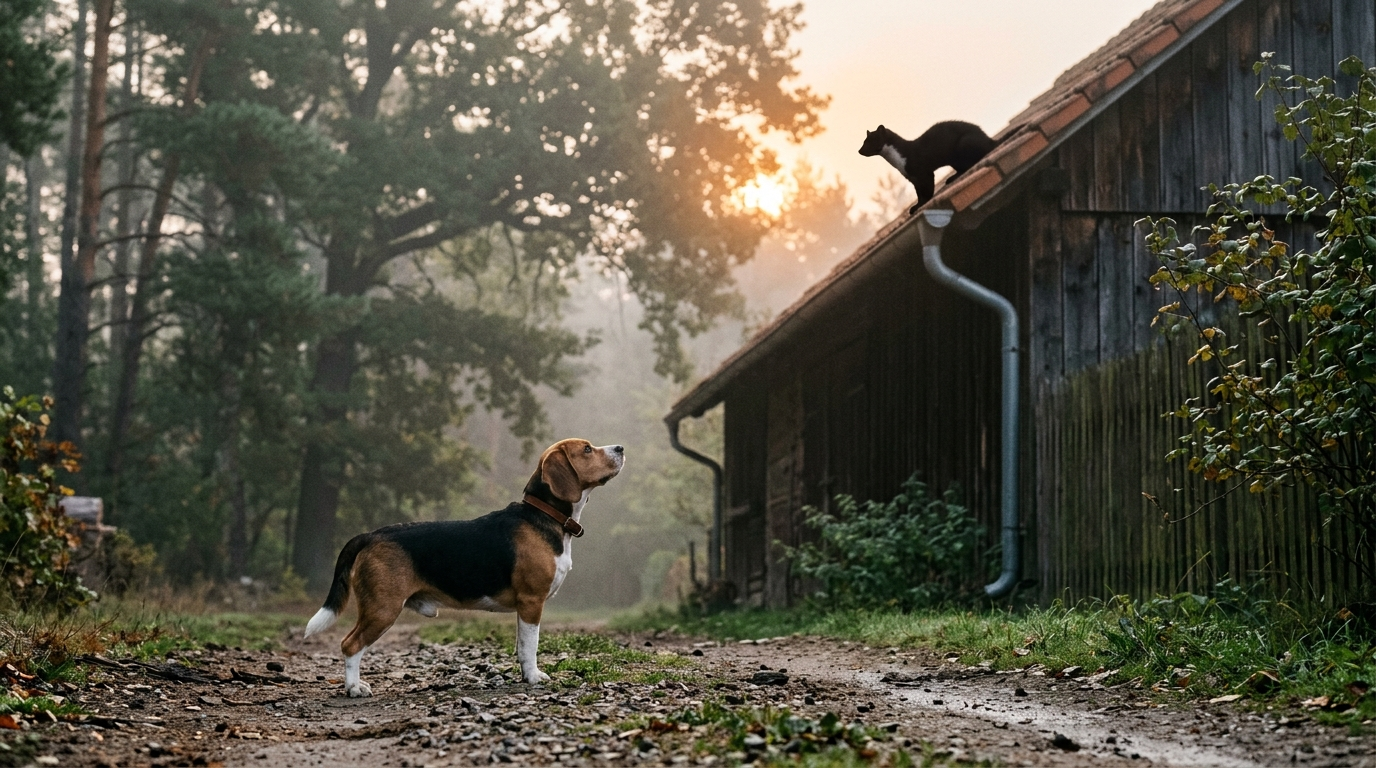
A marten almost never attacks a dog of its own initiative. Real risk appears in a few specific situations: confined space, nest with young, a sick individual, or a puppy/small breed in an accidental encounter. Four rules of neighborhood are enough to ensure that encounters remain the exception rather than the rule. After any bite — visit the vet within 24 hours and check the rabies vaccination status. The rest takes care of itself.
★Frequently asked questions
Can a marten kill a dog?
Practically no — except in extreme situations: a puppy weighing 1–2 kg in a confined space with an adult, defending marten. In adult dogs, even small breeds (Yorkies, Papillons), an encounter with a marten ends in muzzle, eye, and neck injuries, but not death. The asymmetry of mass (marten 1–2.5 kg, dog on average 8–25 kg) and the dog's advantage in aerobic condition mean that a marten in open terrain always chooses to flee. The real danger is not the attack itself, but later complications: bacterial abscess, eye damage, or in extreme cases, rabies (rare in Poland, but possible).
What to do if a marten has bitten a dog?
First — remove the dog from the scene (leash, close the door, do not look for the marten). Second — in good light, inspect the dog's entire head, neck, and front legs for punctures, swelling, and blood in the fur. Rinse every wound with running water or saline; an antiseptic safe near eyes is octenidine (Octenisept). Third — visit the veterinarian within 24 hours, even if the wound looks minor, as an abscess develops only after 24–48 hours. The doctor will assess wound depth, start a protective antibiotic, and check rabies vaccination status.
Can a dog catch rabies from a marten?
Theoretically yes, in practice in Poland very rarely. The stone marten is not the primary vector for rabies (foxes, raccoon dogs, and bats dominate), but recent outbreaks in Masovia, Lublin, and Subcarpathia also included marten individuals. A regularly vaccinated dog (vaccine every 12 months, some every 24) is practically protected. An unvaccinated dog after a wild animal bite should be placed under veterinary observation for 15 days and receive a booster dose if in doubt. Alarm signal: the marten behaved strangely (active during the day, no escape, jaw paralysis).
Which dogs are most at risk of a marten attack?
Three groups: puppies (mass 1–4 kg, soft bones, undeveloped defensive reflexes), small companion breeds (Yorkies, Pinschers, Papillons, Chihuahuas, Maltese — 2–6 kg), and older or sickly dogs (arthrosis, hearing loss, reduced immunity). Medium and large dogs in good condition are practically out of risk — a marten fleeing a Labrador or Shepherd will escape, and if it fails, it will suffer the consequences. A separate group are earth dogs (Jagdterrier, Fox Terrier, Dachshund) — for them, the marten is a natural target, but they usually win and end up at the vet after the fight.
Does the presence of a dog deter martens from the yard?
Partially. A dog present during the day, on a leash, or in the house leaves a scent that a marten easily avoids — but a marten's territory usually spans 40–200 ha, so one yard is a small fragment of terrain that the animal will "pass through" during its nightly rounds anyway. A dog running freely at night can be more effective, but that is precisely when direct encounters most often occur — which is a bad compromise. The best arrangement: the dog sleeps in the house or kennel, its scent is constantly present, and prevention (closed compost, no food on the porch, secured ventilation holes) does the rest.
Is a marten in a garage dangerous for a dog?
Yes — this is the most common scenario for a real encounter. A garage or barn with the door down is a trap with no exit for a marten, where every opponent will be attacked immediately and with full force. The most common sequence of events in Polish households: the owner opens the door at dawn, the dog runs in first, and a marten seeking warmth has spent the night inside. Ten seconds of scuffling and a visit to the vet with stitches on the muzzle. Prevention is simple: the owner enters first, opens a second door (draft), turns on the light, and waits half a minute. The marten escapes, the dog enters an empty garage.