Most readers who come across this text have one question in mind: are those droppings in the attic dangerous and how do I just throw them away. The short answer: they are dangerous enough that you shouldn't treat them like ordinary trash, but the procedure is simple enough that you can handle it in one afternoon. All it takes is the right sequence, personal protection, and the proper disinfectant.
This guide assumes you have already identified the animal. If you're not sure if it's a weasel or a marten, start with the article Weasel vs. marten droppings — key differences, because the size of the droppings and their storage locations differ enough that they can be distinguished without a professional. Below, we focus exclusively on safe removal — from H&S, through cleaning and disinfection, to preventing recurrence.
§ 01Before you start cleaning — Health and Safety
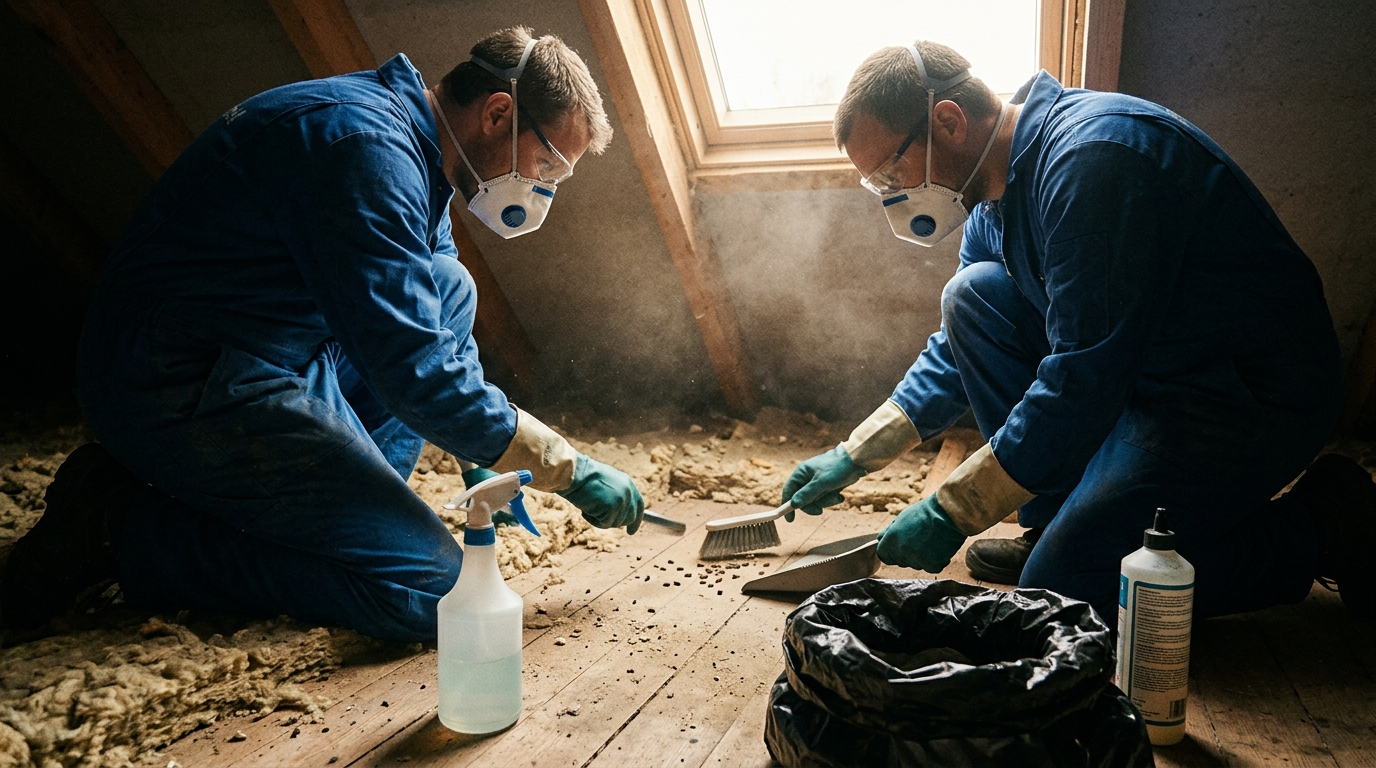
The droppings of the least weasel (Mustela nivalis) are small and look innocent, but they are potentially infectious material. Dry droppings, when disturbed, break into an aerosol of microscopic particles — and that is when you inhale pathogens into your respiratory tract. Therefore, the sequence is always the same: put on protection first, then approach the cluster.
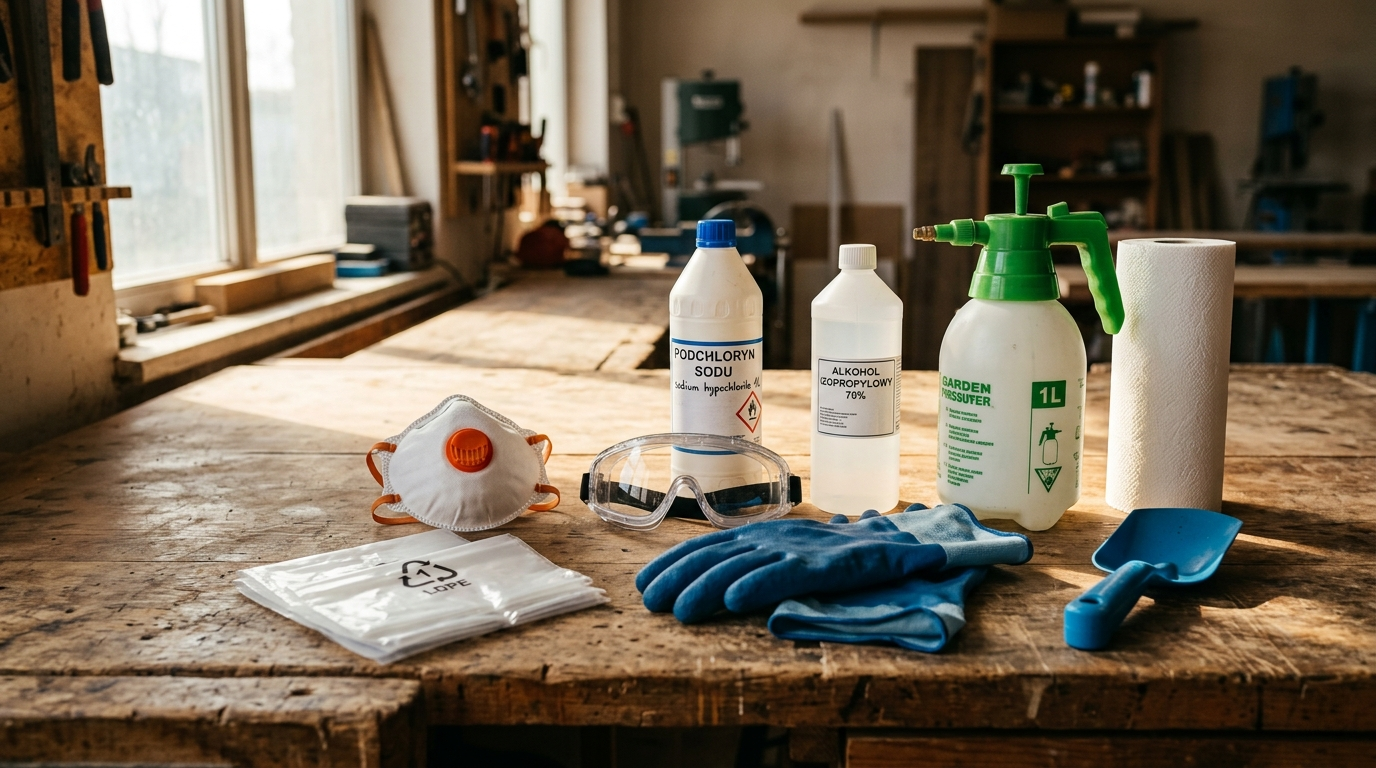
A minimum kit you shouldn't skip:
- FFP2 or FFP3 mask with an exhalation valve — FFP3 is a much more reliable choice here as it stops 99% of particles below 0.6 µm, including tapeworm eggs and bacteria. A simple surgical mask is not enough.
- Thick nitrile gloves (min. 6 mil / 0.15 mm), preferably long ones reaching past the wrist. Latex ones tear on board corners; thin kitchen ones swell from disinfectants.
- Tight protective goggles, not just glasses frames. Aerosol from droppings can hit the eye from a surprising distance — the mucous membrane is a very convenient entry point.
- Work clothes washable at 60 °C — preferably a separate set kept for such tasks, with long sleeves and legs. After work, it goes straight into a bag, then into the washing machine.
- Closed shoes with a smooth sole that can be washed — not wool slippers, not sandals. Sneaker tread is a sponge for particles you won't be able to remove later.
If you have piles of old boxes, papers, or wool in the attic, ventilate the room for 30–60 minutes first with the window open and go downstairs. Air exchange lowers the aerosol concentration by an order of magnitude before you re-enter. It costs nothing and makes the biggest difference.
§ 02Biological hazards — what you really risk
The weasel is a small predator hunting mainly voles and mice, so the food chain it participates in carries several pathogens with it. Most of them are very rare in healthy adults, but they all share one common feature: they are easy to avoid with personal protection, but difficult to treat after the fact.
Four you should know about:
- Echinococcus multilocularis — alveolar hydatid tapeworm. Tapeworm eggs survive in droppings for 6–12 months and are resistant to drying and frost. In humans, they cause hepatic echinococcosis, a chronic and severe disease. The weasel is not a typical definitive host (those are mainly foxes and dogs), but in areas with high prevalence, they have been described as carriers.
- Salmonella spp. — gastrointestinal bacteria. Infection routes: hand-to-mouth after contact with fresh feces, or more rarely, inhalation of aerosol from dry droppings. The result is gastroenterocolitis, which can be severe in children and the elderly.
- Leptospira interrogans — spirochetes transmitted through the urine of rodents and small predators. In practice, urine poses a greater risk, but an environment contaminated with droppings (damp boards, mineral wool) can be an indirect vector. The disease in humans — leptospirosis — ranges from flu-like symptoms to multi-organ failure.
- Toxoplasma gondii — a protozoan whose primary hosts are felids, but mustelids have been described as secondary carriers. Higher risk for pregnant women and immunocompromised individuals.
This guide is not a substitute for medical advice. If you cleaned without protection and within 1–4 weeks fever, abdominal pain, diarrhea, jaundice, flu-like symptoms, or unexplained fatigue appear — immediately consult a doctor and state clearly that you had contact with wild predator droppings. A standard diagnostic panel does not cover this; specific testing must be requested.
Statistics are no reason to panic — in Poland, only individual cases of alveolar echinococcosis and several dozen cases of salmonellosis related to wild animals are recorded annually. On the other hand: the cost of caution is a mask for 12 PLN and gloves for 5 PLN. The balance is obvious. The biological background of the weasel and its diet is described in the text Marten diet — most rules also apply to its smaller cousin.
§ 03Cleaning procedure — step by step
The most common mistake at this stage is using a vacuum cleaner. Dry droppings sucked into the bag break into fine dust, which, along with the exhausted air, returns to the room — often in an even finer, more easily inhalable form. Even a vacuum with a HEPA filter does not provide 100% certainty if the seals are not tight. The rule is: moisten first, then collect manually.
- Step 1 — prepare the workstation. One strong waste bag (LDPE 60 µm, like a standard grey rubble bag), a second — spare. A 1L garden sprayer with water and detergent (e.g., 5 ml of standard dish soap per liter) or a ready-made alcohol-based disinfectant (≥70%). A brush and dustpan, which you will disinfect or throw away afterwards. Paper for thorough surface wiping — preferably kitchen towels.
- Step 2 — moisten each dropping individually. Spray the droppings and surrounding surface from a distance of 20–30 cm, do not splash. Goal: soak the material through so it doesn't crumble or dust when collected. Wait 5–10 minutes for the solution to penetrate. Shorter time = lower disinfection effectiveness.
- Step 3 — collect mechanically. Use the brush and dustpan (or paper towels) to slide the damp droppings into the bag. Work from the edges to the center of the cluster, not vice versa — so you don't smear it over a larger area. Wrap each batch in paper immediately and throw it into the bag.
- Step 4 — wet wipe the surface. Use the same solution to wipe boards, concrete, sheet metal — everything the droppings were lying on, plus a 30 cm margin. Use a fresh paper towel; the one used for collecting goes straight into the bag. Repeat if the surface is porous (wood, raw concrete).
- Step 5 — proper disinfection. After collection, apply the appropriate disinfectant (section 04) and leave it for the contact time specified by the manufacturer — usually 5–15 minutes. Do not wipe dry. Let it evaporate on its own or wipe off excess after the contact time has elapsed.
- Step 6 — seal the bags, remove protection. Tie the waste bag twice, place it in the second bag (double bagging). It goes into mixed waste — not recycling, not compost. Remove gloves last, peeling from the outside in, and put them in the bag too. Remove the mask and goggles only after leaving the room.
- Step 7 — hygiene after work. Wash hands and forearms with soap for at least 30 seconds, twice. Clothes for separate washing at 60 °C with powder. Shower, wash hair. Ventilate the room for another 1–2 hours.
The most dangerous moment of cleaning isn't the contact with feces itself — it's the moment you take off your gloves and accidentally brush your face with a finger. Hand hygiene after work weighs more here than the disinfectant itself.
§ 04Disinfectants — what works and what doesn't
The market is full of "all-purpose" products, but in our context, three things matter: effectiveness against bacteria and parasite eggs, safety for surfaces (wood, concrete, insulation), and availability. Several combinations work, several popular home ones — do not.
| Product | Concentration / Contact time | Effectiveness |
|---|---|---|
| Ethyl / Isopropyl alcohol | ≥70%, 5 min | bacteria, viruses, partially fungi |
| Sodium hypochlorite (bleach) | 0.5% (1:10 from 5% bleach), 10 min | bacteria, viruses, parasite eggs |
| Peracetic acid | 0.2–0.5%, 5–10 min | full spectrum, including Echinococcus |
| Quaternary ammonium compounds (QAC) | per manufacturer, 10 min | bacteria, limited for parasites |
| 10% Vinegar | — | very weak (kitchen myth) |
| Baking soda | — | neutralizes odor, does NOT disinfect |
Vinegar and soda are the most common misunderstandings. Kitchen vinegar (usually 6–10% acetic acid) is weak against vegetative bacteria, and practically useless against parasite eggs and spores. Baking soda absorbs odors and helps mechanically, but it is not a disinfectant in a microbiological sense. Using them instead of a proper product gives a false sense of security.
Three real combinations for the home:
- Wood, concrete, sheet metal — sodium hypochlorite 0.5% (dilution of household bleach like Domestos / ACE 1:10 with water), 10 minutes of contact, then rinse with water. Cheap, available, effective even against tapeworm eggs. Warning: bleaches fabrics, reacts badly with ammonia (toxic fumes).
- Sensitive surfaces (installations, insulation, plastic parts) — 70% isopropyl alcohol, short contact time, evaporates without a trace. Weaker on parasites, but sufficient where there was no direct cluster of feces.
- Surfaces after large clusters — professional product based on peracetic acid (e.g., veterinary / food plant grade), according to instructions. Full spectrum, including Echinococcus. More expensive, but without compromises.
Hypochlorite (bleach) must never be mixed with ammonia (ammonia-based cleaners, some glass cleaners), vinegar, or alcohol. This creates chloramines or chlorine gas — toxic fumes that can send you to the hospital faster than any salmonella.
§ 05Mineral wool and insulation — replace or decontaminate
The most common place to find weasel droppings is mineral wool in the attic — between rafters or on the floor. Wool is porous, absorbent, and full of crevices. There is no point in trying to disinfect it with a sprayer — the product won't penetrate deeper than 1–2 cm, and contamination can reach ten times further.
The practical rule is simple. Local, fresh clusters (up to about 0.5 m² and droppings not older than a few days): simply lift them gently with gloves, place in a bag along with a fragment of the wool, and replace that piece with new material. Spray the rest of the surrounding area within a 30–50 cm radius with disinfectant and leave to dry.
Large clusters, old insulation, urine traces, nests — replace the wool entirely within the contaminated area plus a 1m margin. This is not an exaggeration: urine seeps deeper than visible, and older droppings could contain spores that you simply cannot wash out of porous material. The cost of replacing 5–10 m² of wool (200–400 PLN) is lower than the cost of a single infection.
PUR foam and polystyrene are easier — their surface is smooth, so the disinfectant works without penetrating. Mechanical removal of droppings and surface disinfection is enough here. Glass wool is in the middle of the table — it catches more than foam, but less than mineral wool.
After replacing the insulation, do not lay new wool immediately. Give the sheathing and structure 24–48 hours to dry after disinfection, and give yourself the certainty that you have already sealed the entry point (section 06). Otherwise, you'll be replacing fresh wool again in a month.
§ 06Preventing recurrence — sealing and monitoring
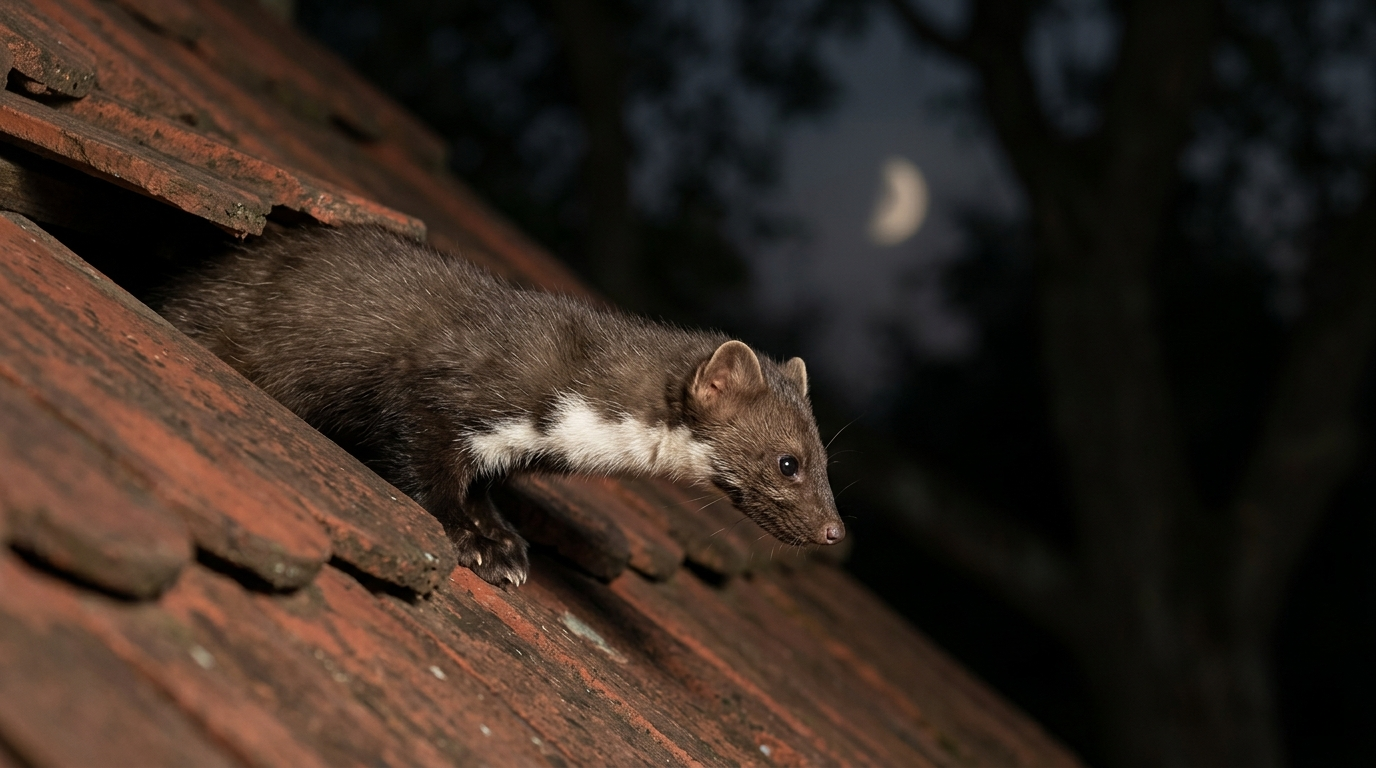
Cleaning up droppings without securing entry points is a job you'll do a second time in a month. The weasel is exceptionally agile: it squeezes through openings smaller than 3 cm, climbs rough walls, and scales vertical downpipes. Protections must be sized for its dimensions, not a marten's.
Critical elements of post-cleaning security:
- Stainless steel mesh with a max. 6 mm opening in all roof vents, soffit vents, and inlets under the eaves. A weasel can pass through a 2.5 cm gap, so a 6 mm mesh is the real minimum, not 2 cm like for martens.
- Sealing gaps under tiles with bird combs, around chimneys with flashing, and at terraces — with grates blocking the space between joists and the ground.
- Monitoring — a patch of flour scattered in a natural walkway, a motion sensor with recording, a simple trail cam. Three weeks without a trace = it has likely moved out. Catch the first recurrence immediately; don't wait.
If you still find fresh traces despite security measures, you're probably leaving something that attracts it: pet food outside, open composters, an unsecured chicken coop, densely overgrown wood piles against the house wall. The full set of deterrents — from ultrasonic to scent-based — is described in our guide on how to effectively deter martens and weasels. This is a supporting solution, but after thorough sealing, it works well enough that the problem usually doesn't return.
§ 07When to call a professional
Most situations can be handled independently — the cost of protection and products is 80–150 PLN, and the work time is 2–4 hours. However, there are cases where delegating the task is simply more sensible.
- Large clusters lingering for months — attic interior full of feces and urine, smell detectable in living quarters, insulation requiring replacement on a scale of several dozen square meters. This requires working in a full protective suit with stronger professional products.
- Decomposing animal in a hard-to-reach place (between a partition wall and the roof sheathing, in a ventilation duct, behind fireplace cladding). A home product won't be enough, and lack of access prevents mechanical removal. Pest control companies (DDD) have the equipment for this scenario.
- Contact of a child, pregnant woman, or immunocompromised person with droppings or contaminated material. Here, in addition to cleaning, medical consultation is needed — and neither of these paths should be delayed.
- Repeated recurrences despite sealing — this often means you missed an entry point. A fresh pair of eyes from someone who does this professionally will find a gap in an hour that you didn't notice in a week.
The cost of a pest control service covering the removal of wild predator droppings and basic disinfection of an attic starts in Poland at around 500 PLN and increases with the area. Full decontamination with insulation replacement — 1500–4000 PLN, depending on the scale. It's a significant amount, but when counted together with the value of time and (rare, but still) the risk of zoonosis, the balance comes out more sensible than it seems at first glance.
FFP3 mask, goggles, nitrile gloves, two bags. Moisten with solution first, then collect — never vacuum. 0.5% hypochlorite or 70% alcohol, 10 minutes contact. Replace wool with large clusters, don't just disinfect it. 6 mm mesh in every gap. Afterwards — shower, wash clothes at 60 °C, ventilate. The full procedure fits into one afternoon.
★Frequently asked questions
Are weasel droppings dangerous to humans?
Yes, they can be carriers of pathogens: Echinococcus multilocularis tapeworm eggs (surviving 6–12 months), Salmonella bacteria, Leptospira spirochetes, and Toxoplasma gondii protozoa. The risk of infection in a healthy adult is low but real — especially when inhaling aerosol from dry droppings. An FFP2/FFP3 mask, gloves, and hand hygiene after work reduce it to a minimum. After contact without protection and the occurrence of symptoms (fever, diarrhea, abdominal pain, jaundice), contact a doctor immediately and report the source of exposure.
Can I vacuum up weasel droppings?
No, that is the worst possible way. Dry droppings sucked into the bag break into microparticles that return to the room with the exhaust air — often in an even finer, more easily inhalable form. Even vacuums with HEPA filters do not provide 100% certainty if the seals are not tight. The only correct sequence: moisten with a solution, wait 5–10 minutes, collect mechanically with a dustpan and paper towels, then disinfect the surface.
Is vinegar enough for disinfection?
No. Kitchen vinegar (6–10% acetic acid) is weak against vegetative bacteria and practically useless against parasite eggs and spores. The same applies to baking soda — it neutralizes odors but is not a disinfectant in a microbiological sense. Effective products include ethyl or isopropyl alcohol ≥70%, sodium hypochlorite 0.5% (bleach diluted 1:10), and peracetic acid-based products. Each requires observing the contact time indicated by the manufacturer — usually 5–15 minutes.
What should I do with mineral wool contaminated with droppings?
Small, fresh clusters (up to about 0.5 m², droppings not older than a few days) — simply lift them with gloves along with a fragment of the wool and replace that piece, then spray the surrounding area with disinfectant. Large clusters, old insulation, urine traces, nests — full replacement within the contaminated field plus a 1m margin. Mineral wool is porous; the product won't penetrate deeper than 1–2 cm, while contamination can reach much further. The replacement cost of 5–10 m² (200–400 PLN) is lower than the risk of a persistent infection source.
How can I secure my home so the weasel doesn't return?
A weasel can squeeze through a gap smaller than 3 cm, so a mesh size of max. 6 mm is crucial (not 2 cm as for martens). Secure all roof vents, soffit grilles, and eave inlets with stainless steel mesh. Seal gaps under tiles with bird combs and use flashing around chimneys. Remove attractants: outdoor pet food, open composters, unsecured chicken coops, wood piles right against the house wall. Three weeks without traces after monitoring = the weasel has moved out.
Is it easy to confuse weasel droppings with marten droppings?
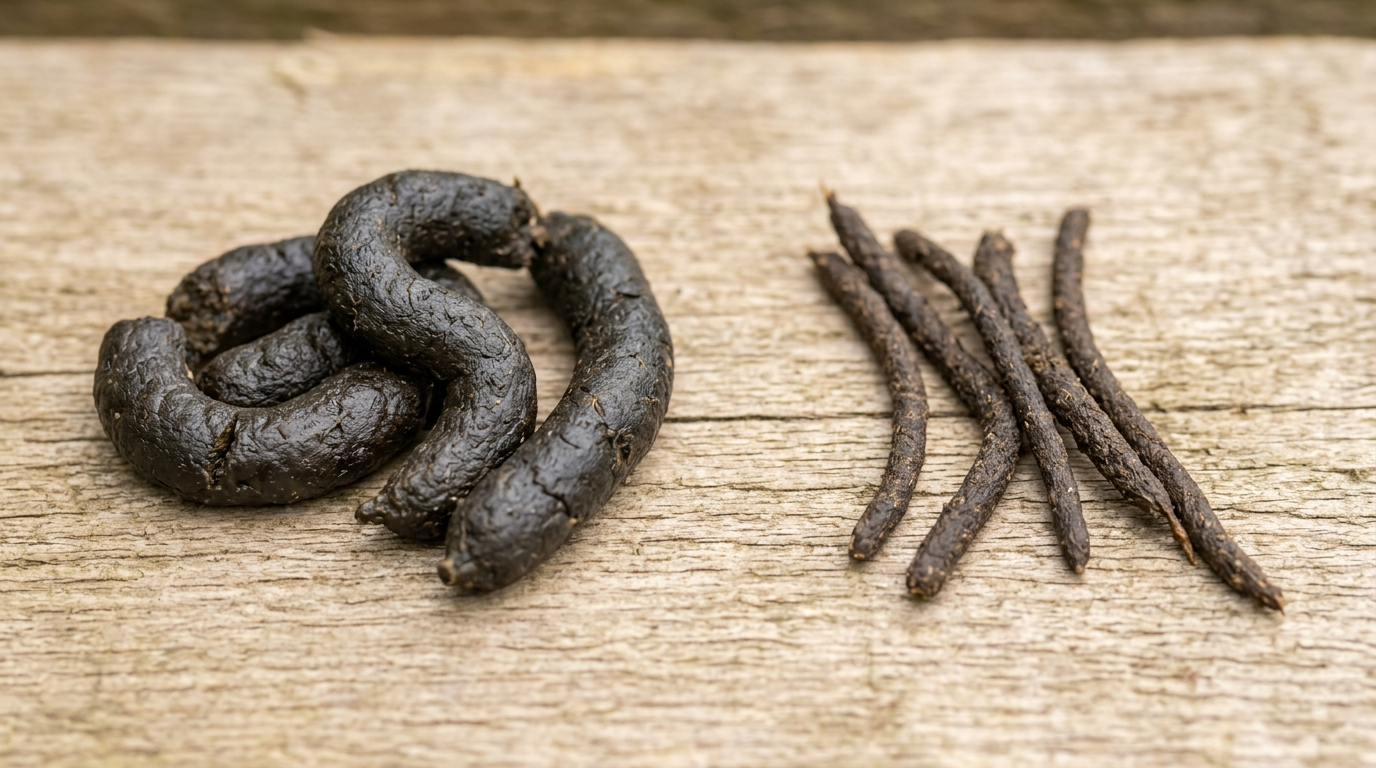
Not if you know what to look for. Weasel droppings are significantly smaller: 3–5 cm long and half a centimeter in diameter, twisted but thin. A stone marten leaves rolls 6–10 cm long and about 1 cm in diameter, which are much bulkier, often with tapering ends and a more distinct musky smell. Weasels mark territory more discreetly and leave smaller amounts at a time. Full comparison with photographs can be found in the guide Weasel vs. marten droppings — key differences.