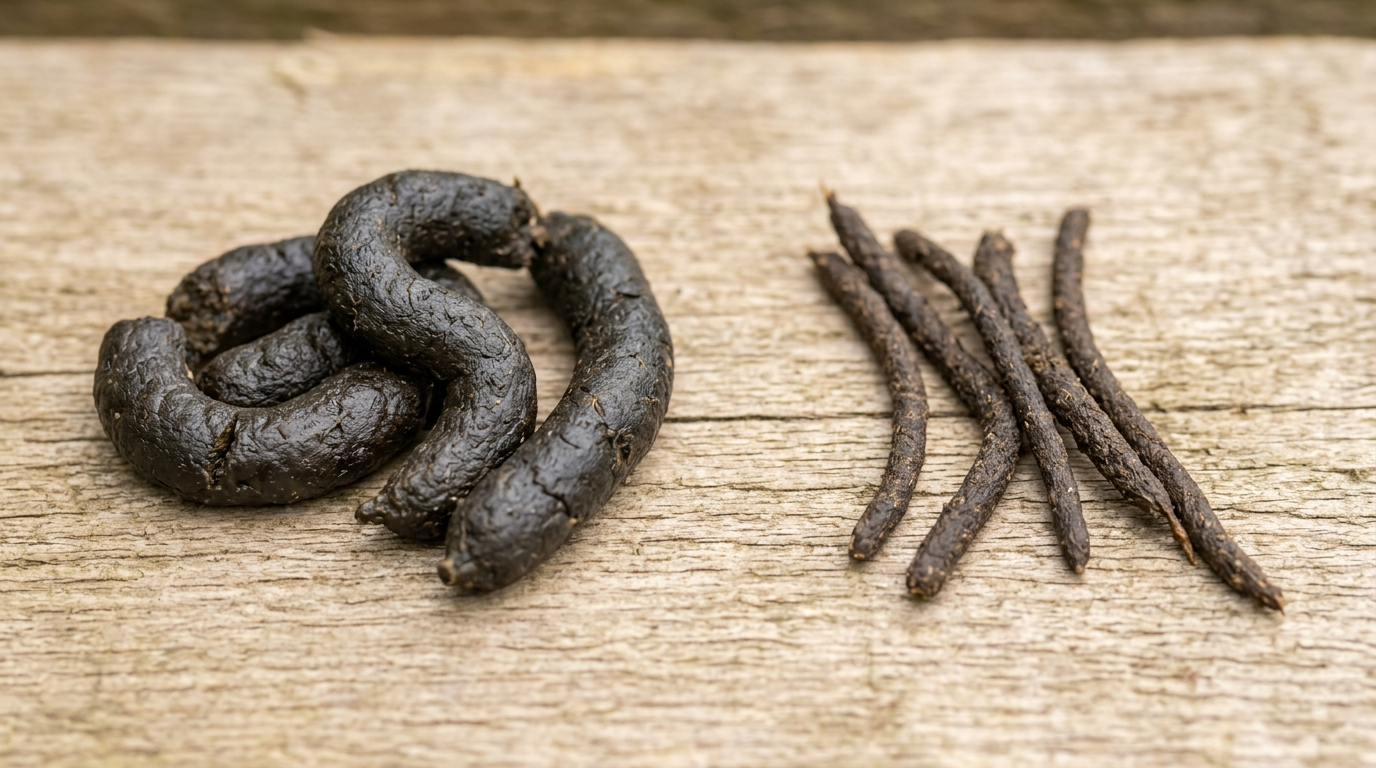
Most mistakes in the field stem from one thing: not looking at the size to scale. From a distance, a cylinder lying on a stump looks the same whether it is three or eight centimeters. Only a ruler or a coin placed next to it shows the difference. And the difference is precisely that one pile means a beech marten in the attic, and the other — a weasel hunting in a wood stack. Two completely different scenarios.
This guide gathers seven features by which you can distinguish beech marten scat (Martes foina) from least weasel scat (Mustela nivalis) in a few seconds. No microscope, no specialized tests — just observation, context, and a simple table at the end. If you are interested in the broader picture of these animals' presence, start with the article How to recognize the presence of a marten or weasel in the garden.
§ 01Weasel vs Marten Scat — A Quick Answer
In the shortest terms possible: martens leave large cylinders 6–10 cm long, while weasels leave small droppings 3–5 cm long. This is a difference you can see immediately without getting within a centimeter. If the pile you are looking at is thicker than a pencil and longer than an index finger — you are dealing with a marten. If it resembles a thin, short string with tiny bones inside — it's a weasel.
The difference in size alone is the key that settles most cases. The rest of the features (shape, color, scent, content, placement) act as confirmation. But beware: young martens leave smaller scat, so it's worth looking at the full set of signals, not just the size.
Before you move anything, take a photo with a coin or a matchstick next to it — it's the simplest reference scale. A matchstick is 4.5 cm, a 2 Euro coin is 2.57 cm in diameter. Without a scale, the photo is useless, and doubts remain forever.
§ 02Shape and Size — First Diagnosis
Marten scat has a characteristic, thick shape. It is a cylinder with a diameter of about 1 cm and a length of 6–10 cm, almost always with twists resembling an "S" or a spiral. The ends are tapered and often curled — the result of the way the marten "squeezes" the scat while rotating its hindquarters. Fresh scat is firm, plastic, and holds its shape well.
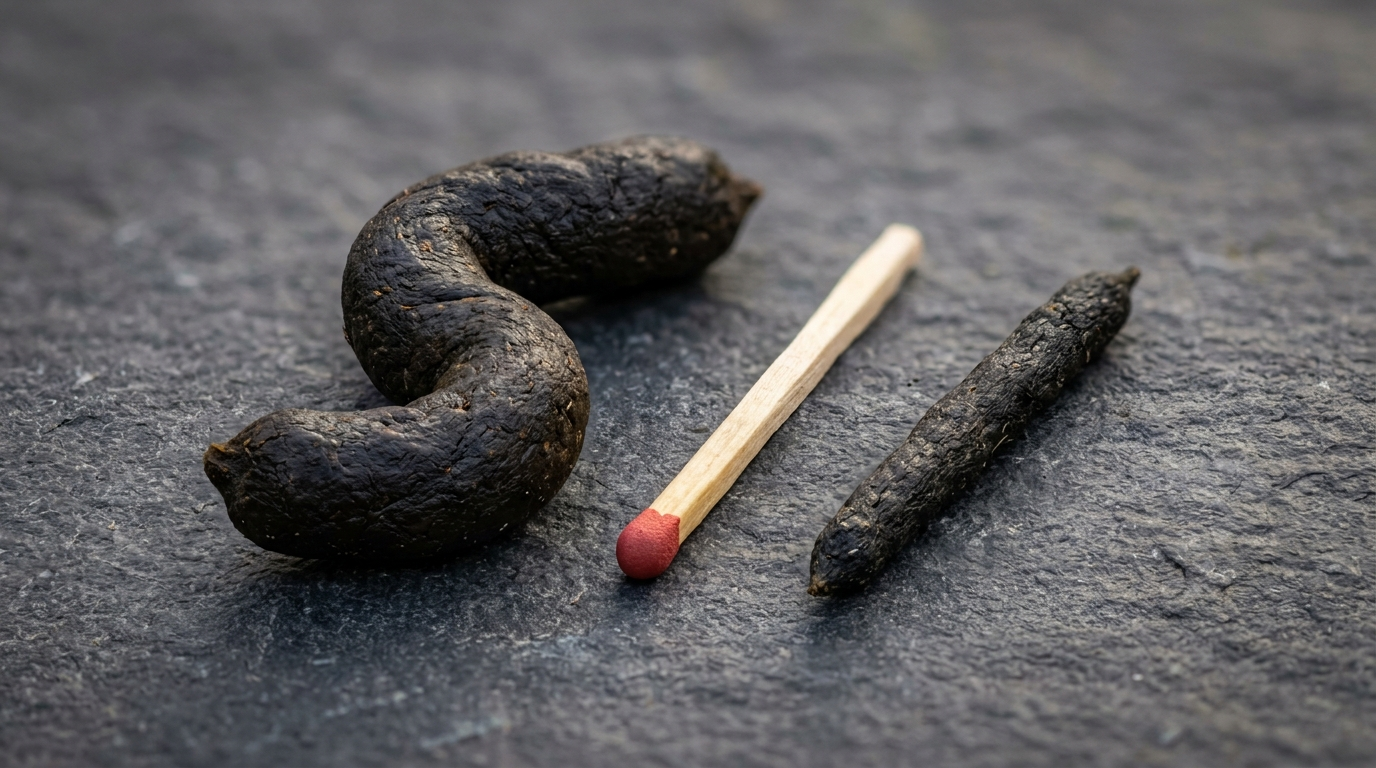
Weasel scat is fundamentally different. It is a thin, short string with a diameter of 0.3–0.5 cm and a length of 3–5 cm, usually straight or slightly curved. Twists are rare — the weasel is small and the scat simply "falls out" in one piece. It looks like a miniature of marten scat, only three times smaller and much more delicate.
This difference in size results from anatomy: a marten weighs 1.1–2.5 kg, while a weasel weighs only 60–200 g. The mass ratio is roughly 10:1, and the scat ratio is 2-3:1. Remember one exception: young marten scat can resemble adult weasel scat in size. Then the location and content decide.
§ 03Color, Texture, Scent
Next are three features you check literally with your eyes and nose. The color of marten scat is dark brown, sometimes almost black, and it glistens when fresh. After two or three days, it becomes matte and starts to gray; after a week, it turns into brittle, dry "pencils" of a gray-beige hue. The texture of fresh scat is plastic, slightly moist, with bone fragments and fur clearly visible.
Weasel scat is dark gray to black, almost always darker than marten scat of the same age. The reason is simple: weasels eat almost exclusively meat, so digested blood and rodent fur dominate the scat. The texture is smoother, the scat dries faster (it is thin), and after just two days, it crumbles when touched with a stick.
A marten smells of musk and sweetness, a weasel — of a pungent, "animal" odor. The nose decides faster than the eye.
Scent is the hardest to describe but often the most decisive signal. Fresh marten scat has a characteristic musky, sweet scent — strong, but not repulsive in the way canine feces smell. This is the result of secretions from the perianal glands. A weasel smells different: more intense, sharper, more "animal", without the musky note. Some observers compare this smell to the scent of a ferret, which makes sense — they are close relatives.
§ 04Content — What You’ll Find Inside
The third level of diagnosis: looking inside. Not very appetizing, but reliable. A stick and a glove are enough — the scat crumbles and shows what the animal ate. This leads to very precise identification because the diets of martens and weasels differ fundamentally.
In marten scat, you will almost always find a mixture of:
- Tiny rodent bones (mice, voles, rats) — fragments of spine, pelvis, small skulls.
- Fur in thick strands, usually gray-brown (rodents), sometimes black (blackbird, jackdaw).
- Fruit seeds — cherries, sour cherries, berries, rowan berries, grapes. This is the marten's signature: only they among our mustelids regularly eat fruit.
- Insect remains — beetle carapaces, fragments of hymenopterans.
- Sometimes egg shell fragments if the marten has recently been in a chicken coop.
A weasel's diet is 90–95% meat. Its scat is dominated by bones and fur of small rodents, essentially only voles and mice. You will practically never see fruit — the only exceptions are accidental grain particles from the stomach of an eaten mouse. Therefore, if you find a cherry pit in a small, thin cylinder — it is not a weasel. It is a young marten.
Fruit seed in scat = definitely a marten (young or adult). Only bones and fur in a small, thin cylinder = very likely a weasel. These are the two most decisive content signals.
§ 05Placement
Here anatomy ends and behavior begins. Martens and weasels behave very differently when "doing their business" because they have different territory marking strategies. Often, just looking at where the pile lies can settle the matter without even examining the scat itself.
A marten marks its territory in exposed, clearly visible places. Most common locations:
- Stumps, tops of walls, concrete edges — deliberately chosen elevations.
- Roof tiles, gutters, ridges — especially above the attic where it lives.
- Car hoods and roofs — martens like parked cars, especially near bushes.
- Stairs, windowsills, terrace boards — literally where it cannot be missed.
- Children's toys left in the garden — skateboards, scooters, inflatable pools.
A weasel does exactly the opposite. It hides its scat close to its paths and hiding spots. You will most often find them:
- In firewood stacks, between logs, in crevices.
- Under stones, in wall cracks, near mouse burrows.
- In compost piles and leaf litter, in shady, damp places.
- In rodent burrows that the weasel occupies after a successful hunt.
- Under piles of hay in barns and unfinished outbuildings.
Rule of thumb: scat demonstratively in the middle of a roof tile = marten. Scat hidden between logs in a woodshed = weasel. This rule resolves 80% of doubts even before measurement.
§ 06Frequency and Quantity
The final layer of diagnosis: how much and how often. A marten leaves 3–5 droppings a day and often groups them in one permanent place — a so-called "latrine". A latrine is a deliberately chosen location (usually the same stump, the same roof tile, the same windowsill) to which the marten returns for weeks. There may be a dozen or so droppings in various stages of freshness in one spot.
A weasel behaves the opposite way. It leaves 1–3 droppings a day, widely scattered in the area at various points along its hunting route. It rarely creates latrines and only in the immediate vicinity of its main hideout. Therefore, if you see a cluster of 5–10 cylinders in one place — it is almost certainly a marten. If there is a single, small trace somewhere on a path — more likely a weasel.
Seasonality also differs. A marten marks territory particularly intensely during the mating season (July–August), and then the number of droppings in the latrine can double. A weasel does not have such a clear peak — it hunts all year round at a more or less constant rate. More about the lifestyle of these animals can be found in the article Marten vs Weasel — What's worth knowing about these mammals.
Fresh scat from both martens and weasels can contain parasite eggs (e.g., roundworms, tapeworms) and pathogenic bacteria. Never touch them with bare hands. Always: nitrile gloves, an FFP2 mask, pour water with chlorine (or another disinfectant) over the scat for 5 minutes before removal, and use a tightly tied trash bag. After work — thorough hand washing and a shower, wash clothes at 60°C.
§ 07Comparison Table
All differences in one place — to print, cut out, and hang in the garage next to the socket wrench. For a full picture of diet and behavior, it's also worth looking at the separate article Marten Diet, where we described in detail what the marten eats in different seasons.
| Feature | Marten Scat Martes foina | Weasel Scat Mustela nivalis |
|---|---|---|
| Length | 6–10 cm | 3–5 cm |
| Diameter | about 1 cm | 0.3–0.5 cm |
| Color (fresh) | dark brown, almost black, shiny | dark gray to black, matte |
| Shape | thick cylinder, "S" type twist | thin, straight or slightly curved |
| Scent | musky, sweetish, distinct | sharp, "animal", no musk |
| Content | bones + fur + fruit seeds + insects | mainly rodent bones and fur |
| Placement | exposed (roof tiles, stumps, cars) | hidden (wood stacks, under stones, burrows) |
| Frequency | 3–5 daily, latrines in a permanent spot | 1–3 daily, scattered |
| Seasonality | peak July–August (mating) | constant throughout the year |
| Legal Protection | game animal, closed season | strict species protection |
★Frequently asked questions
How to distinguish weasel scat from marten scat?
The fastest way is by size: marten scat consists of thick cylinders 6–10 cm long and about 1 cm in diameter, with an "S" type twist. Weasel scat is much smaller — 3–5 cm long and 0.3–0.5 cm in diameter, almost straight. Martens leave them in exposed places (roof tiles, stumps, cars), while weasels hide them (wood stacks, burrows, compost). You will often find fruit seeds in marten scat — almost never in weasel scat.
What does weasel scat look like?
Least weasel scat (Mustela nivalis) consists of thin, short strings 3–5 cm long and 0.3–0.5 cm in diameter, dark gray to black, almost straight or slightly curved. Fresh ones have an intense, sharp, "animal" scent — without the musky note characteristic of martens. Inside you will find mainly tiny rodent bones and fur — the weasel is practically a pure carnivore.
How big is marten scat?
Adult beech marten scat is 6–10 cm long and about 1 cm in diameter. It is a thick cylinder with a characteristic "S" or spiral twist, tapering at the ends. Scat from young individuals is smaller (4–6 cm) and can resemble large weasel scat in size — then the identification is determined by the location (exposed = marten) and content (seeds = marten).
Is weasel scat dangerous to health?
Yes, just like marten scat. Weasels can carry parasites (including nematodes, tapeworms) and pathogenic bacteria, and eggs can survive in their scat for several weeks. Do not touch them with bare hands. Use nitrile gloves and a mask, and it's worth pouring water with chlorine or disinfectant over fresh scat first. After work — thorough hand washing and a shower.
What to do with found scat?
First: don't panic, but don't ignore it. Put on nitrile gloves and a mask, pour water with chlorine (or another disinfectant) over the scat, and wait 5 minutes. Then collect it with a stick into a sealed bag and throw it in the mixed waste bin (not in the compost!). The area where the scat was found should be washed with the same disinfectant solution. If there are many droppings in one place — you are probably dealing with a marten latrine, which is a sign that a permanent resident lives in the attic or garage.
Can you identify the sex of the animal from its scat?
In field conditions — no. The differences between male and female scat are minimal and fall within the natural variation in size. Males tend to be slightly larger, but this is not a diagnostic feature. Sex is determined by observing the animal, urine traces (males mark more abundantly and higher up), or genetic testing — which we are unlikely to do in the garden.