Most people encounter a weasel in the house by chance — a flash of something reddish-brown behind a wardrobe, a tiny patter in the basement, or finding single, tiny droppings near a wall. This is not an animal that makes a loud entrance. The least weasel (Mustela nivalis) is the world's smallest predator, weighing from sixty to two hundred grams, and moves so quietly that it is sometimes called the „shadow of the barn”. If it entered your home — it almost certainly came following mice.
This article answers the four most common questions from owners of old houses, barns, and farms: what a weasel looks like, whether it is dangerous to poultry and humans, whether it's better to leave it alone, and what you absolutely must not do. Along the way, we will also show how to distinguish it from a marten or a rat — because these are three completely different situations requiring completely different decisions. If you are looking for a comparison between a marten and a weasel in the field, start with our guide to signs in the garden.
§ 01Weasel in the House — First Signs
The first sign that you have a weasel in the house is subtle: the sudden disappearance of mice. Where just a week ago you were finding fresh rodent tracks — droppings in the pantry, torn bags of feed, crunching behind the wood paneling at night — it suddenly becomes strangely quiet. This is no coincidence. A weasel can catch a dozen mice in a few days and treats a large basement or barn as its own pantry.
The second signal is sound. A weasel is much quieter than a marten, but not silent. Characteristic is the short, delicate pitter-patter in the basement or in the space between floorboards — more of a rustle than a stomp. Sometimes thin, short squeaks resembling a mosquito can be heard — this is the voice of the young or the female communicating with her litter. The third, least noticed signal is scent: slightly musky, but significantly weaker than in the case of a marten.
A weasel does not walk on the attic ceiling like a marten does. If you hear a distinct gallop above the ceiling — it is almost certainly a stone marten, not a weasel. A weasel sticks to the ground floor, basement, and foundation level, as that is where its main hunting grounds are — rodents.
The fourth signal, the most spectacular, is a face-to-face encounter. The weasel is active at various times of the day — including daylight hours. Sometimes an owner goes down to the basement in the morning for a jar, opens the door, and literally stands face to face with a few-centimeter-long, reddish-brown animal that freezes for a split second before vanishing into a gap only one and a half centimeters wide. This is the moment when most people search the internet for „weasel photos” to make sure what they actually saw.
§ 02What a Weasel Looks Like — A Quick Description
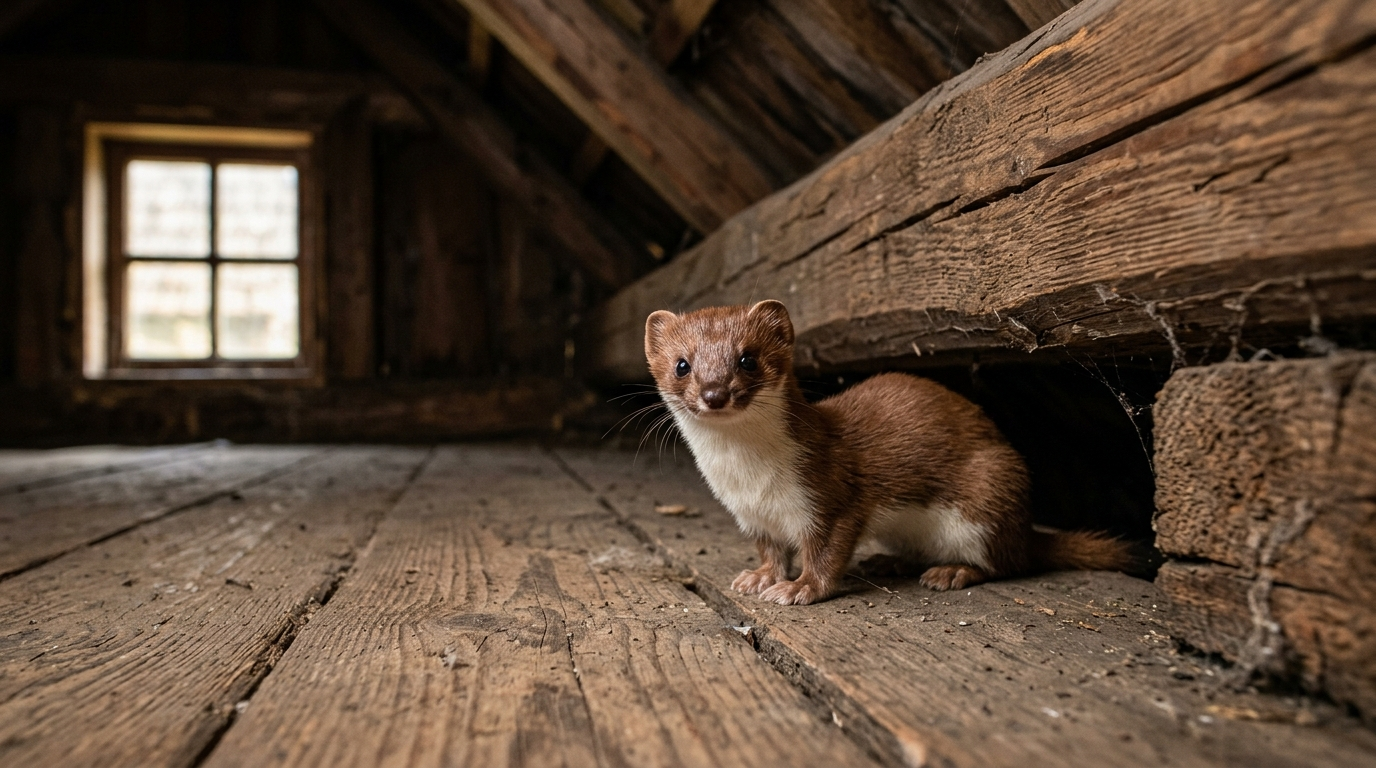
What does a weasel look like? The simplest way to put it is this: imagine an elongated, furry sausage fourteen to twenty-three centimeters long, on very short legs, with a tiny, short tail and large black eyes. In summer, the fur is reddish-brown on the back and distinctly white on the belly, throat, and inner sides of the legs. The border between these colors is sharp, following an irregular line — this is one of the surest identification marks.
In winter, especially in northern and eastern Poland, the weasel may turn completely white — then a layperson often confuses it with an ermine (stoat). The difference is single and simple: an ermine has a black tip on its tail, a weasel never does. A weasel's tail is entirely uniform in color and very short, about one-third of its body length. The least weasel is the species with the smallest mass among mustelids — males weigh up to two hundred grams, females often below one hundred grams.

Up close, the head structure is notable: small, wedge-shaped, with a short snout, tiny rounded ears, and disproportionately large, black, shiny eyes. The entire silhouette is so narrow and flexible that a weasel easily squeezes through openings only one and a half to two centimeters wide — the diameter of a small coin. This is why it cannot be effectively „bricked in” — instead, one should look for a way to make it lose the reason it came in the first place.
§ 03What a Weasel Does in the House — Its Goals
It's worth remembering one thing: a weasel doesn't come to a house „for the house”. It comes for the food. Its diet consists ninety percent of small rodents — house mice, field mice, voles, sometimes young rats. If a weasel has appeared on your farm, it means you have a mouse problem that you might not have even fully noticed. The weasel sensed it first.
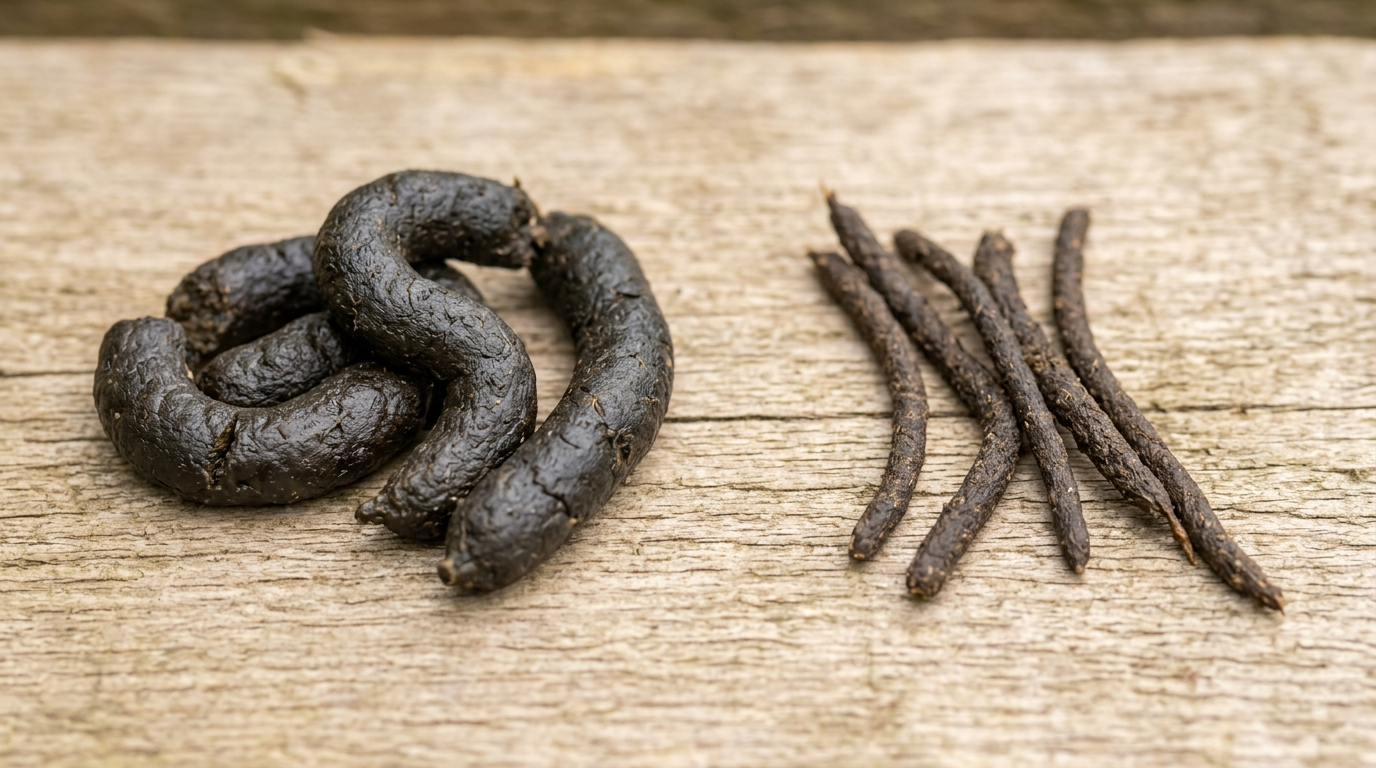
Importantly: a weasel does not harm the house structure. It does not gnaw through beams, it doesn't pull out attic insulation like a marten, and it doesn't build large nests out of rags and chaff. It uses ready-made hiding spots — gaps in foundations, spaces under floor joists, piles of firewood, abandoned rodent burrows. If it leaves a trace, it is most often tiny, dark, twisted droppings about three to five centimeters long, half a centimeter in diameter — with remnants of fur and mouse bones inside.
A weasel is not a guest who destroys. It is a guest who ate the pests and moved on. The problem usually isn't with the weasel — it's with what brought it here.
A weasel in a house rarely stays permanently. It is an animal with a large range (several to a dozen hectares for females, more for males) and a wandering nature. When the local rodent population disappears — it often disappears too, within a few weeks. A practical tip: before you do anything, count how long you've had it. If it's been two or three weeks — it might already be halfway to a neighboring habitat.
§ 04Is a Weasel Dangerous — Chickens, Poultry, Children
Does a weasel kill chickens? Yes — it can, although it does so much less frequently than a marten and much less often than popular stories suggest. The least weasel, as a animal weighing only a few dozen grams, is unable to defeat an adult, healthy chicken in an open fight. It can, however: kill chicks, young nestlings, and quail, drink eggs, and occasionally kill an adult chicken sleeping on a roost — by biting the back of the skull.
Yes, when this happens, it does so in a way that leaves an impression. The weasel, like other mustelids, has an overkill instinct — in a confined, panicking group of animals, it may kill significantly more than it can eat. Hence the dramatic descriptions of „a weasel wiped out the whole coop in one night.” This is true, though rare — and almost always avoidable.
- Mesh with openings under two centimeters — regular garden fencing is not enough. A weasel will squeeze through a three-centimeter opening without effort.
- Solid floor in the coop or mesh under the bedding — weasels often enter through unprotected burrows and rodent holes under walls.
- Doors and flaps closed at night — weasels are active at dusk and night; an open coop is an invitation.
- No rodents nearby — a tidy, clean coop without leftover feed is less attractive to both mice and their hunter.
Towards humans, the weasel is distinctly withdrawn. It does not attack people — even when surprised, it flees. The only situations where bites are recorded are grabbing the animal with bare hands (usually by children trying to „help”) or cornering a female with young in a dead end. In both cases, the fault lies with the human, not the animal. For small children and pets larger than a cat, the weasel does not pose a real threat.
A weasel can carry parasites (including nematodes and tapeworms) and, occasionally, rabies. Never catch it with bare hands and do not let children near it. If the animal behaves strangely — walking in circles, being apathetic, not reacting to stimuli — call the district veterinarian.
§ 05Whether to Leave or Remove It
This question has one clear legal answer in Poland. The least weasel is under strict species protection — by decree of the Minister of the Environment. It is forbidden to kill, capture, maim, disturb it during the breeding season, or destroy its shelters. The fine for killing a protected animal can reach five thousand zlotys, and in some cases, it qualifies as a crime.
Leaving the law aside — from a purely practical point of view, it's worth leaving it. A weasel in the house is the cheapest, quietest, and most effective way to get rid of mice imaginable. It works for free, uses no poison, leaves no traces behind except tiny droppings in a corner — and disappears on its own when the rodents are gone. From the perspective of an old house owner, it is the ideal neighbor.
What should you do if you still want it to move out? Three gentle methods, in order:
- Remove the food source — tidy up the pantry, feed, and grain in the barn. Without mice, the weasel will leave on its own within one to two weeks.
- Introduce „discomfort” — light, radio, movement in the basement. Weasels dislike frequent human presence and noise; they prefer a quiet hiding spot elsewhere.
- Secure openings after it leaves — gaps in foundations, ungrated ventilation holes, holes under the threshold. Stainless steel mesh with a one-and-a-half-centimeter opening is sufficient.
- Never lock the animal inside — first make sure it has left (for example, by sprinkling flour at the entrance and observing tracks for two or three nights).
The most common mistake is sealing all openings „just in case” while the animal is still inside. A weasel trapped in a basement without an exit will try every gap, every corner — and may die of hunger or panic. First observation, then securing.
§ 06What You Must Absolutely Not Do
A short list of things that must not be done under any circumstances — for legal, ethical, and purely practical reasons. Each of the following points ends every year with a fine, a court case, or an injured animal in the house that no one knows what to do with.
- Lethal traps (snap, grip, or bow traps) — these are illegal for a strictly protected species. Additionally, they often catch animals other than the target (house cats, hedgehogs).
- Rodent poison left „for the weasel” — the weasel eats the poisoned mice and dies of secondary poisoning. This is an indirect but real way of killing a protected species.
- Catching with bare hands — the animal defends itself with a bite as sharp as a needle. The risk of bacterial infection is high; the risk of rabies is low but non-zero.
- Live traps without permits — capturing a strictly protected species (even for the purpose of „releasing”) requires permission from the Regional Directorate for Environmental Protection. Without it — it's a misdemeanor.
- Feeding — despite good intentions, taming a wild predator ends badly for it. A weasel tamed to humans starts approaching farms where it might meet someone with worse intentions.
If the situation overwhelms you — the animal is injured, stuck in a mouse trap, or got into an apartment in a building — do not try to solve it yourself. Call the Regional Directorate for Environmental Protection, the nearest wild animal rehabilitation center, or the municipal police. These are institutions that do this every day and do it safely — for both the animal and you.
§ 07Weasel vs Other Animals in the House
The final section — a quick comparison with two other guests that the weasel is sometimes confused with in domestic settings: the stone marten and the brown rat. Three completely different animals, three different situations, three different reactions. A full comparison of the marten and the weasel can be found in the article Marten vs Weasel — What's Worth Knowing About These Mammals.
| Feature | Least Weasel Mustela nivalis | Stone Marten Martes foina | Brown Rat Rattus norvegicus |
|---|---|---|---|
| Body length | 14–23 cm | 42–48 cm | 20–28 cm (+ tail) |
| Mass | 60–200 g | 1.1–2.5 kg | 200–500 g |
| Coloration | reddish-brown + white belly | brown + white bib | grayish-brown, uniform |
| Tail | short, uniform | long, fluffy | long, hairless, scaly |
| Typical location | basement, foundation, barn | attic, chimney, garage | sewers, trash, basement |
| Voice | thin squeaks, rustle | gallop, scratching, screams | squeaking, gnawing wood |
| Damage | none (hunts mice) | insulation, cables, poultry | cables, bags, window frames |
| Legal protection | strict protection | game species, closed season | sanitary pest |
| Reaction to humans | flees, withdraws | flees, sometimes freezes | flees or attacks if cornered |
The most common mistakes: a weasel turning white in winter taken for an ermine (difference — black tip on the ermine's tail), a young marten taken for a weasel (a marten has a distinct white bib on its chest, whereas a weasel has an entirely white belly), a rat taken for a weasel (a rat has a long, hairless tail and is distinctly heavier). If you saw something reddish-brown with a white belly and a short tail in the basement or barn — it is almost certainly a weasel. And probably the best thing that has happened to you lately in the fight against mice.
Small, reddish-brown, with a white belly, short tail without a black tip, weighing a few dozen grams, in the basement or barn, disappearing mice, no structural damage — that is a least weasel. Under strict protection. The best decision: leave it alone, clean up after it wearing gloves, and secure openings only after it has left.
★Frequently asked questions
What does a weasel look like?
The least weasel is a small, elongated animal fourteen to twenty-three centimeters long, weighing from sixty to two hundred grams. In summer, it has a reddish-brown back and a distinct white belly, throat, and inner sides of the legs. The tail is short (about one-third of the body length), uniformly colored, without a black tip at the end — this distinguishes it from the ermine. The head is small and wedge-shaped, with large black eyes. In winter, especially in northern Poland, the weasel may turn completely white.
Does a weasel kill chickens?
Yes, although less frequently than a marten and almost always only when the coop is poorly secured. A weasel cannot defeat an adult, healthy chicken in an open fight, but it can kill chicks, nestlings, quail, and drink eggs. Occasionally, it kills adult chickens sleeping on a roost. Unfortunately, like other mustelids, it has an overkill instinct — in a panicking coop, it can kill significantly more than it can eat. Effective protection: mesh with openings under two centimeters, floor secured against burrowing, and doors closed at night.
Is the weasel protected?
Yes. The least weasel (Mustela nivalis) is under strict species protection in Poland by decree of the Minister of the Environment. It is forbidden to kill, capture, maim, disturb it during the breeding season, or destroy its shelters. The fine for killing a protected animal can reach up to five thousand zlotys, and in some cases, it qualifies as a crime. Even a live trap for a weasel requires permission from the Regional Directorate for Environmental Protection.
How to tell a weasel from a marten in the house?
Three quick differences. Size: a weasel weighs a few dozen to two hundred grams, whereas a marten weighs from one to two and a half kilograms. Belly coloration: a weasel has an entirely white belly, while a marten has a white bib on its chest that is split and reaches the front legs. Location: a weasel stays in the basement, foundations, barn, and ground level (hunting mice), while a marten prefers the attic and the space under the roof (building nests). If you hear a gallop above the ceiling — it's a marten. If you hear tiny steps in the basement and see disappearing mice — it's a weasel. More in the guide signs in the garden.
Can a weasel bite a human?
Yes, but only in an ultimate situation — when caught with bare hands or cornered in a dead end. Under normal circumstances, a weasel flees from humans, even when surprised. Its bite is sharp and deep (predator's teeth), and the risk of bacterial infection is real, so any wound from contact with a wild animal should be shown to a doctor immediately. The risk of rabies in Poland is low but non-zero — the decision on post-exposure vaccination is made by a doctor.
Is a weasel an animal suitable for taming?
No. The weasel is a wild, predatory, and territorial animal — it is not a domesticated species. Attempts at taming usually end in stress for the animal, bites for the caretaker, and — most importantly — breaking the law, as keeping a protected species in captivity requires a permit from the Regional Directorate for Environmental Protection and appropriate conditions. The best form of contact with a weasel is observation from a distance, or in the case of an injured animal — contacting a wild animal rehabilitation center.