Most conversations about the marten and weasel start with the question „how to get rid of them". This is understandable when a marten has torn apart chickens or chewed through a car cable. But if we take a step back and look at these two mesopredators (middle-order predators) from the perspective of the entire ecosystem, the picture becomes completely different — and much more interesting. These are animals without which fields, forests, and village outskirts simply do not function as they should.
The stone marten (Martes foina) and the least weasel (Mustela nivalis) are two of the most undervalued pillars of rodent population regulation in Poland. This field journal gathers what we know about their role in nature from scientific research — and shows why in 95% of cases it is worth tolerating rather than fighting them. We start with the place they occupy in the food chain.
§ 01Mid-order Predators — Who They Are in the Food Chain
Ecologists use a special term for this: mesopredators, meaning middle-order predators. These are animals that hunt themselves but are also prey for apex predators. The marten and weasel sit exactly in the middle of the pyramid: above them are the fox, lynx, northern goshawk, and Eurasian eagle-owl; below them are field rodents, shrews, small birds, insects, and young hares.
What does this mean in practice? Mesopredators are the shock absorber of the entire system. When there is a lack of predators from above (e.g., the fox has a bad year), the marten and weasel populations increase and put more pressure on rodents. When rodents are exceptionally numerous — weasels start to reproduce faster and balance the equilibrium in 1-2 seasons. It is a buffer that stabilizes the numbers of everything living in the field and at the forest edge.
A mesopredator is a medium-sized predator that occupies an intermediate position in the food chain. In Polish realities, these are primarily mustelids: European pine marten, stone marten, least weasel, stoat, polecat, and badger.
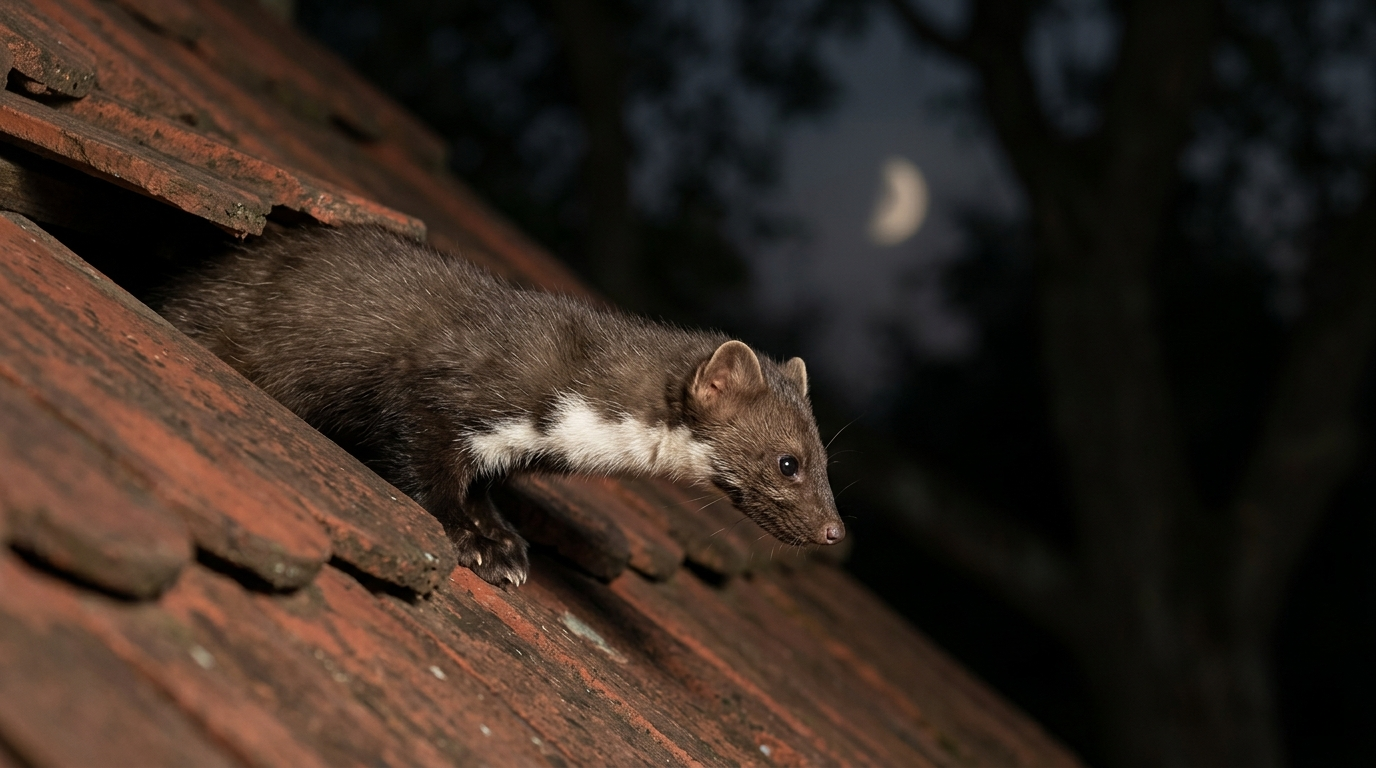
What is a marten and what is a weasel from a zoological point of view? Both species belong to the mustelid family (Mustelidae). The least weasel is the world's smallest predator — the male weighs 100-200 g, the female only 60-90 g. The stone marten is a much larger animal, 1.1-2.5 kg, agile, a good swimmer, and climber. Despite the weight difference, they perform a similar ecological function — though the weasel specializes in one thing, while the marten is a typical opportunist. More on that in a moment.
§ 02What They Eat — Rodent Population Controllers
This is the core of why both species are so important. The questions „what does a stone marten eat" and „what do weasels eat" have very specific answers, well-documented in Polish and German diet studies. Let's start with the weasel — because here the matter is most spectacular.
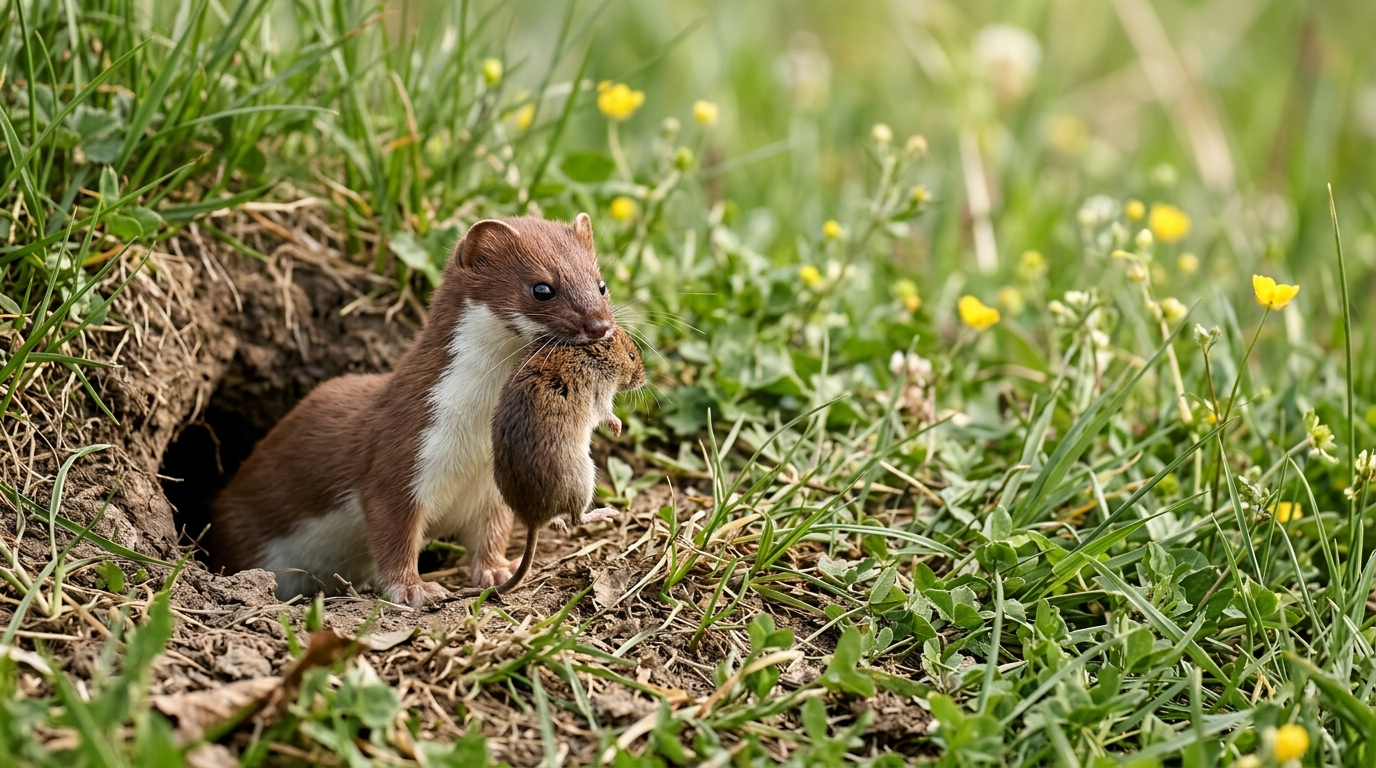
The least weasel is a specialized hunter of voles. In its diet, common voles, pine voles, and mice constitute 70-95% of the prey biomass, depending on the season and region. A weasel is small enough to enter a vole's burrow and hunt it in its own home — something no other predator of this size can do. Scientific estimates say that one weasel eliminates between 2,000 and 3,000 small rodents per year. For scale: a single pair of common voles can produce 30-50 offspring in one season.
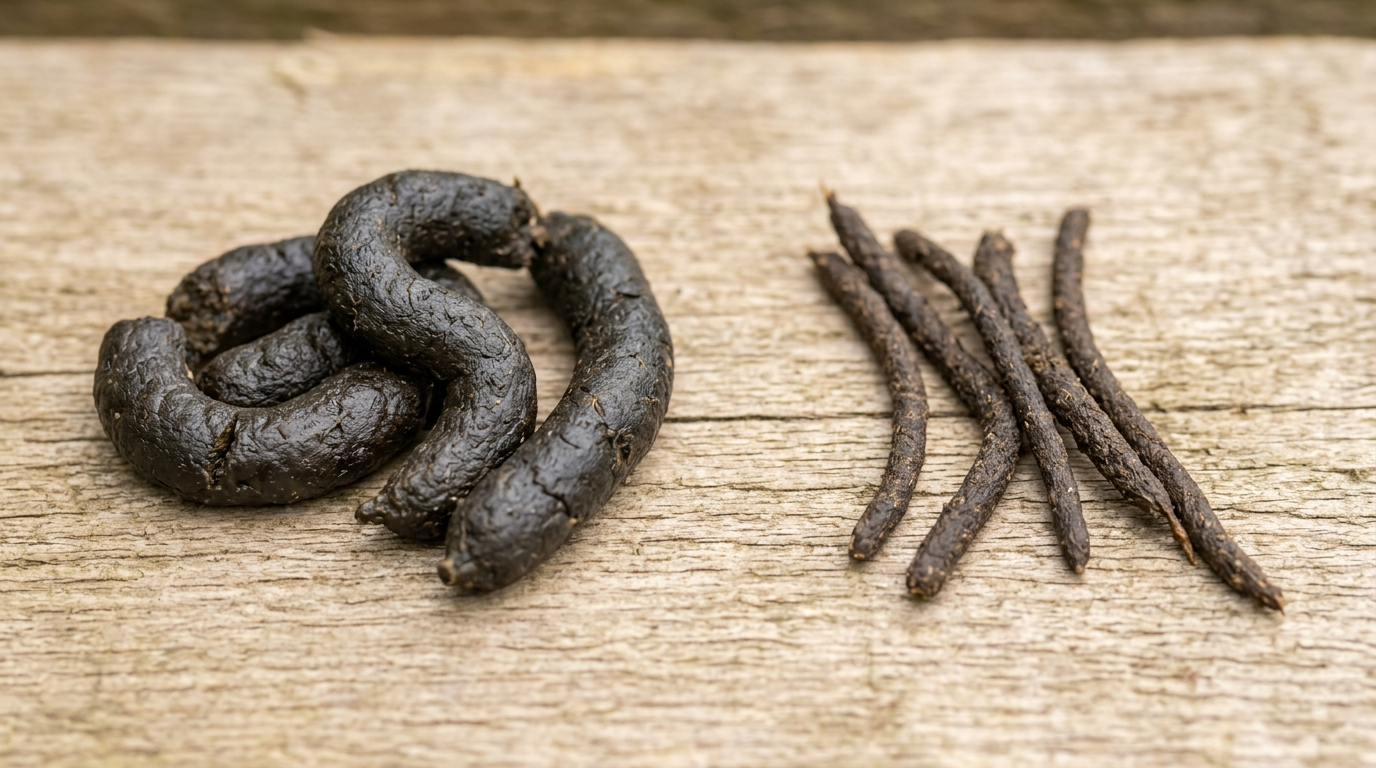
The marten is a completely different type — it is a classic opportunist. The question „what do martens like to eat" has an evasive answer: almost anything that can be caught and eaten. Analyses of stone marten droppings show the composition: rodents 40-50%, birds and their eggs 10-20%, seasonal fruits (cherries, sweet cherries, berries, apples) 15-30%, insects and invertebrates 5-10%, carrion 5-10%. In summer, the share of fruit increases; in winter, rodents and carrion dominate.
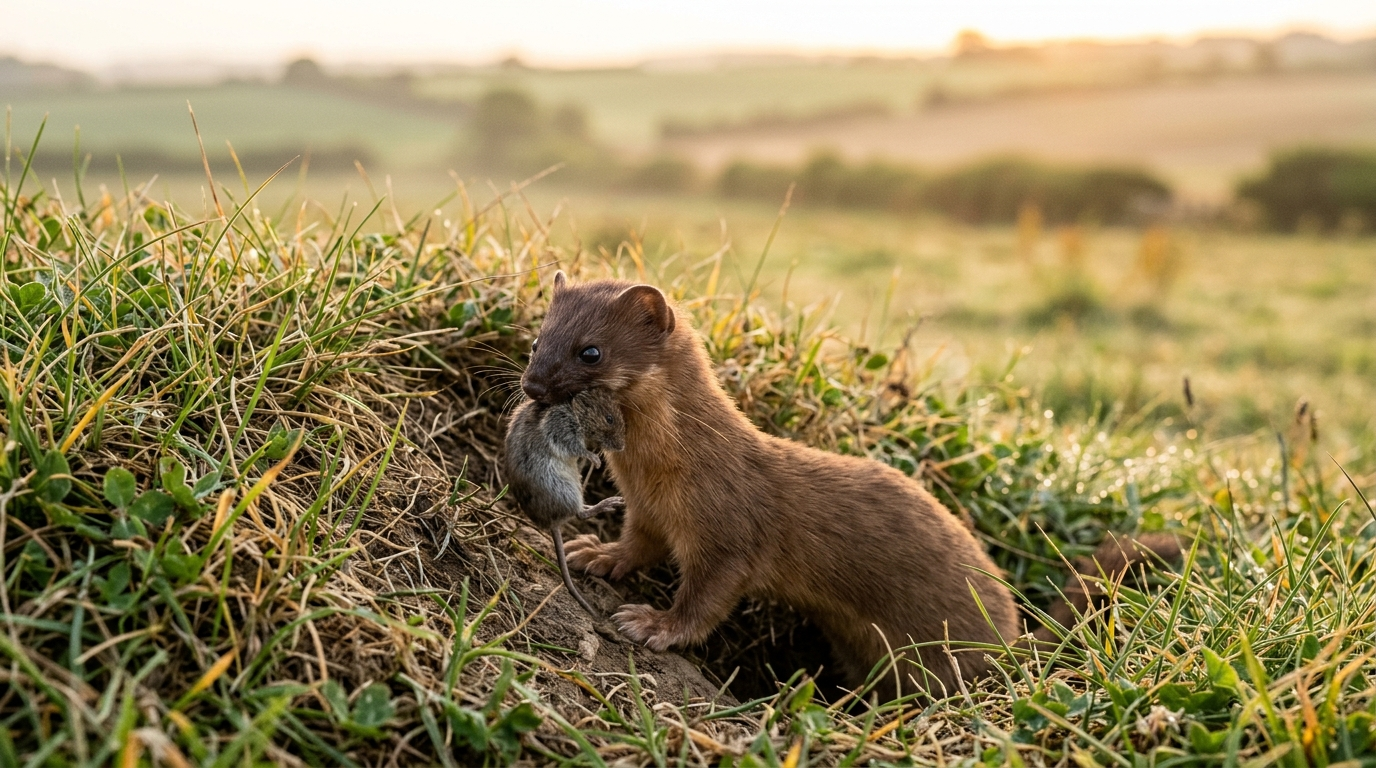
What does a marten hunt in practice? In rural areas, mainly common voles, striped field mice, house mice, young rats, and moles. In the forest, it adds squirrels, young hares, and birds nesting in hollows. What a marten eats in a single night makes a difference on a field scale: a single individual patrolling an area of approx. 1.5 km² can reduce the local common vole population by up to 20-30% during the growing season.
Weasel = specialized „single-track" hunter of underground rodents. Marten = opportunist that eats whatever is available, but 50-70% of its diet is still small mammals. Both species, each in their own way, control rodent populations on a scale that no chemical rodenticide can match.
§ 03The Weasel and Its Burrow — Does the Weasel Dig?
This question appears in search engines surprisingly often — and it has a clear answer: no, the weasel does not dig burrows. Anatomically, it is not adapted for it. A weasel's paws are small, claws thin and sharp, perfect for climbing through stone crevices but completely useless for digging soil. It is not a badger or a fox.
The weasel benefits from others' work. It occupies abandoned (or freshly vacated — often after its own hunt) burrows of small rodents: common voles, pine voles, field mice. It can have several hiding places within its territory (a few hectares for a female, a dozen or so for a male) and move between them depending on the weather, prey availability, and breeding season.
Other typical weasel hiding places: rock piles, brushwood stacks, abandoned outbuildings, voids in barn foundations, roots of an overturned tree. Anywhere that is dark, dry, cramped (a weasel chooses crevices literally 3-4 cm wide), and close to prey. From an ecological point of view, the weasel is therefore not only a predator but also an „infrastructure recycler" — it uses what other animals have left behind.
A middle-order predator does not break the ecosystem — it regulates it.
§ 04Impact on Birds, Small Mammals, and the Forest Ecosystem
Here the narrative becomes more nuanced. Martens and weasels also hunt birds nesting on the ground and in low bushes, their eggs, and chicks. This is a real impact — in some studies, the stone marten was responsible for 10-25% of losses in the nests of thrushes, blackbirds, and tits nesting low. Does it sound bad? Yes — until you look at the other side of the balance sheet.
Without the pressure of a mid-order predator, rodent populations explode, and then the rodents eat the eggs and chicks of those same birds much more effectively than the marten. Field mice and voles are also nest predators. On an ecosystem scale, a healthy population of martens and weasels protects birds from a rodent surplus, even though individual nests also fall victim to them. Selection primarily affects weaker, sick individuals nesting in non-optimal locations.
- Carrion removal — the marten readily eats small carrion (dead birds, rodents, insects), acting as a natural cleaner of forest edges and fields.
- Disease reduction — by removing sick and weakened rodents, mesopredators limit the spread of pathogens (including hantaviruses and leptospires).
- Natural selection — weaker individuals are most often the victims, which improves the overall fitness of bird and small mammal populations.
- Seed dispersal — martens eating berries and fruits disperse seeds in their droppings, participating in forest regeneration.
- Food web stabilization — a buffer between apex predators and the base of the pyramid that mitigates cyclical population fluctuations.
In the forest, the role of the pine marten (its close relative) is even more important, but the stone marten, reaching the edges of buildings and orchards, performs a similar function at the intersection of the wild world and human settlement. This role is well described comparatively in our text Marten vs Weasel — What's Worth Knowing About These Mammals.
§ 05Do They Harm the Farm?
Time for an honest account of losses and gains. Let's start with the weasel: the weasel almost always helps. The question „do weasels kill chickens" appears in searches, but realistically this is an extremely rare incident — a weasel is simply too small to handle an adult hen. It may (rarely) kill a small chick or a quail, but that is the exception, not the rule. A standard weasel on a farm eats mice in the granary, voles in the meadow, and moles in the vegetable garden — and nothing more.
The stone marten is more troublesome, but also not as much as commonly believed. Real damage concerns three situations: unsecured chicken coop, attic with open ventilation, car engine compartment. All three are fully solvable without harming the animal — mesh, plugs, cable covers. Outside of these situations, a marten near a farm is a cheap, self-sufficient, and 24/7 pest control service.
§ 06What Happens When They are Gone?
This question long ago ceased to be theoretical. We have dozens of studies from Europe and North America tracking what happens to rodent populations after mid-order predators are eliminated. They all point in the same direction: mouse and vole populations grow 3-5x within 2-3 seasons, along with all the problems they bring with them.
- Common vole plagues — losses in grain, alfalfa, and potato crops reaching dozens of percent at the individual field level. In plague years, farmers in Poland record losses of 1-2 tons per hectare.
- Hantaviruses — transmitted mainly by the bank vole and striped field mouse, they can cause severe kidney inflammation (HFRS) in humans. More mice mean a higher risk of human infection.
- Lyme disease and tick-borne encephalitis — rodents are the main reservoir for early tick stages. An explosion of rodents = more infected ticks in the forest and meadow.
- Leptospirosis — bacteria transmitted through rodent urine, dangerous for humans, dogs, and cattle. In plague cycles, the number of cases measurably increases.
- Destruction of granaries and warehouses — house mice and rats, deprived of a natural enemy in the form of weasels and martens, start to pose an economic problem on an individual farm scale.
These are measurable effects, well-documented in the works of teams from Białowieża, Germany, and Scandinavia. The conclusion is simple: in a healthy ecosystem, we cannot afford to remove mesopredators. They can be relocated from a specific attic, they can be deterred from a specific chicken coop — but globally they belong where they are.
§ 07What You Can Do — Living Alongside a Predator
Since they are worth tolerating, how do you do it practically? A few things that every homeowner can do in one weekend, which solve 90% of potential conflicts. Let's start with the most important: securing areas of real value — the chicken coop, the attic, the car.
- Secure the chicken coop — solid steel mesh with a max. 2 cm mesh size, buried 30 cm into the ground around the perimeter. This is a one-time cost that eliminates 99% of risk. Details in our guide to effectively deterring martens and weasels.
- Ventilation and eaves plugs — all openings in the roof larger than 4 cm must be secured with stainless steel mesh. A marten won't enter the attic if it has no way in.
- Leave wild edges — a 1-2 m strip of unmown grass, rock piles, an old stump, hawthorn bushes. This is weasel habitat. The more such places, the more free natural pest control.
- Do not use rodenticides — martens and weasels eating poisoned rodents die secondarily. You lose the predator, and rodents return with a surplus in 2-3 seasons.
- Don't fight blindly — before you do anything, find out who your neighbors are and what exactly they are doing. In most cases, the problem disappears by itself after securing a few meters of mesh.
If you want to delve deeper into the topic of marten diet and behavior, I recommend our text Marten Diet. For a comparison with other mustelid species in Poland — animals similar to the marten. The more you know about these animals, the easier it is to live in the neighborhood with them without conflict.
The marten and weasel are mid-order predators (mesopredators) that stabilize rodent populations on a scale no chemical can match. The weasel does not dig burrows, the marten rarely causes real harm to the farm, and both species save fields from vole plagues. Secure the coop, leave the edges wild, don't fight blindly — and enjoy free, 24/7 rodent control for years to come.
★Frequently asked questions
What do weasels eat?
The least weasel is a specialized hunter of small rodents. Common voles, pine voles, striped field mice, and house mice constitute 70-95% of its diet. Shrews, small ground-nesting birds, eggs, and occasionally frogs and insects supplement this. One weasel eliminates 2,000–3,000 rodents per year — a scale no other predator of its body mass achieves.
Do weasels dig burrows?
No, the weasel does not dig burrows. Anatomically, it is not adapted for it — it has small paws and thin claws, good for climbing through crevices but useless for digging soil. The weasel occupies existing burrows of small rodents (common vole, pine vole, mice) that it has previously hunted or that were abandoned. It also uses crevices in rock piles, barn foundations, and under tree roots.
Do weasels kill chickens?
Realistically very rarely. The least weasel weighs 60-200 g — it is simply too small to handle an adult hen. It may (exceptionally) kill a chick, quail, or very small chicken, but this is an incident, not a rule. On a farm, the weasel takes care of mice in the granary and voles in the meadow. It is often confused with the stone marten or polecat, which are much larger and can actually get into a chicken coop.
Why do we need the marten and weasel in the ecosystem?
They function as mid-order predators (mesopredators) — they control rodent populations, limit the spread of diseases (hantaviruses, leptospirosis, Lyme disease), clean up carrion, participate in natural selection, and disperse seeds. Without them, mouse and vole populations grow 3-5x in 2-3 seasons, which translates into real crop losses and increased sanitary risks for humans and domestic animals.
Is the marten useful?
Yes — in 95% of situations the stone marten is useful. It eliminates rodents on a field scale (an individual patrolling 1.5 km² reduces the local vole population by 20-30%), eats carrion, and limits rat and house mouse populations. Real damage concerns three specific situations: an unsecured chicken coop, an open attic, and a car engine compartment — all solvable mechanically without the need to eliminate the animal.
What does a marten hunt?
The stone marten is a classic opportunist. Its main victims: common vole, striped field mouse, house mouse, young rats, and moles. Seasonally, it adds low-nesting birds and their eggs (10-20% of diet), fruit (cherries, sweet cherries, berries, apples — 15-30% in summer and autumn), insects, and carrion. In the forest, it also hunts squirrels and young hares. What a marten eats in a year is 50-70% small mammals — mainly rodents.