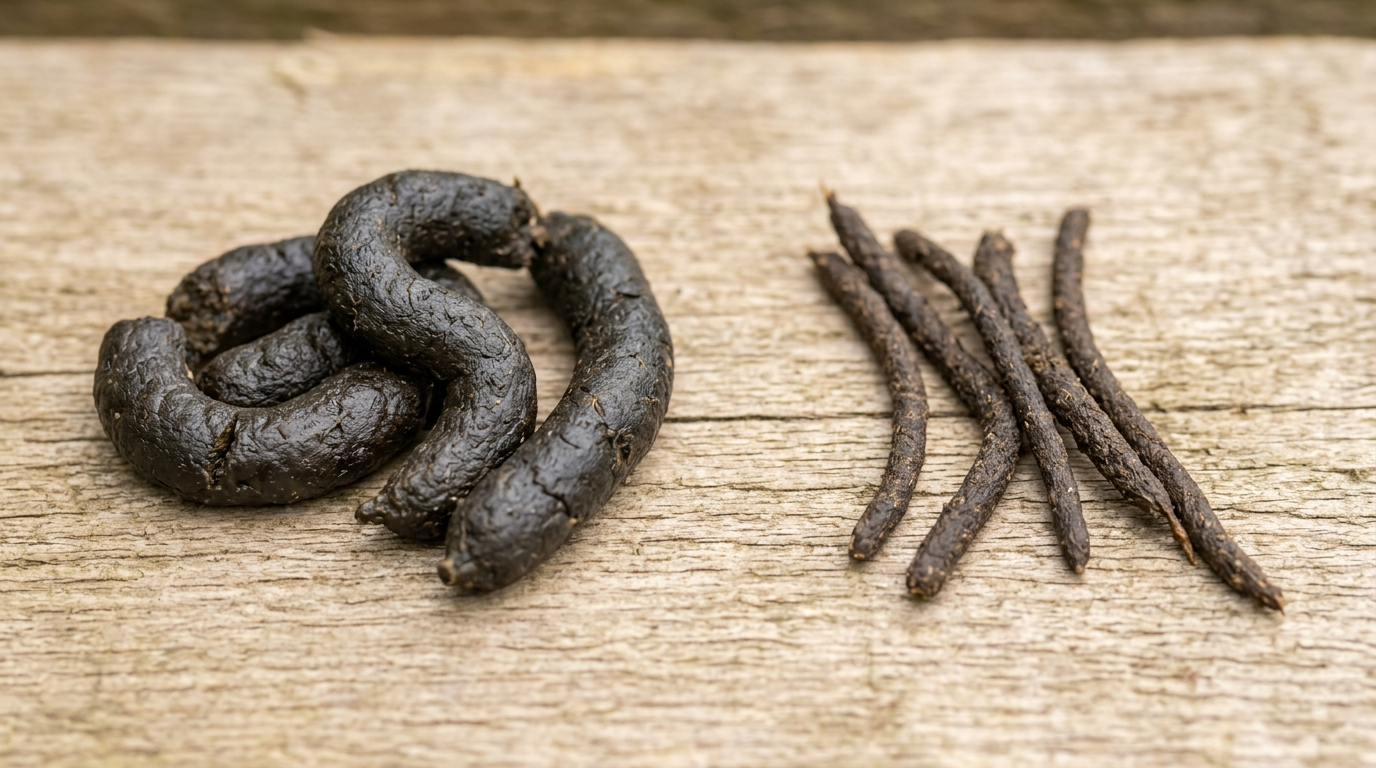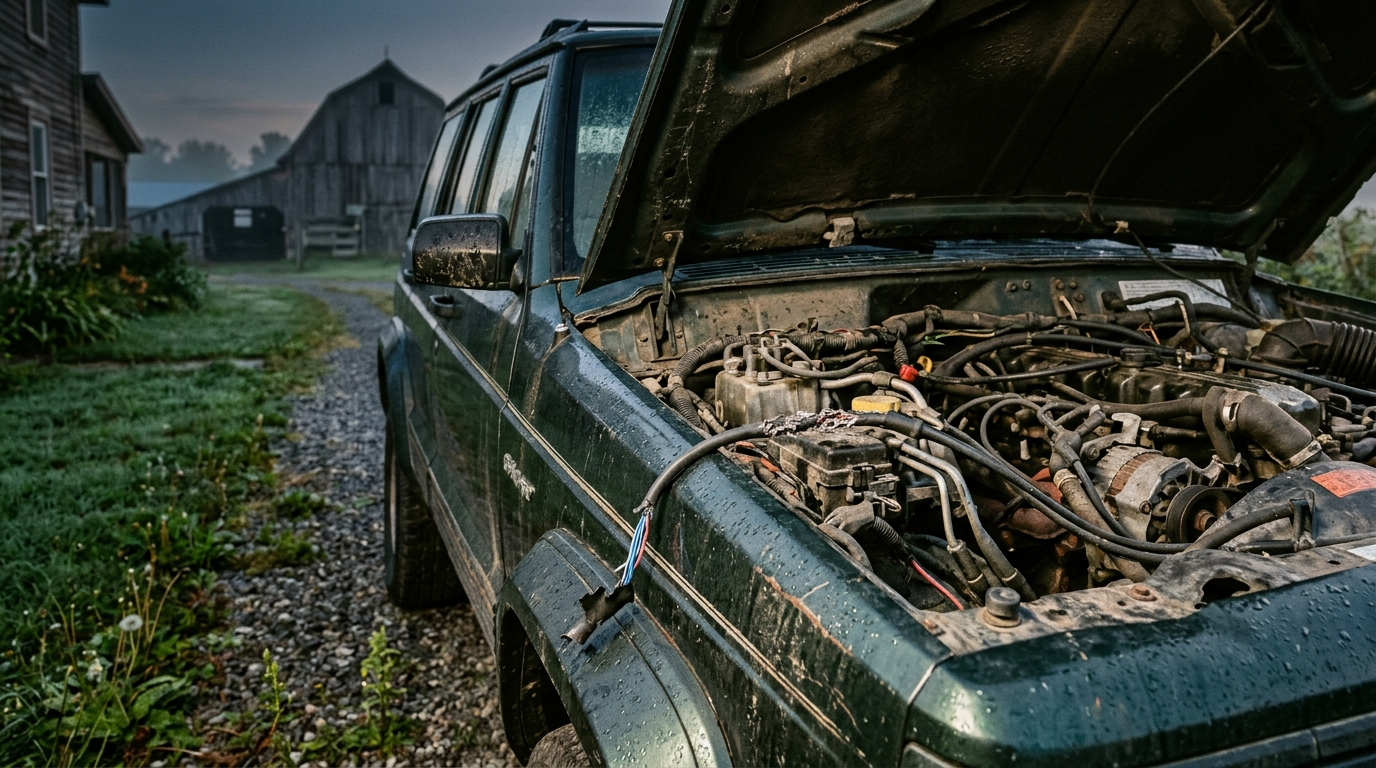
Most readers come to this article at one of two moments: in the morning, after a strange sound during startup and an error on the dashboard, or in the evening, after a call from the mechanic with a figure they didn't expect. The culprit is almost always the same — the stone marten, a small predator that treats your car's engine as part of its territory.
This guide deals neither with biology for biologists nor with panicky forum advice. It shows why a marten appears in a car once and then returns, what exactly it destroys, how much it costs, whether insurance will cover any of it, and — most importantly — which protection methods are effective and which are overrated. If you're not sure if you're even dealing with a marten, start with the text How to recognize the presence of a marten or weasel in the garden.
§ 01Why a marten bites under the hood — it's not hunger
The first thing to get out of your head: the marten does not eat your cables. Chewed cables don't go to the stomach — they lie where they were bitten off, usually next to paw prints on the engine covers. The motive is ethological, not nutritional. This is the point where most guides get it wrong from the first sentence.
Three mechanisms work simultaneously. First — territoriality. The stone marten (Martes foina) marks a territory of 30–80 hectares and treats it as property. A warm engine is an excellent place for a night hideout: quiet, warm, and smells of familiar oils. The first marten that enters leaves a scent from its paw glands. The second — usually from a neighboring territory — detects it after a few days or weeks and flies into a rage. Destroying cables is a form of fighting the rival's scent mark, not a snack.
The second mechanism — texture. Modern cable insulation, rubber hoses, and plastic covers are pleasant to bite for an animal whose incisors are constantly growing. Soft silicone rubber with a hardness of about 60 ShoreA fits perfectly between the animal's cartilage and bone — something the marten knows from nature. Third — the curiosity of young individuals. This year's young (born in March–April) test everything biteable in a way comparable to puppies.
A marten entering under the hood for the first time usually destroys nothing. It is the second one, which comes after it and falls into a territorial frenzy, that causes the destruction. Therefore, the worst damage happens where the car is parked alternately with another (village street, estate parking) or where it moves between territories — e.g., after a weekend trip near the woods.
§ 02What is most often destroyed — and how much it costs
From workshop notes and insurance claims, a fairly repetitive list emerges. Some damage is cheap and can be fixed in an hour. Others can stop a car for weeks and cost as much as a used gearbox.
- Ignition cables and spark plug wires — a classic. Soft, thick silicone insulation perfectly meets the criteria for "good to bite." Result: uneven engine operation, ignition errors, sometimes inability to start. Repair: 150–600 PLN for a set of cables + labor.
- Radiator hoses (upper and lower) — the worst category, because the symptom might only be an overheated engine on the road. Coolant escape in 5 minutes can finish off the head gasket. The hose itself: 80–250 PLN. Overheating consequences: 1500–8000 PLN.
- Rubber boots ("CV boots") on axles, steering rods, CV joints — a crack allows grease to leak and water/sand to enter. Joint failure within a few weeks. The boot itself: 30–80 PLN, replacement with labor: 200–500 PLN.
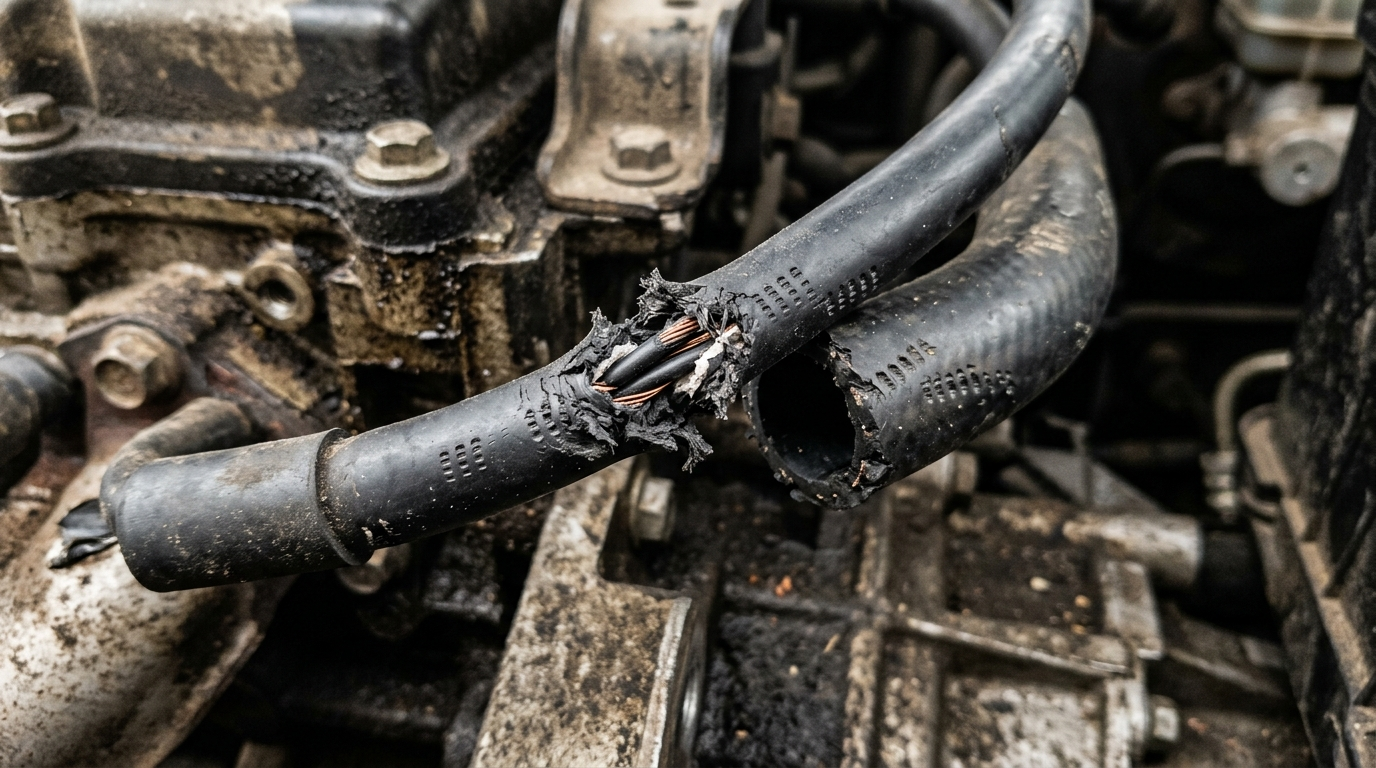
- Engine harness insulation — thick, black, braided tape. The marten tears it and exposes bare copper wires. Results: short circuits, electronic errors, in extreme cases, fire. Repair: 200–1500 PLN depending on the scope.
- Servo hose (braking system or clutch) — rarer, but can appear in older cars with rubber pneumatic lines. Result: loss of power assistance, hard brakes. Repair: 100–400 PLN.
- Soundproofing mats under the hood — a favorite nest for a marten that wants to settle in longer. Not critical in themselves, but full of fur, bones, and dry leaves. Mat replacement: 80–250 PLN.
The real cost of a single "visit" by a marten under the hood most often falls within the range of 300–3000 PLN, with the workshop median being around 700–1200 PLN. The upper limit is set by the "chewed hose + engine overheating + head gasket" scenario — this can exceed 5–8 thousand PLN in one go. Only the lightest cases: a single spark plug cable plus an hour of labor, end up under 300 PLN.
Unnoticed damage is the most dangerous. A cracked radiator hose at dawn looks exactly like an undamaged one — it leaks a drop per minute. The car starts, drives 30 km on the highway, the temperature gauge jumps to red, and the engine is toast. Therefore, after the first symptoms of "something strange under the hood" — a quick visit to the lift before you hit the road.
§ 03Does insurance cover damage — AC, OC, packages
The question returns to the editorial inbox regularly and almost always rests on the same misunderstanding. Liability (OC) never covers it — OC protects third parties from damage you cause. A marten destroying your car is not a third party with a policy. There is no room for debate here.
Comprehensive (AC) usually covers it, but not always. Most Polish companies have a clause in their terms (OWU) regarding "damage caused by animals." It should be read carefully — the devil is in three places:
- Wild vs. domestic animals. Some terms cover only "wild animals" (marten, fox, boar), others explicitly exclude "domestic and synanthropic animals." The stone marten is formally a wild species — and that's how most insurers qualify it — but the name confuses many agents. It's worth paying attention to this when claiming.
- Deductibles (reduction and integral). A standard deductible of 500–1000 PLN means that in half of the cases, there is simply no payout. A repair for 800 PLN and a 1000 PLN deductible — you are left with the bill.
- Requirement for a guarded parking lot or garage. Some cheaper AC packages limit protection to a car parked in a garage from dusk to dawn. This is a bizarre clause for marten damage — because that's where they often operate — but it's legal.
Separate "animal damage" packages have been offered by more and more companies for several years — usually for 50–150 PLN per year on top of standard AC. They have a lower deductible (or zero) and do not require a garage. For people living in areas with documented marten activity (villages, city outskirts, allotments), this pays off within one season.
The most common mistake owners make — they silently assume that "some" insurance will cover it. AC without reading the terms covers about half of marten damages. The other half involves deductibles, exclusions, and denials.
Claim procedure: photos of the damage before touching anything (from a mobile phone with a date), a mechanic's opinion describing "mechanical damage of the biting type," repair receipt. Without this evidence triangle, the claim will likely be rejected or undervalued. Time to report — usually 7–14 days from discovery, depending on the terms.
§ 04How to tell it's a marten and not a mouse or rat
Diagnosis is obvious in 90% of cases, but that 1 in 10 error can send an owner in the wrong direction — with zero results after a month. Three species are often confused: marten, brown rat, house mouse. Each leaves different traces — and each requires a different reaction.
- Damage characteristics. A marten bites large, clean, even wounds, mostly single snaps. Insulation strips torn off in 2–5 cm pieces. Rats and mice make small, repeated gnaws, often in one place, with clear rows of teeth. Mouse tracks are hundreds of tiny holes; a marten — a few sweeping ones.
- Droppings. Marten: cylindrical, dark gray or black, length 6–10 cm, diameter 1–1.5 cm, often with fragments of fur, bones, and fruit seeds. Rat: much smaller, oval, 1.5–2 cm, uniform. Mouse: rice-like grains, 4–7 mm, black and dry.
- Hair. A marten leaves characteristic fur under the hood — thick cream-brown fur with a white throat (white patch), hair length 2–4 cm. Rats and mice have short, gray-brown fur, individual hairs.
- Scent. A marten has a strong, sweet-musky scent from its anal glands — it stays under the hood for weeks. Mouse: light ammonia smell of urine. Rat: sharp, irritating, ammoniacal.
- Activity period. A marten enters under the hood mainly in the evening (9 PM – 12 AM) and leaves before dawn. Mice and rats are also active in the middle of the night and towards morning. If someone from the house saw "something big" near the car after 9 PM — it's almost always a marten.
More details about tracks and droppings from different times of the year can be found in the guide Marten tracks and signs. From editorial notes: in doubtful cases, interesting facts about martens and weasels are helpful — the difference between both species and rodents becomes much more obvious after a few paragraphs.
§ 05Effective protection methods — what really works
This is where the part starts for which most readers opened this article. Contrary to appearances, there are fewer working methods than the market advertises. A clear hierarchy emerges from our own notes and dozens of interviews with mechanics and hunters.
| Method | Price | Effectiveness | Installation Difficulty |
|---|---|---|---|
| Mesh under the engine (fine steel) | 150–400 PLN | Very high | Medium (workshop) |
| Electric fence under the hood (12V) | 300–700 PLN | Very high | High (installer) |
| Protective plates on cable harnesses | 100–300 PLN | High (local) | Low (DIY) |
| Plastic corrugated cable protectors | 30–80 PLN | Medium | Very low |
| Scent spray / repellent | 20–60 PLN | Low (short term) | Very low |
| Mothballs, lion urine, dog hair | 10–80 PLN | Negligible / myth | Very low |
| Ultrasonic deterrent under the hood | 80–250 PLN | Low in open air | Low |
The best practical strategy is as follows. Step one — steel mesh under the engine (10–15 mm mesh) installed in a body shop for 200–300 PLN. It cuts off access from below, the path the marten takes in 80% of cases. Step two — for cars often parked near woods or in places with documented marten activity: an electric fence under the hood. These are several thin metal strips under the engine insulation, connected to a 12V pulse generator (1.5–4 mA — harmless to humans, for a 5-kg marten, unpleasant enough). The marten gets a short pulse upon first contact and won't return for weeks. From the notes: the most effective single investment against martens, in the 400–700 PLN range with installation.
Plates and corrugated covers make sense as a cheaper plan B — they protect specific, most frequently attacked elements (ignition cables, radiator hose). They don't eliminate visits but reduce damage. Scent sprays and repellents (lion, fox, mint scents) really only work for 7–14 days, then they must be renewed — with regular use, they become more expensive than mesh. More on a broader deterrence strategy can be found in the guide how to effectively deter marten and weasel.
If your budget allows for one thing — choose the electric fence, not the mesh. Mesh works well, but a marten can squeeze through the radiator or air intake. The fence shocks at the point of contact with insulation, regardless of the entry path. Effectiveness over 90% throughout the season, cost spread over 5–7 years of operation = a few dozen PLN per year.
§ 06What DOES NOT work — popular myths
The internet is full of "proven" ways, most of which have no basis in field observations. We list them not to mock anyone — but so you don't spend money on something that won't work.
- Mothballs under the hood — naphthalene has a low sublimation threshold at engine temperatures and evaporates within a few hours of operation. After the first long trip, its smell stays on the passenger seat, not under the hood. Effectiveness: near zero.
- Lion urine, wolf urine sold in bottles — works for the first 2–4 days, then the scent evaporates and the marten quickly gets used to it. Price 60–120 PLN for 250 ml, must be regenerated every week. Marketing based on observations from large open areas (orchards, forests), not from car engines.
- Ultrasonic deterrent under the hood — physics is brutal. Ultrasound at 25–40 kHz is muffled instantly on metal and rubber, and the open space under the hood is the worst in this regard. Lab effectiveness doesn't translate to a real car. The only ultrasound that helps is mains-powered and placed in the garage — not screwed to the battery.
- Dog or cat hair scattered under the hood — works for the first 3–5 days until it loses its scent. Then the marten just jumps over it. Safer than chemicals, but no more effective.
- Strong smell of gasoline or WD-40 — contrary to popular belief, a marten doesn't avoid it. Under the hood already smells of oils and greases. Additionally, WD-40 destroys rubber covers from the inside.
- Washing the engine with strong detergent every week — removes the scent of the previous marten, so theoretically disarms the territorial mechanism. In practice: pressurized water destroys electronics, and the engine smell returns after 2–3 drives. Mechanics advise against it.
Field observations show something unpopular: the most effective "natural" measures are not chemical, but mechanical. Minor changes in parking habits (rotating spots, parking under a strong lamp, parking in two different places alternately) can lower the chances of a marten returning by 40–60% at zero cost. This stems from a simple fact — a marten patrols its territory by sight and smell, and a car is a permanent fixture for it. A variable element loses priority faster.
§ 07First aid after detection — what to do immediately
If you've just discovered damage under the hood, there are three things to do within the next hour and three within the next week. The order matters — some mistakes in the first steps cost a lot later.
- Step 1 — do not start the engine until you visually check all hoses (especially radiator and power steering) and harnesses under the hood. Liquid leakage in the first 30 seconds of starting can damage the head gasket.
- Step 2 — documentation. Photos of every trace up close and from a distance, preferably with the license plate in the frame. These photos will later be evidence for the insurer. Without photos, talking to the claims adjuster is twice as hard.
- Step 3 — visit to the lift. Ideally on the same day. Even if everything looks fine visually, checking the bottom of the car takes 15 minutes and costs 30–80 PLN. It reveals hidden damage to boots and joints.
- Step 4 — repair and receipts. The mechanic should write "mechanical damage of the biting type / animal foraging marks" in the description. This is key for an AC claim.
- Step 5 — report to the insurer within 7–14 days (depending on terms). Along with photos, mechanic's description, and receipt.
- Step 6 — install protection before the next visit. Without this step, the previous five are a waste of time — a marten returns on average within 3–8 weeks. Mesh, electric fence, or at least protective plates on the most vulnerable parts.
When to go to the mechanic immediately: any trace of fluid under the car (cooling, power steering, brakes), uneven engine operation, smell of fuel, "check engine" error appearing after the first start. When you can wait a day or two: minor insulation damage without operating symptoms, chewed soundproofing mat, paw marks without bitten cables. In the latter case, it's still worth going — but you can schedule the visit.
After repair and protection, it's good to learn why the marten chose your car. Sometimes it's the location (edge of the village, proximity to a forest, a barn nearby), sometimes the parking time coincides with night activity. The background lies in the habits of the stone marten — once you understand them, it's much easier to choose a protection strategy for your own property.
Six steps, one weekend, cost 300–800 PLN including protection for the season. Photos, lift, mechanic with the right description, insurer, mesh or electric fence under the hood. There's no magic — there's a procedure. A car that has been "marked" once by a marten will be attacked on average 2–4 times in the same season without protection.
★Frequently asked questions
Why does a marten bite cables in a car?
A marten does not eat the cables — it destroys them for territorial reasons. The first marten that enters under the hood leaves a scent from its paw glands. A second one, usually from a neighboring territory, senses it and goes into a territorial frenzy — destroying everything nearby. Additionally, the soft silicone rubber of the insulation is attractive to bite for an animal that naturally encounters cartilage and bone. The curiosity of young individuals (born in March–April) further increases the scale of damage in spring and early summer.
Does insurance cover marten damage to a car?
Liability (OC) never covers it. Comprehensive (AC) usually covers it, but you must read the terms (OWU) — the devil is in the deductible (500–1000 PLN), garage requirements in some packages, and terms like "wild animals" vs. "synanthropic." Some companies offer a separate "animal damage" package for 50–150 PLN per year with a lower deductible and no garage requirement — for rural and suburban residents, it pays for itself in one season. Required for a claim: photos of damage, mechanic's opinion mentioning "biting-type" damage, receipt, and reporting within 7–14 days of discovery.
How much does it cost to repair a car after marten damage?
The median cost of a single marten visit under the hood from Polish workshops is 700–1200 PLN, with the full range being 300–3000 PLN. A single ignition cable is the cheapest (150–600 PLN). The most expensive is a chewed radiator hose ignored before driving, leading to engine overheating and head gasket damage (5000–8000 PLN or more). Rubber CV boots: 200–500 PLN with labor. Replacing part of the engine harness: 200–1500 PLN depending on the scope.
How to effectively protect a car from a marten?
Three methods actually work. Steel mesh under the engine (10–15 mm mesh, installed in a body shop, 200–300 PLN) — cuts off access from below. Electric fence under the hood (12V, 1.5–4 mA pulse — harmless to humans, 400–700 PLN with installation) — the most effective single investment, works regardless of the entry path. Protective plates on specific parts (ignition cables, radiator hose, 100–300 PLN, DIY installation) — a cheaper plan B, reduces damage but doesn't eliminate visits. Scent sprays, mothballs, lion urine, ultrasonic deterrents — work briefly or not at all.
Do mothballs and lion urine deter martens from a car?
Practically no. Mothballs sublimate at engine operating temperatures in a few hours — after the first trip, the smell is in the cabin, not under the hood. Lion urine works for 2–4 days, then evaporates and the marten gets used to it (price 60–120 PLN for 250 ml, must be renewed weekly). Ultrasound is muffled instantly by metal and rubber under the hood — it only works in a closed garage, not under the bonnet. From observations: rotating parking spots is much more effective than chemicals and parking under a strong lamp — reduces return chances by 40–60% at zero cost.
How can you tell if it was a marten or a rat or mouse?
Four indicators. Bite character — a marten tears insulation in 2–5 cm strips; mice/rats make hundreds of tiny gnaws. Droppings — marten droppings are cylindrical, 6–10 cm, dark gray, with fur fragments; rats are 1.5–2 cm; mice are "rice grains" 4–7 mm. Fur — martens leave thick cream-brown fur 2–4 cm long under the hood; mice and rats only short gray hairs. Scent — marten smells sweet-musky (anal glands), mice/rats smell of sharp ammonia. Activity time: marten is mainly evening 9 PM – 12 AM, rodents all night.