Mustelids are a family about which everyone has an opinion — usually a wrong one. On one hand, they are the „poultry house pest" and „night raider above the ceiling"; on the other, an almost mythical, clever creature from children's stories. Meanwhile, the biology of martens and weasels is far more interesting than either. Evolutionarily, they have devised solutions that a biotechnology engineer would call brilliant and an ethologist would call unbelievable.
We have gathered seven facts that are worth knowing, regardless of whether a marten is currently living above your ceiling or you've never seen one in person. Each of them slightly changes the way you look at these animals — and each is backed by current field research. If you are curious about how these two species differ in their daily lives, start with the article Marten vs Weasel — what you need to know about these mammals.
§ 01Delayed implantation — a pregnancy that „stops" for 8 months
The first interesting fact is also the most surprising. Martens — and almost all mustelids of the genus Martes — have a mechanism called delayed implantation (from the Latin embryonic diapause). In practice, it looks like this: mating takes place in July and August, the female is fertilized normally, but after a few divisions, the embryo stops at the blastocyst stage and does not implant in the uterus for the next 7–8 months.
Only in February or March, when the female's body „understands" that the days are getting longer and spring is approaching, does the blastocyst implant in the uterine wall and the actual development of the embryo begins. This stage lasts only about 30 days. The young are born in April — at the optimal time when it is warm, there is food for the nursing female, and chicks and the first insects will soon appear for hunting.
Why such a complicated mechanism? To separate the moment of mating from the moment of birth. Mating must occur in summer, when males and females have the most energy and are in excellent condition. Birth must occur in spring — winter with nursing young in an unheated hiding place would end in disaster. Delayed implantation reconciles these two requirements in a single annual cycle.
The least weasel (Mustela nivalis) does not have diapause — its pregnancy lasts a standard 34–37 days, and a female can have up to two litters per season. Smaller body, shorter life, „faster" reproductive strategy. Delayed implantation is an evolutionary luxury of larger mustelids.
§ 02A weasel hunts prey five times larger than itself
The least weasel is the world's smallest predator — males weigh 60–250 g, females a mere 30–120 g. It fits in a palm, a jacket pocket, or an old slipper under the bed. Yet, it can single-handedly hunt a European hare weighing 4–6 kg, which is prey five times heavier than itself.
The mechanism of this hunt is a small masterpiece of evolution. The weasel doesn't try to „pin down" the hare with body weight — because it can't. It jumps onto its back from behind, entangles its paws in the fur, and with one precise bite severs the carotid artery at the base of the skull. The hare runs another 30–80 meters in panic but loses consciousness in a matter of seconds.

Importantly, hares are not a weasel's daily diet — it opts for such a hunt mainly in winter, when voles are hard to find under the snow and hunger is real. On a daily basis, a weasel eats over a dozen voles and mice per week, which is the equivalent of its own body weight in food every few days. The metabolic rate of such a small predator is simply lethal — a break in eating longer than 24 hours can be fatal.
A weasel is not afraid of larger prey. It is afraid of a missed opportunity — because tomorrow it might not have the strength to hunt at all.
§ 03Martens recognize specific cars
Every car mechanic working in the countryside will tell the same story. A customer comes in with chewed ignition cables, replaces the entire harness, goes home — and returns two weeks later with the exact same damage. The stone marten recognizes a specific vehicle and returns to it, regardless of where that vehicle is parked.
The mechanism is olfactory. A marten marks the vehicle with urine and secretions from its anal glands, leaving a scent in the wheel arches, on the engine insulation, and on the cables. When a foreign car (e.g., a guest's) parks in „its territory", the marten often attacks it, treating the scent as a challenge from a competitor — and „claims" the vehicle as its own. From there, it's a straight path to damage.
| Vehicle component | Frequency of damage | Repair cost |
|---|---|---|
| Ignition cables | very frequent | 200–800 PLN |
| Engine insulation (mat) | frequent | 150–600 PLN |
| ABS cables and sensors | frequent | 300–1500 PLN |
| Radiator / washer hose | occasional | 100–400 PLN |
| Seat belts | rare | 500–2000 PLN |
German insurance companies estimate that car damage caused by martens costs local firms a total of about 100 million euros annually. In Poland, statistics are not published, but service centers in Małopolska, Podkarpacie, and Masuria confirm an increase in such damages by several hundred percent over the last 15 years. This most often affects cars parked regularly in driveways or open garages.
If you catch the first signs — chewed rubber, paw prints on the hood, a characteristic smell — wash the engine compartment with a grease and odor-removing agent (e.g., a citrus-based mechanic's cleaner). Without removing the scent marking, simply parking elsewhere won't help — the marten will still find the car by smell.
§ 04Spatial intelligence — over a dozen routes by heart
The stone marten is one of the more spatially intelligent medium-sized animals living close to humans. Radio telemetry studies in Germany (Bavaria, 2018–2021) showed that an adult marten remembers 12–18 regular routes within its territory and navigates them with a precision of a dozen centimeters, regardless of the time of day, weather, or the individual's age.
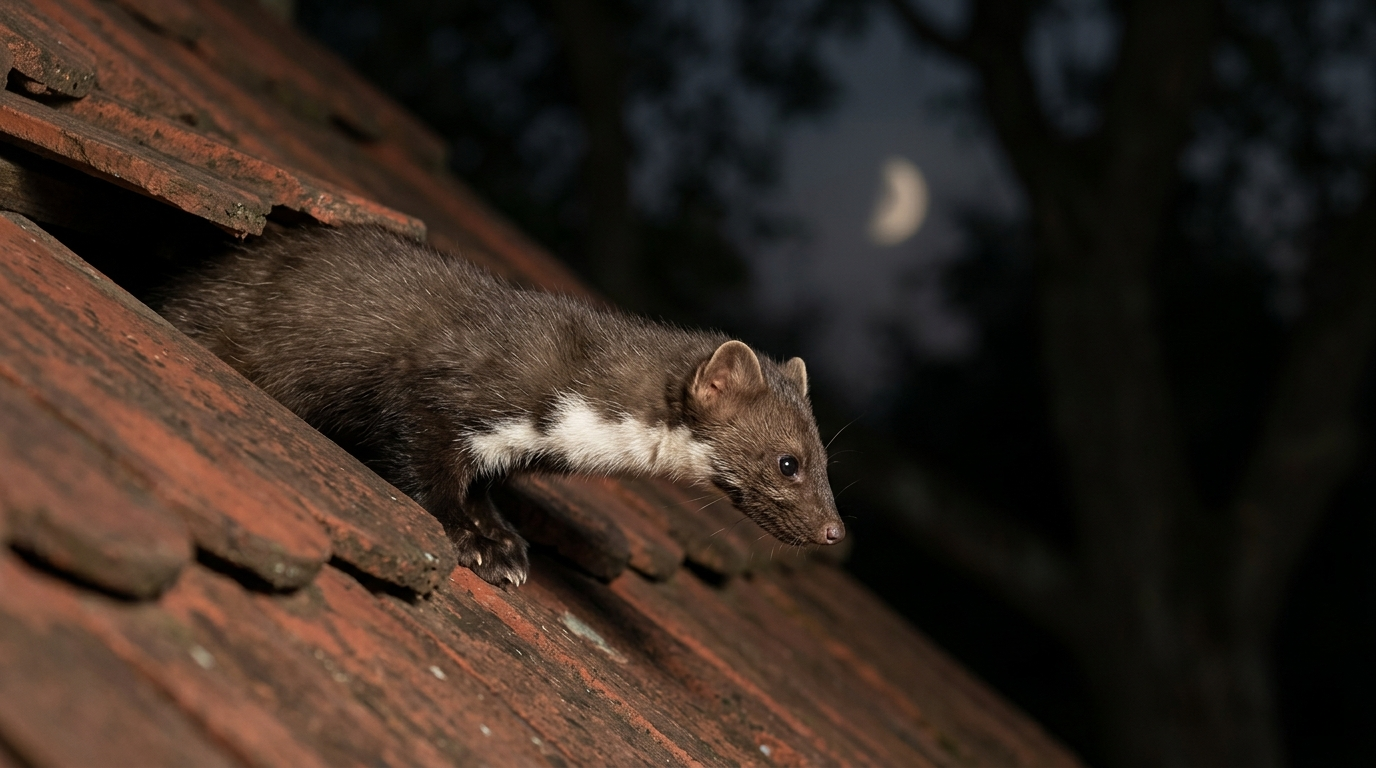
In practice, it looks like this: a marten might have four entrances to an attic (a hole in the ridge tile, a gap by the chimney, a hole by the gutter, a loose basement window), five hiding places (behind the chimney, in mineral wool, in a pile of boxes, in a clothes chest, in the void between rafters), and several „warehouses" for food scraps. It knows every path between these points by heart — and each of them is individually optimized: the fastest at night, the quietest during the day, the safest after rain.
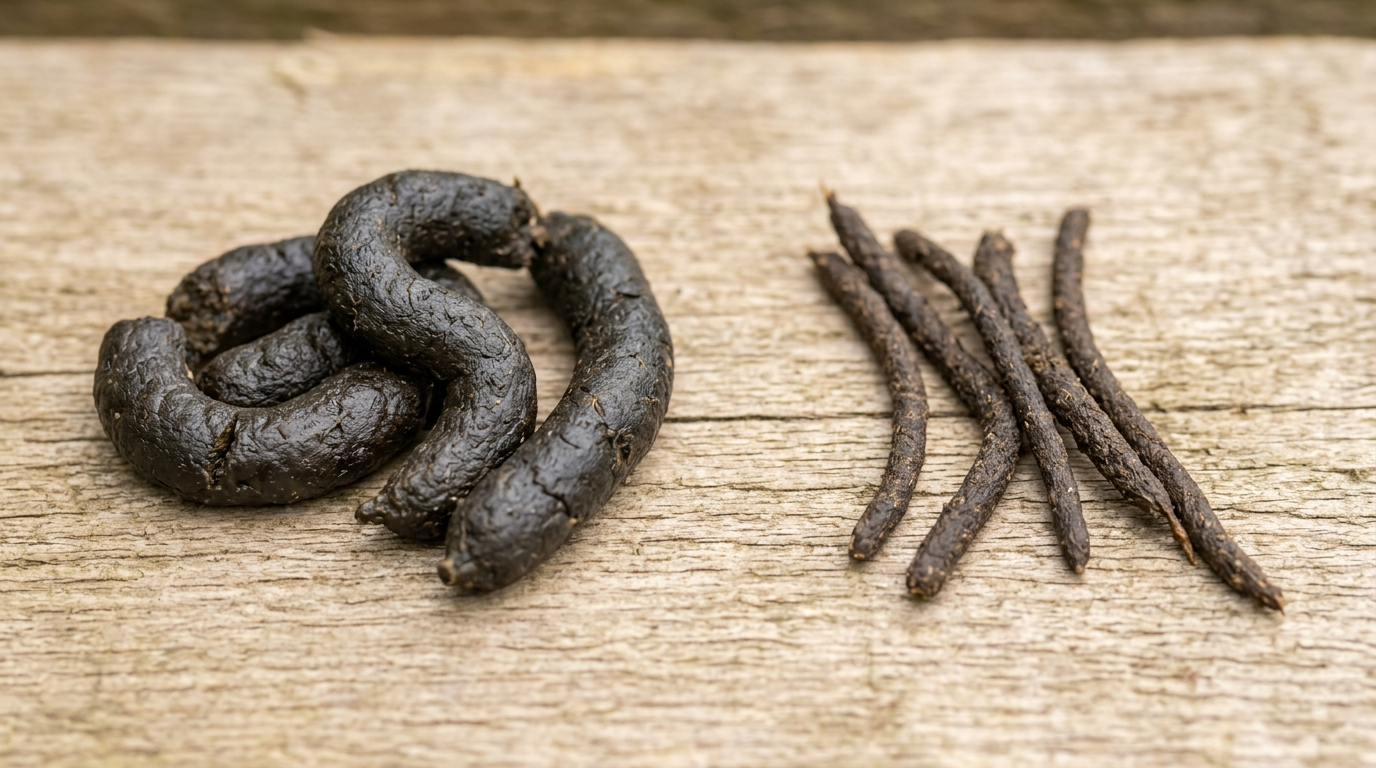
From the perspective of a person trying to remove a marten from an attic, this fact is fundamental. Closing one entrance does nothing — within a few hours, the marten will use one of the others that you usually don't even know about. Therefore, effective sealing requires finding all entrances simultaneously. Tracks, trails, and droppings will help with this — we described it in the guide How to recognize the presence of a marten or weasel in the garden.
Spatial memory is also the reason why relocated martens return. Captured in a live trap and released 5 km from home, an adult female returns in 80% of cases — usually within 3–7 days. At 10 km, the chance drops to a dozen percent, but still exists. A safe relocation distance is only 20 km and more, preferably beyond a terrain obstacle (river, highway, large forest).
§ 05Vocalizations — grumbling, hisses, mating whistles
Most people have never heard a marten's voice. This is natural — martens are quiet for predators of their size and conduct most communication through scent. But when they do speak up, their repertoire is surprisingly rich: bioacoustic studies distinguish at least seven different types of vocalization in Martes foina.
- „Grumbling" — low, fast murmurs used by the female to communicate with her young in the nest. It sounds a bit like a complaint, a bit like a monologue. Audible only from very close range.
- Hiss — a warning, long hiss identical to a cat's; a reaction to a threat, e.g., a human looking into the nest. Usually accompanied by bristling fur and baring teeth.
- Mating whistle — a high, piercing sound made by males during the mating season (July–August). It carries for several hundred meters at night. Few people hear it consciously — most mistake it for a bird's voice or „something strange".
- Squeaking of young — high, irregular squeaks of hungry young after leaving the nest. Most often heard from June to mid-July, usually at dawn.
- Growl — a low, guttural sound produced during a fight with a competitor; very rare, heard in extreme situations.
- „Panting" — fast, short exhales while hunting or tearing prey.
- „Sneezing" — a sharp, short sound that serves as a communication signal between adults, e.g., a mother and juveniles while learning to hunt.
The weasel is even quieter. Its repertoire is limited to hisses, short squeaks, and a „shriek" — a sharp scream in a situation of mortal danger. Most people who have a weasel on their property will never hear its voice. They only hear pattering on boards, usually at three in the morning, and the characteristic „crawling" of a small body in narrow gaps.
§ 06A weasel's jump — equivalent to 6 meters for a human
The least weasel jumps vertically up to 50–70 cm and horizontally over a meter. This doesn't seem like much until you consider that the animal itself measures 15–25 cm in body length and weighs only a few dozen grams. Proportionally to body length, a weasel's jump would correspond to an adult human jumping over 6 meters high and a dozen meters long.
The secret lies in the structure of the spine. Mustelids have an exceptionally flexible and short spine — not a „stiff rod" like a dog's, but a „spring" that curls into a ball and releases explosively. The hind legs generate power in a fraction of a second that larger cats would envy. For comparison: a leopard jumps up to 6 m high with a body length of 130 cm — a weasel does the same proportionally with a body 5× smaller.
This mechanism has a practical consequence for anyone wanting to secure a poultry house against weasels. A standard 50–60 cm fence is laughable to it — it jumps over it from a run, without even needing momentum. An effective mechanical barrier is a mesh with a maximum size of 1 cm, brought to the ground, buried 30 cm into the soil, and closing the space from above. Anything smaller — the weasel will find a way.
A weasel can enter through a hole the size of 2.5 cm — literally a gap in the poultry house boards. A marten needs 5–6 cm. If you have both species on your property, always design protections for the weasel — then you will automatically stop the larger marten too.
§ 07Longevity — 3 years in the wild, 18 in captivity
The final fact is the one that most changes the perspective on these animals. A stone marten in natural conditions lives an average of 3–5 years. The least weasel — even shorter, usually 1–2 years, and only a few individuals reach their third year. These are the lives of predators that constantly balance on the edge of hunger, cold, predation by foxes, tawny owls, stray dogs, and cars on the road.
Meanwhile, a marten kept in captivity (e.g., in zoos, wildlife parks, rehabilitation centers) lives to be 14–18 years old. The oldest documented stone marten in Europe was 21 years old. This is eight times the average lifespan in nature — a difference greater than in any other medium-sized mammal in Poland.
What kills a wild marten? In order: cars (approx. 35% of adult deaths), winter hunger and exhaustion (20%), fights with other martens over territory (15%), predation — mainly tawny owls and foxes (10%), diseases, including parasitic ones and poisoning from compost bin baits (10%), hunting, snares, illegal traps (10%). Natural death from old age is an absolute exception in this group.
For this reason, these predators have a more complicated role in the ecosystem than it seems — and a short life doesn't mean „insignificant". Martens and weasels regulate rodent populations on a scale that no trap or poison can replace. You can read more about this role in the article Stone marten and weasel — their role in the ecosystem.
From a homeowner's perspective, the fact that a wild marten in the attic will statistically die within the next 2–3 years is no consolation — because in that time it can cause plenty of damage. Effectively and humanely getting rid of it from the attic requires combining the sealing of all entrances, scent deterrence, and (if necessary) a live trap. If a marten has already moved into the attic, check the guide on deterring martens and weasels — five methods that work, and a few that are a waste of time and money.
Mustelids are predators with disproportionately complex biology. Delayed implantation, hunting prey many times their size, spatial memory of over a dozen routes, a „human" 6-meter jump, a short but intense life. The more you know about them, the easier it is to live as neighbors — or (politely) convince them to move out.
★Frequently asked questions
How long does a marten live in the wild?
A stone marten (Martes foina) in natural conditions lives an average of 3–5 years. Many individuals do not survive past their second year — the main causes of death are car accidents (approx. 35%), winter hunger, territorial fights, and predation by owls and foxes. In captivity (zoos, rehabilitation centers), martens live to be 14–18 years old, and in extreme cases even 21 years — the difference is almost entirely due to the absence of external threats.
What is delayed implantation in martens?
Delayed implantation (embryonic diapause) is a mechanism where, after fertilization, the embryo develops only to the blastocyst stage and „waits" in the uterus without implanting for 7–8 months. In martens, mating occurs in July–August, but actual embryo development begins only in February or March and lasts about 30 days. Thanks to this, the young are born in April, during the optimal season. The least weasel does not have this mechanism.
Does a weasel really hunt hares?
Yes — although it is not its daily diet. The least weasel (Mustela nivalis) weighs 30–250 g and can attack a European hare weighing 4–6 kg, which is prey five times heavier than itself. It attacks from behind, entangles itself in the fur, and severs the carotid artery at the base of the victim's skull. It opts for such a hunt mainly in winter when rodents are scarce. On a daily basis, it eats over a dozen voles and mice per week.
Why does a marten bite car cables?
The stone marten scent-marks vehicles — with urine and secretions from anal glands — and treats them as part of its territory. When a foreign car parks in „its" area, the marten perceives its scent as a provocation from a competitor and attacks the cables, engine insulation, hoses, and ABS sensors. This most often affects vehicles parked regularly in driveways or open garages. German insurance companies estimate such damages at 100 million euros annually.
Does a marten return after being relocated?
Yes, and with a high probability. A marten has excellent spatial memory — it remembers 12–18 regular routes in its territory and can return home from a distance of several kilometers. Relocation statistics show that from a distance of 5 km, about 80% of captured adults return; from 10 km, a dozen percent return; only 20 km or more (preferably behind a terrain obstacle like a large river or highway) gives a real chance that the animal will stay in the new location.
How high does a weasel jump?
A least weasel jumps vertically up to 50–70 cm and horizontally over a meter — which, with a body length of 15–25 cm and a weight of a few dozen grams, means that proportionally to its size it jumps as high as a human performing a 6-meter high jump. The key is an exceptionally flexible, short spine acting like a spring. For this reason, standard 50–60 cm fences around poultry houses are no obstacle for a weasel — effective protection requires a mesh with a maximum size of 1 cm, buried in the ground and closed from above.