Six mustelid species in Poland occupy the same type of habitat — a mosaic of forest, meadow, and human settlements. From a theoretical perspective, they should fight over every vole and every nest. In practice, they divide the landscape so cleverly that they rarely meet, and if they do — it is usually during hours when the stronger one is asleep. This text shows what this division is based on.
If you are primarily interested in distinguishing silhouettes and anatomical features, start with the sister morphological article — a key based on size, bib, tail, and environment settles 90% of cases. Here we go a level deeper: to ecological niches, those invisible compartments in which each of these species performs its professional role as a predator.
§ 01What is an ecological niche and how mustelids share it
The concept of an ecological niche in the classic Hutchinsonian sense is not a place in the field, but an n-dimensional set of conditions in which a species can reproduce and maintain a population. For Poland's mustelids, four dimensions are of primary importance: prey size, environment type, activity hours, and vertical preferences (whether the animal hunts on the ground, in burrows, in trees, or in water).
These four dimensions form a very clear gradient. The least weasel, weighing 60–200 g, fits into rodent burrows — and this is its primary niche. The stoat, twice as heavy, also enters burrows, but mainly larger ones abandoned by moles and water voles. The polecat heads to the water's edge, the otter goes into the water, the pine marten climbs trees, the beech marten moves into human buildings, and the badger digs multi-generational setts under the roots of old oaks. Each occupies a different sector of the same landscape.
In ecological theory (Gause, 1934), two species with an identical niche cannot stably coexist — the stronger displaces the weaker. Poland's mustelids are a textbook example of this law: seemingly occupying the same environment, in reality, each „carves out” a different fragment of available resources. Hence their surprisingly peaceful coexistence.
§ 02Home range and territory — how much space is needed
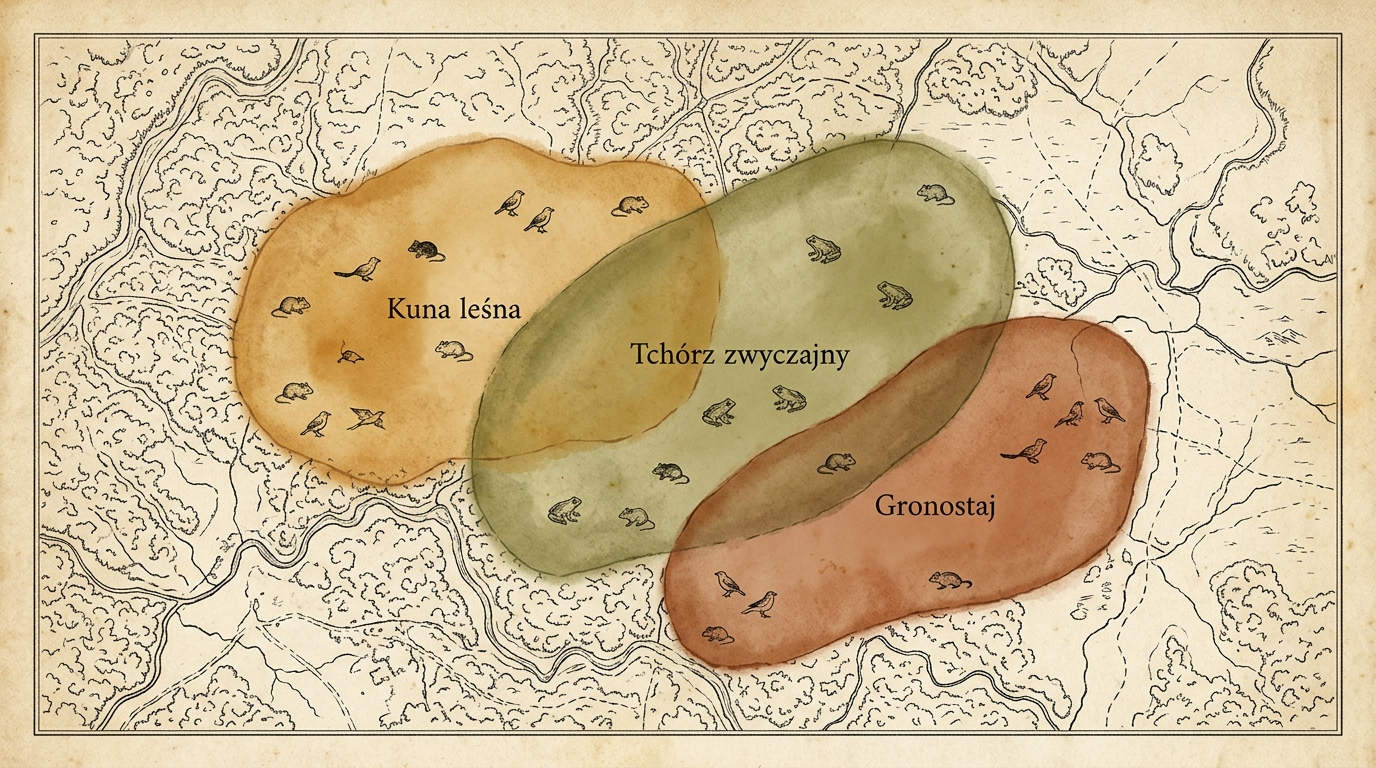
In mustelids, home range size is almost linearly correlated with body mass — a larger predator needs more prey, and more prey requires a larger area. For orientation: the least weasel needs 1–10 ha, the stoat 10–40 ha, the beech marten 30–80 ha, the pine marten 50–250 ha, and the polecat 50–150 ha. The badger has a clan range of 30–150 ha (shared by 4–8 individuals), and the otter measures its territory in kilometers of shoreline — from 5 to 15 km for a male.
Within each of these areas, there is an internal geometry: the core (where the animal spends most of its time and defends aggressively), the usage zone (hunting paths, movement corridors), and the periphery (visited seasonally, shared with neighbors). Males have home ranges 1.5–3 times larger than females and often encompass the areas of 2–4 females — a typical polygynous pattern.
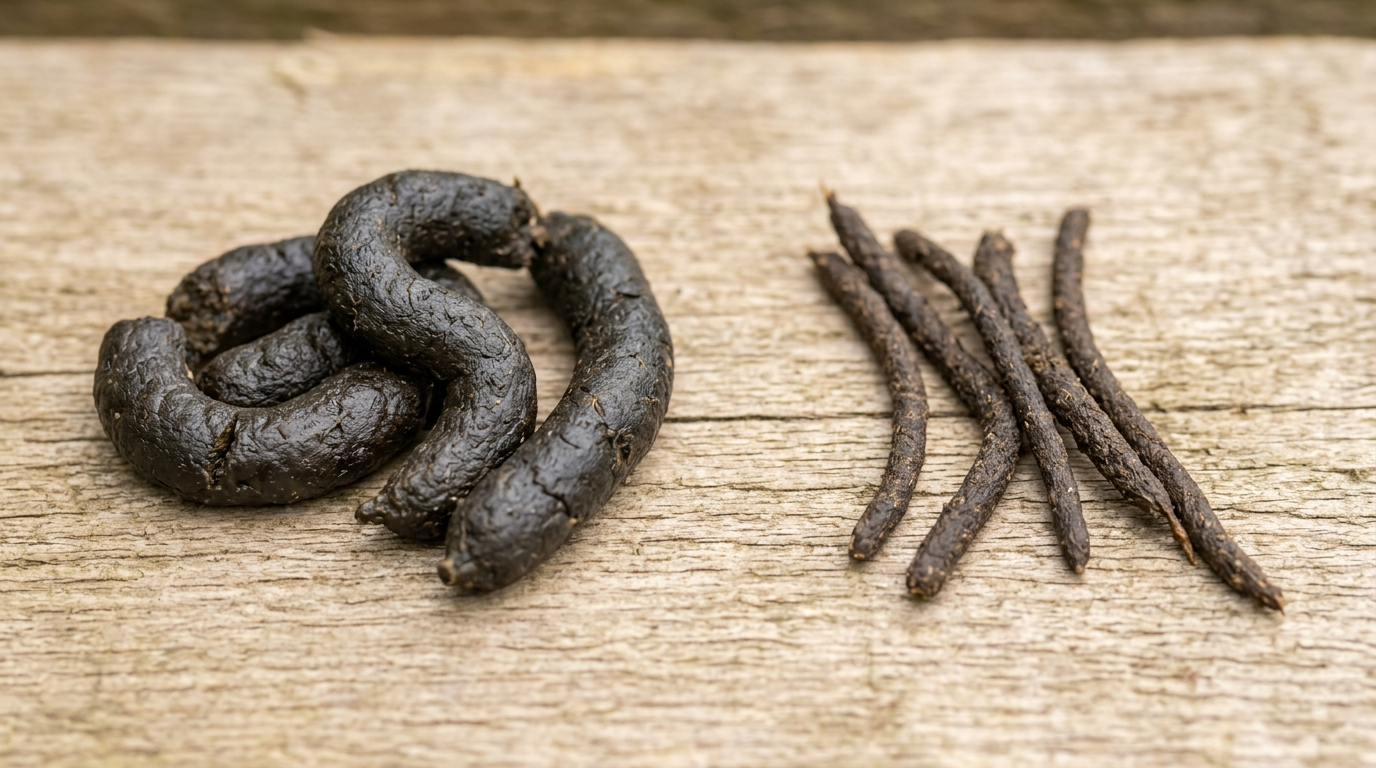
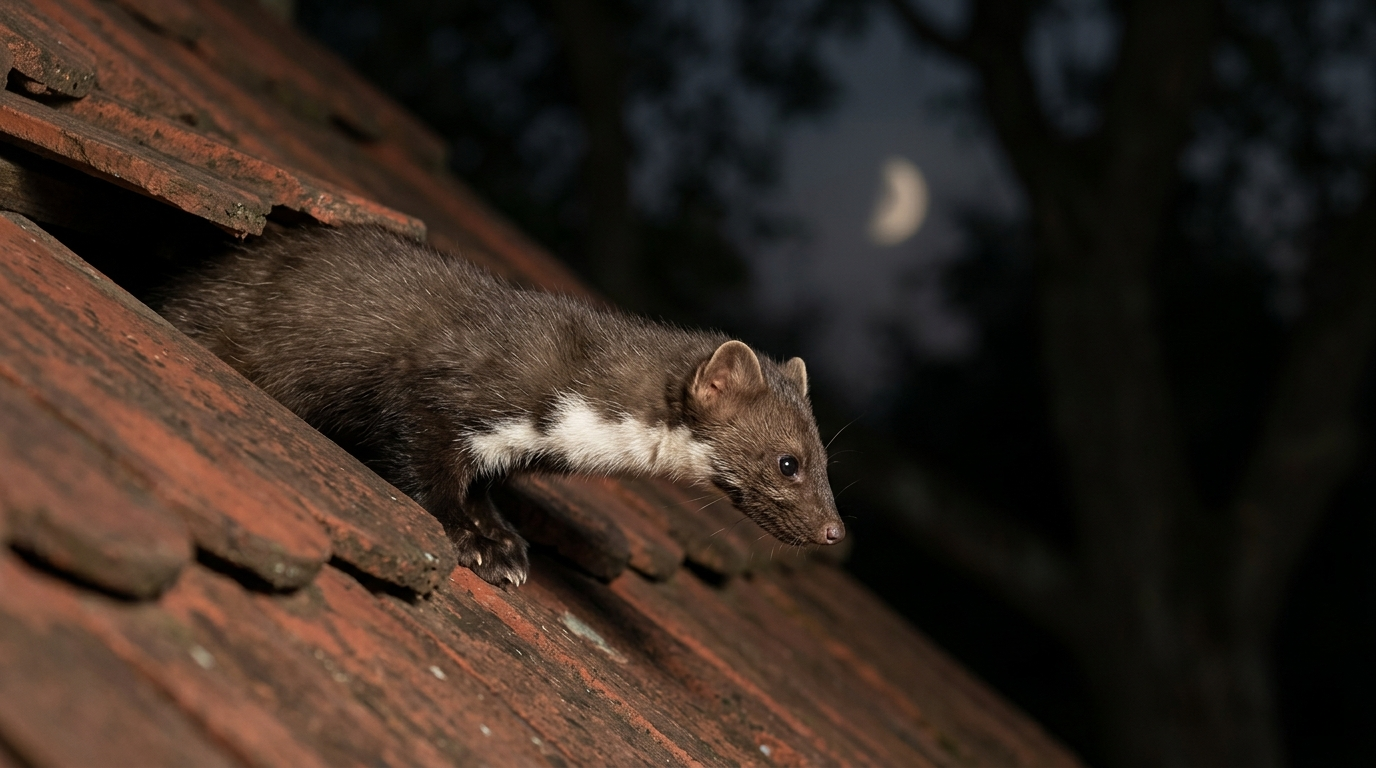
Boundaries are not lines on a map — they are scent clouds. Every mustelid marks its territory with anal gland secretions, urine, and feces placed in exposed spots. The badger uses clan latrines — small pits dug at fixed points on the range boundary. The beech marten leaves droppings on roof ridges, wall edges, and tiles. The polecat marks along ditch banks. The otter uses spraints — droppings on characteristic rock outcroppings over water. Each chemical language is different and legible only to its own species.
Neighbors' home ranges rarely overlap perfectly — more often, they overlap at the edges in a zone of 10–20% of the surface area. This is the strip where species meet during hours when one of them is resting. A detailed record of the pine marten's chemical signature can be found in the article Marten diet — the content of the dropping is simultaneously the scent label of the home range.
§ 03Hunting strategies — six styles of hunting
Each of the native mustelids has developed its own food acquisition technique, which explains its anatomy, daily rhythm, and environmental choice. Understanding these techniques is key to understanding why six so similar animals do not eliminate each other.
- Least weasel — burrow specialist. Its cylindrical, narrow body (chest diameter barely 3–4 cm) allows it to enter the tunnels of voles and water voles, where it hunts underground. It is the only native predator capable of doing this systematically. Diet: 90% mouse-sized rodents.
- Stoat — medium rodent hunter. Slightly too large for vole burrows, so it hunts mainly on the surface: voles, young hares, young rabbits, ground-nesting birds. Characterized by a „dance” that disorients prey before an attack. Effective on both snow and meadow.
- Pine marten — arboreal acrobat. Jumps between canopies, plunders squirrel nests and hollows, hunts birds sleeping during the day. A foot reversible by 180 degrees allows it to descend trunks head-first. Menu: forest rodents, squirrels, birds, insects, seasonal fruits.
- Beech marten — anthropogenic opportunist. Less arboreal than the pine marten, more terrestrial and „vertical” within buildings (gutters, chimneys, roofs). Eats everything: rodents, pigeons, eggs, kitchen scraps, fruit. Adapts its diet to what the human neighborhood provides.
- European polecat — wetland hunter. The only native mustelid that regularly hunts amphibians (frogs, newts) and small mammals in humid environments. Enters the water, though does not dive for long. Caches prey — paralyzed frogs are stored in an underground chamber.
- European otter — fish specialist. 80–95% of the diet is fish (roach, perch, ruffe, eels), supplemented by crayfish, frogs, and waterfowl. Dives for 30–40 seconds, hears fish movement underwater with vibrissae. Catches one at a time and carries them to shore.
- Badger — terrestrial omnivore. The least „predatory” of the family. 50–60% of the diet consists of earthworms (collected during nightly meadow rounds), the rest is roots, fruits, rodents, young hares, and eggs. Snout in the ground, paws for digging — anatomy different from its relatives.
Six bodies with almost identical templates perform six completely different jobs. Mustelid ecology is a lesson in how strong specialization can be with minimal anatomical differences.
§ 04Daily and seasonal activity — who hunts when
The second mechanism separating niches is time. Even if two species use the same clearing, they can avoid each other thanks to different activity hours. Poland's mustelids show clear patterns here — consistent and predictable.
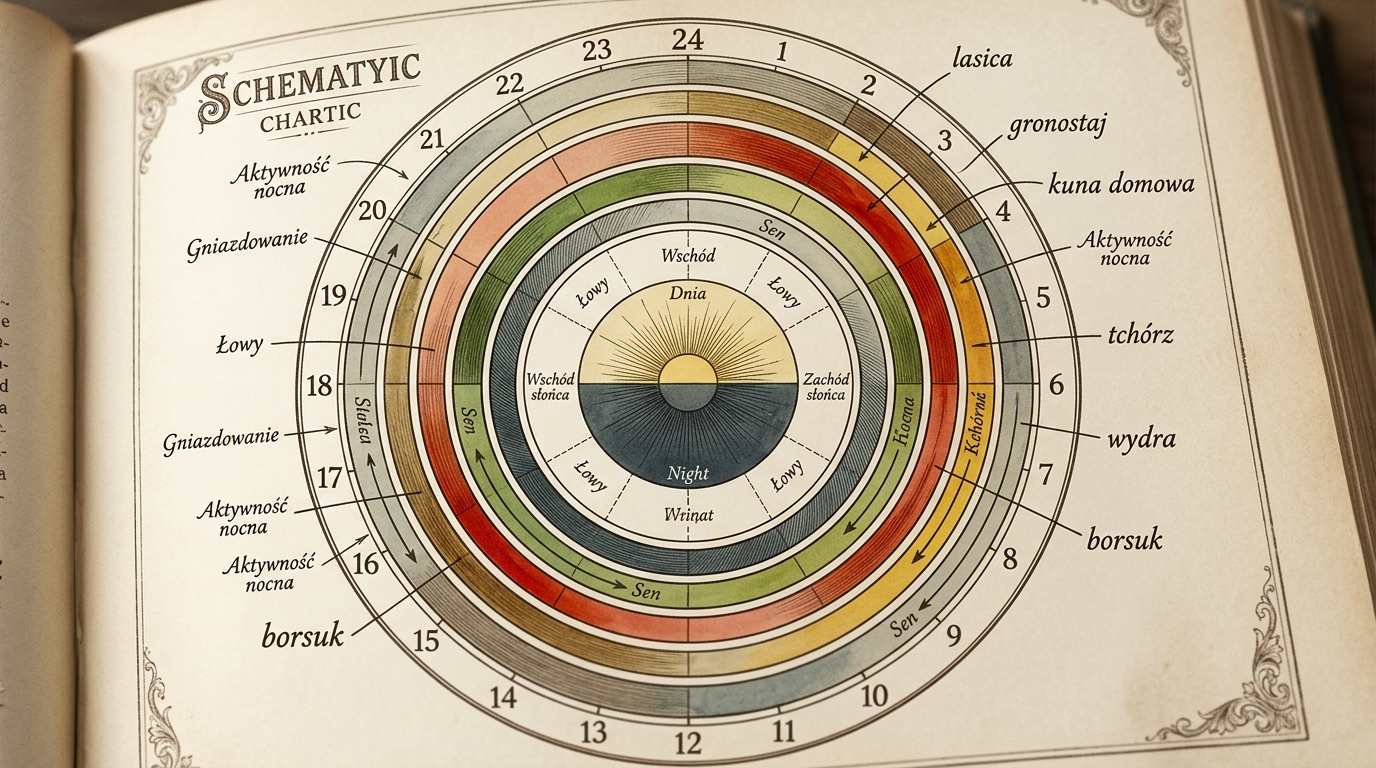
The beech marten, pine marten, and polecat are nocturnal species in the full sense of the word — activity increases 30–60 minutes after sunset, peaking between 22:00 and 4:00, with a return to the shelter an hour before dawn. The badger is even stricter: it leaves the sett only in complete darkness and dislikes full moonlight (on those nights, it usually remains underground).
The weasel and stoat have a completely different rhythm — short cycles of activity and rest every 2–4 hours throughout the day. This is due to physiology: their bodies lose heat very quickly (high surface-to-mass ratio), so they must eat frequently. A weasel eats 30–40% of its own mass daily — it does not have the luxury of waiting for night. The otter is primarily crepuscular, but in quiet places, it also hunts during the day.
The seasonal dimension works just as clearly. The badger enters a state of winter torpor (not true hibernation — body temperature drops by only a few degrees) from November to March, and in colder winters up to 5 months without leaving the sett. This is a period when its niche opens up for others — the polecat and beech marten then take advantage of the earthworms and rodents that the badger is not collecting. The remaining species remain active all winter — the weasel even under the snow, in mouse tunnels, where it hunts voles without coming to the surface.
§ 05Interspecific competition — who displaces whom
Despite all the niche-separating mechanisms, encounters do happen — and they always end according to the same hierarchy: larger displaces smaller, stronger scent displaces weaker, local resident displaces intruder. These are the three rules from which the entire geography of Poland's mustelids follows.
A classic example: pine marten and beech marten. Where the forest meets a settlement, the pine marten sticks to the woodland, and the beech marten to the buildings. The overlap zone (forest edge, abandoned farms) is rarely shared; one of the martens usually gives way. German studies show that in heavily anthropized areas, the beech marten effectively displaces the pine marten from old cultural behaviors. You can read more about this pair in the article Pine marten vs beech marten.
Second example: stoat and least weasel. The stoat is 2–3 times larger and regularly kills the weasel upon meeting — sometimes eating it, sometimes leaving it as a territorial signal. Where a stable stoat population appears, the weasel retreats to the smallest burrows and places with dense, low vegetation (stone piles, balks, foundations of old buildings). This mechanism pushes the weasel closer to humans, paradoxically making it easier to observe in gardens.
Third example: otter and American mink. The invasive mink (Neogale vison) occupies a similar niche to the native European mink and partially overlaps with the otter. However, the otter is 3–4 times heavier and absolutely dominant — when it returns to a watercourse from which it was absent for years, the American mink gives way or moves to smaller tributaries. This is a rare case where a native species actively limits an invasive one.
In ecology, this phenomenon is called intraguild predation — predation within the same feeding guild. The stoat kills the weasel, the pine marten kills the stoat, the lynx kills the pine marten. The weight hierarchy works down the family (and beyond it) — and it is this, more than competition for food, that shapes population distribution.
§ 06Adaptations to human proximity
Not all mustelids deal with humans in the same way. Five levels of adaptation, from full synanthropy to extreme avoidance — this is one of the most interesting gradients in Polish fauna.
The beech marten is a fully synanthropic species — it not only tolerates humans but actually prefers them. Attics are warmer and safer for it than tree hollows, wood piles offer more hiding places than a natural forest, and trash cans and compost heaps provide more predictable food than field rodents. The beech marten population in Polish cities has been growing steadily since the 1970s. The consequences of this adaptation are described in the article Beech marten and weasel — their role in the ecosystem.
The European polecat is a classic semi-automatic synanthrope. It chooses not houses, but the edges of buildings: abandoned farms, barns, straw stacks, edges of fish ponds. It is tolerant of humans but does not seek them out. In winter, it sometimes enters basements and outbuildings where it catches mice and rats. Its presence near humans is functional: a farm with a polecat has a smaller rodent population.
The otter has a specific adaptation: it uses human river infrastructure. Road bridges, culverts, and hydroelectric dam weirs are regular points on its routes — it leaves a spraint under a bridge because it's a good, exposed scent spot; it can rest in a culvert during the day. The otter does not seek out residential buildings, but it recognizes linear infrastructure and incorporates it into its home range.
The badger is a peripheral neighbor — it often digs its multi-generational setts on the outskirts of cities (parks, abandoned orchards, railway embankments), taking advantage of access to compost heaps and vegetable gardens, but avoiding the center of human activity. A badger clan can stay in one sett system for 50–80 years, even as the surrounding forest turns into a housing estate.
On the opposite side of the scale are the pine marten, stoat, and least weasel. The pine marten is the most forest-dependent of the native mustelids — the presence of roads reduces population density linearly. The stoat and weasel tolerate open agricultural landscapes but avoid residential buildings — unlike the beech marten, which is attracted to them. This gradient has significant practical consequences: in the garden, you will mainly meet the beech marten, the weasel, and sometimes the polecat; you must look for the other species yourself, in the field.
§ 07Ecological niche comparison table
Six native mustelids in one overview — home range, main prey, activity hours, preferred habitat, and way of dealing with humans. The table brings together in one place what was scattered across the six previous sections.
| Species | Home range | Main prey | Activity | Habitat | Anthropogenic adaptation |
|---|---|---|---|---|---|
| Least weasel | 1–10 ha | voles in burrows | 24/7 cyclical | meadows, balks, stone piles | gardens, foundations (indirectly) |
| Stoat | 10–40 ha | voles, young hares | 24/7 cyclical | meadows, forest edges, water banks | tolerant, avoids buildings |
| Beech marten | 30–80 ha | rodents, birds, eggs | nocturnal | buildings, cities, villages | full synanthropy |
| Pine marten | 50–250 ha | squirrels, birds, fruit | nocturnal | old-growth forests | avoids humans |
| Polecat | 50–150 ha | amphibians, rodents | nocturnal with daytime episodes | waterfront thickets, wetlands | farm edges, barns |
| Otter | 5–15 km shoreline | fish, crayfish, amphibians | crepuscular | rivers, lakes, ponds | uses bridges and culverts |
| Badger | 30–150 ha (clan) | earthworms, roots | nocturnal, winter sleep | mixed forests, embankments | city outskirts, parks |
The table is an operational tool. If you see a mustelid predator at dawn by a ditch with a frog in its mouth — it is a polecat, not a marten; in a mouse tunnel in the snow in winter — a weasel, not a stoat; under a bridge on a river with a fresh spraint — an otter, not a mink. Each cell in this table is a filter that narrows the list of candidates down to one.
Understanding a neighbor's ecology is the first step; the second is deciding what to do with them. If a species has entered into conflict with a farm (chicken coop, koi pond, attic with insulation), attempting independent action often complicates the matter more than it resolves it — especially with strictly protected species. In such situations, it is worth delegating the assessment and procedure to a specialist with the appropriate permits; this saves time, money, and unnecessary stress for the animal.
The entire six-member family is currently stable or growing in the Polish landscape — with the exception of the native European mink, which has practically disappeared. Understanding the niche division allows us to look at this landscape differently: as a game of precisely positioned pieces, where each of the six players has its own square — and very rarely leaves it without a reason.
★Frequently asked questions
How much territory does one marten occupy?
The home range of a beech marten in Poland is typically 30–80 ha, of which the core (intensely used zone) is 5–15 ha. Males have ranges 1.5–3 times larger than females and often encompass the areas of 2–4 females. The pine marten needs much more — 50–250 ha, and up to 400 ha in old-growth forests. Boundaries are scent clouds, marked with droppings in exposed spots (roof ridges, wall edges, stumps) and anal gland secretions. Neighbors' ranges overlap at the edges in a 10–20% zone.
Can the weasel and stoat live next to each other?
Yes, but with a hierarchy. The stoat is 2–3 times heavier and regularly kills the weasel upon meeting — this is a classic example of intraguild predation. The weasel then retreats to the smallest burrows and places with dense, low vegetation (stone piles, balks, building foundations). Paradoxically, this mechanism pushes the weasel closer to humans, where the stoat does not enter. Where populations of both are stable, they divide the landscape vertically: the weasel in tunnels underground, the stoat on the surface.
Why are mustelids active at different times?
This is a mechanism of temporal niche separation. The beech marten, pine marten, polecat, and badger are nocturnal — with peak activity between 22:00 and 4:00. The weasel and stoat have 2–4 hour cycles throughout the day because their bodies lose heat too quickly to wait 18 hours for the next meal (a weasel eats 30–40% of its own mass daily). The otter is primarily crepuscular. The badger hibernates lightly from November to March — during this time, its niche of earthworms and roots opens up for other species.
Which mustelid copes best close to humans?
The beech marten is a fully synanthropic species — it not only tolerates humans but actually prefers them. Attics are warmer than hollows, wood piles offer more hiding places than the forest, and compost heaps and trash cans provide predictable food. The population in Polish cities has been growing since the 1970s. The polecat chooses farm outskirts (barns, straw stacks), the badger digs setts on city peripheries, and the otter utilizes bridges and culverts. The least tolerant of humans are the pine marten, stoat, and least weasel.
Does a badger hunt like a marten?
No. The badger is the least predatory of the native mustelids. 50–60% of its diet consists of earthworms, collected during systematic nightly rounds of meadows after rain. The rest of the menu is filled with roots, fruits, rodents, young hares, and eggs of ground-nesting birds. The badger's anatomy reflects this diet: a stocky body, short legs, long claws for digging, and a snout usually close to the ground. A marten is an active vertical hunter (trees, roofs, chimneys), while a badger is a terrestrial gatherer.
How do mustelids share the same area?
Four mechanisms: different prey size (weasel — mice in burrows, marten — rodents and birds, otter — fish), different landscape level (weasel underground, pine marten in canopies, badger underground in clan setts, otter in water), different activity hours (nocturnal martens and badger vs. cyclical weasel), and scent marking of boundaries, which reduces the number of encounters. Neighbors' home ranges overlap only at the peripheries, and in the overlap zone, one species usually gives way to the stronger one — a phenomenon known as intraguild predation.