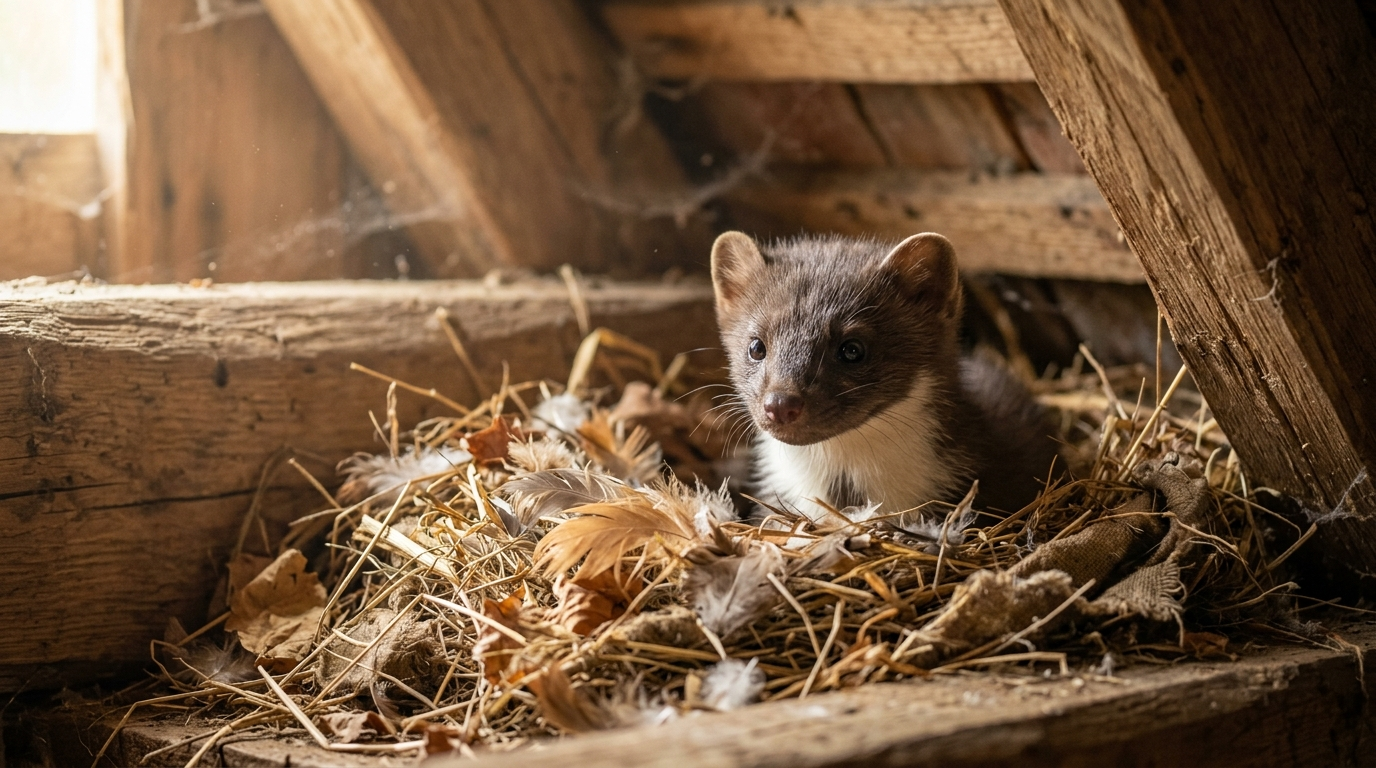
Most people only ask about young martens when they hear them — high-pitched, chirping squeaks coming from somewhere under the joists or behind the chimney casing. The question is usually short: when will they leave and what to do until then. The answer is longer than it seems — because the reproductive cycle of the beech marten and pine marten is one of the most intriguing among European mammals.
This guide leads through the full cycle: from summer mating, through the physiological phenomenon of embryonic diapause, birth, the first weeks in the nest, to the moment when the young disperse into their own territories. It also shows how to recognize if there is a litter in the attic and what (not) to do if you happen upon this period. For a concise summary of adult ethology, we refer to the text Beech marten habits.
§ 01When martens reproduce — summer mating
The mating season of both domestic martens — the beech marten (Martes foina) and the pine marten (Martes martes) — falls in July and August, with local advancement by a few weeks in warmer regions of southern Poland. This is an unusual timing compared to most European predators, which associate mating with early spring. Martens have their evolutionary reason for this, which we return to in section 02.
The signal for the opening of the season is a change in vocalization. Animals that are usually very discreet begin to make long, moaning calls — deceptively similar to cat meowing, only lower and more rhythmic. This is primarily the voice of females in heat, but also of males patrolling significantly expanded territories. Anyone who has heard marten mating in the attic on a July night even once remembers that sound for years.
During the mating season, the male crosses his usual boundaries, visiting the territories of several nearby females in turn. Encounters with other males end in physical confrontation more often than in other months of the year — hence the characteristic scars on the muzzles of older animals. Copulation itself is long: it lasts from several minutes to even an hour and is repeated multiple times a day, sometimes for two or three consecutive evenings. This mechanism increases the chances of fertilization because in martens, ovulation occurs inductively — after stimulation by copulation, rather than spontaneously.
Mating in the middle of summer seems counterintuitive — after all, the young are not born until spring. The key is delayed embryo implantation: copulation in July produces an embryo that only begins to develop in February. The mating season is chosen for the availability of partners (summer — peak population activity), not for the availability of food for the young — which is ensured by a separate „window" in the physiological calendar.
§ 02Delayed implantation — a biological masterpiece
Embryonic diapause, or delayed embryo implantation (embryonic diapause), is the most interesting reproductive mechanism of martens and — more broadly — many mustelids. It consists of the fact that the fertilized egg, transformed into a blastocyst after several divisions, does not immediately embed in the uterine lining. For long months, it floats freely in the uterine cavity in a state of almost complete metabolic arrest.
In martens, this period averages 7–8 months. For comparison: in badgers 9–10 months, in stoats 9–10 months, while in the European bank vole, diapause does not exist at all. The mechanism is hormonally controlled and turns on in response to the photoperiod: at the moment when the day length begins to clearly increase (the turn of January and February), prolactin levels drop, the female's body „unlocks" the uterus, and the blastocyst embeds in the lining. From this point, the actual pregnancy, lasting only about a month, is counted.
Evolution in martens has separated the moment of copulation from the moment of embryo development — and placed half a year of waiting between them. From the female's point of view, this is a luxury: mating without the metabolic cost of pregnancy.
Why did this mechanism evolve at all? Three hypotheses are not mutually exclusive and probably all have some merit. First — separating the mating season (when the population is dense and the chance of a partner is greatest) from the birth (when food for the young is easy to find). Second — the possibility of „halting the pregnancy" in case of poor conditions, although field data suggest that females in very poor condition more often resorb the embryo than prolong the diapause. Third — genetic quality control: the long period between fertilization and implantation selects only healthy blastocysts.
For the field observer, diapause has one fundamental consequence: calculated from copulation, pregnancy in a marten lasts a total of about 9 months, although actual embryo development takes 4–5 weeks. This is why old guides sometimes list „pregnancy 30 days" and others „9 months" — both descriptions are correct, referring to different stages of the same process.
§ 03Pregnancy, birth, and litter size
After blastocyst implantation, embryo development proceeds typically for mustelids. Actual pregnancy lasts about 30 days (28–32, with sporadic exceptions in both directions). During this time, the female significantly reduces the range of her nightly rounds, returns more often to the same hideout, and engages in more intensive foraging — weight gain in the second half of pregnancy is clearly visible in animals caught for telemetry studies.
Just before giving birth (24–48 hours earlier), the female chooses one well-secured place for a nest and brings lining material to it: dry hay, leaves, moss, bird feathers, sometimes fragments of insulation wool from the attic, dog or cat hair. The nest has the shape of a compact ball with a diameter of 25–35 cm and a clear, tight interior. Most often it is created in an attic, in the ceiling above a cow shed, in an abandoned barn or in a woodpile; less frequently, though still classic — in the hollow of an old tree or between roots.
Birth occurs in March or April — with a very narrow peak in the second and third decade of March. Locally, individual litters may shift by two or three weeks in either direction, but fluctuations outside the March–April window are rare. A litter usually consists of 2–7 young, most commonly 3, sometimes 4. Extreme numbers (1 or 7) do occur, but are reserved for females in exceptional condition or, conversely, for first-time mothers.
| Cycle Stage | Timing | Duration |
|---|---|---|
| Mating / copulation | July–August | several days |
| Delayed implantation | August–January | approx. 7–8 months |
| Actual pregnancy | February–March | approx. 30 days |
| Birth | March–April | — |
| Litter care | March–July | approx. 3–4 months |
| Independence of young | July–August | — |
| Sexual maturity | Summer of following year | 12–18 months from birth |
The pine marten has an almost identical cycle — differences are at the level of weeks and stem mainly from the fact that it lives in a cooler forest environment with a slightly later spring. A detailed comparison of both species can be found in the guide Pine marten vs beech marten.
§ 04First weeks of life in the nest
Newborn martens weigh only 25–30 g — which is less than an average house mouse. They are about 10 cm long, covered with sparse, light gray down through which pink skin peeks out. They are born blind, deaf, and toothless, unable to regulate their own body temperature. Full dependence on the mother in the first two months of life is not a metaphor but a literal biological necessity.
For the first 7–10 days, the female spends practically all her time in the nest. She leaves only for very short foraging trips (15–30 minutes), usually shortly after sunset, to the nearest food sources — compost bins, chicken coops, rodent habitats within 100–200 m of the nest. This is why conflict with poultry intensifies dramatically in March and April — a nursing mother needs approx. 1.5–2 times more calories than at other times of the year, and a chicken coop is the nearest dense source of calories in the area.
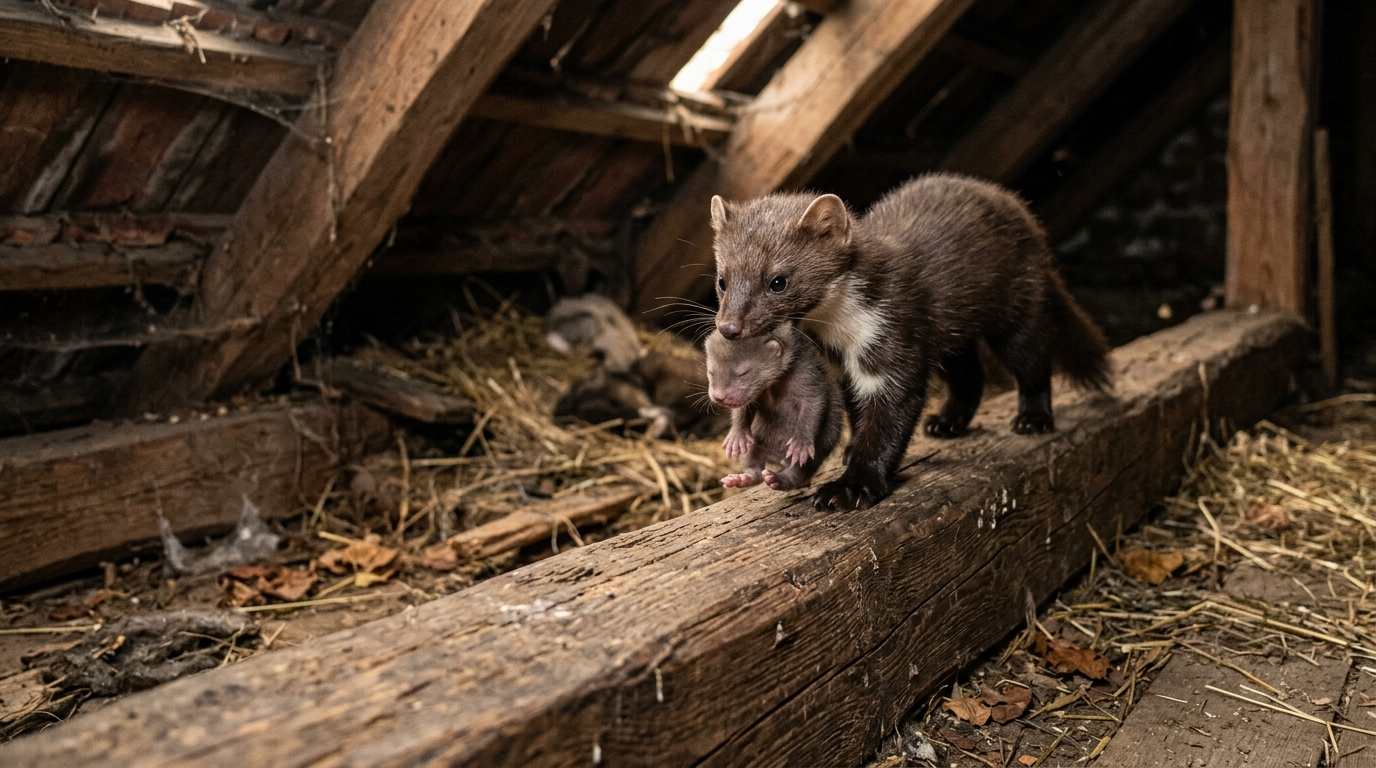
A characteristic feature is the tendency to move the litter. At least once, more often twice during rearing, the female moves the young to another, backup nest. The reason is most often the soiling of the primary hideout (parasites, food remains) or disturbance by humans — scent after entering the attic, smoke, intense noises. The moving takes place one by one, in the mouth, by the scruff of the neck — just like with cats. The entire operation takes 1–3 hours and always takes place at night.
Until about the 3rd week, the young make almost no sounds — occasional chirps during feeding are the only sign of life. From the 3rd–4th week, their vocalization becomes louder and more varied, and from the 5th week, clear squeaks and short growls in play can be heard. This is when house residents begin to hear „something more than one animal" above the ceiling.
§ 05Development and milestones
The development rate of young martens is relatively slow for mustelids — faster than a badger, but clearly slower than a least weasel. The key stages in the first two to three months of life are predictable enough that they allow for dating the age of a litter found in an attic with good approximation.
- Week 1–2: mass grows from 25–30 g to approx. 60–70 g. The young sleep practically all the time, suckling every 2–3 hours. No pigmentation in the fur, no teeth. Zero thermoregulation — without the mother, they cool down in a dozen or so minutes.
- Week 3: the first milk incisors grow in. The fur darkens, an outline of the white bib appears on the chest. Hearing begins to function — the young react with a startle to sudden sounds.
- Week 4 (approx. 30th day): opening of eyes. The most distinct moment in development. Full fur, thermoregulation begins to work, the young can temporarily leave the mother. Mass: 130–180 g.
- Week 5–6: first attempts at solid food — initially semi-liquid fragments of prey brought by the mother (brain, bird liver, young mice). Milk still dominates, but the share of solid food grows day by day. First quarrels and play in the nest.
- Week 7–8: first excursions from the nest. First a few meters around the attic or barn, then further and further. Fur already similar to adult coloration, though downy and lighter. Mass: 350–500 g.
- Week 10–12: first nightly trips with the mother. Learning to hunt small rodents, attempts at stalking, the „kill anything that moves" instinct begins to kick in. Milk is gradually phased out.
- Month 4: functional independence. The young hunt independently, though still within the mother's territory. They slowly prepare for dispersal.
From the moment the eyes open in the 4th week, development is almost linear — each subsequent week is a clear step forward, easy to notice in field observation. One of the best times for non-invasive observation of young under their mother's supervision is late June and July, when „teenagers" tumble out onto the roof tiles in the first hour after dusk — especially in old farms with roofs covered in metal sheets or fiber cement, where every step can be heard.
§ 06How to recognize if there are young in the attic
Most house residents only find out about a marten litter in the 5th–7th week of its life, when the young begin to vocalize and leave the nest. Earlier, the presence of a litter is only revealed by the mother's behavior — which, if you know what to look for, is quite clear.
Five diagnostic signals, in order of appearance from March to June:
- Short excursions at dawn — a nursing female regularly goes out 30–60 minutes before dawn for very short foraging. If you consistently see someone disappearing into the same gap between 4:30 and 5:30, that's her.
- Excursions in broad daylight — in May and June, the female cannot sustain herself on nights alone. If you see a marten regularly after 7 AM and it looks healthy, it is very likely a nursing mother, not a sick animal.
- Characteristic squeaks — high-pitched, chirping sounds coming from behind the ceiling casing or from the attic, most often between 10 PM and 1 AM and just after dawn. They begin around the 3rd week and intensify in the 5th–6th.
- The sound of many pairs of paws — from the 7th–8th week. Instead of one „gallop," a chaotic scratching appears in three different places at once; characteristic are short sprints on the rafters interrupted by falls and squeaks of play.
- Increased amount of droppings on the roof — during the rearing season, the female marks much more often than usual. Strands of cylindrical droppings on the edge of the gutter or wall increase from week to week. For recognition details, see How to recognize the presence of a marten or weasel in the garden.
If there are young in the attic, do not scare away the mother. A frightened female will not return, and orphaned young under 6 weeks old will die of hunger within 3–5 days — often in an inaccessible place, where they then decompose for weeks. The rule of thumb is simple: wait until the end of care (August), and only then seal the house. Attempts at chemical repellents during lactation are ineffective (the mother will overcome any smell to reach her young) and cruel. If you must do something today, limit yourself to gentle light deterrents near the mother's external paths — without interfering with the nest itself.
§ 07Dispersal and sexual maturity
After reaching full functional independence in the 3rd–4th month of life, young martens do not leave immediately. For the next few weeks — usually until the end of September — they remain within the mother's territory, hunting independently but still using her hideouts. This stage is called the early-teenage phase in ethological literature, in which tensions with the mother grow from week to week.
Actual dispersal occurs in September–November. Young martens leave their mother's territory and wander in search of their own — sometimes 5–10 km, sometimes (mainly males) over 20 km from their birthplace. It is during this period that „new" martens most often appear in homes where there was no problem before: an inexperienced individual looks for a winter shelter and chooses the first attic they can access. Dispersal is also the period of highest mortality in the life cycle — the rate of roadkill and collisions with large predators reaches its annual peak in October and November.
Young martens reach sexual maturity at 12–18 months of age, which is in the summer of the year following their birth. Some females born in March can take part in mating as early as July of the same year (15–16 months of age), but a real chance for the first litter only appears in the 2nd or 3rd year of life — first-time mothers usually have smaller litters and higher young mortality. Males mature slightly later than females and usually participate in mating for the first time at 18–24 months.
Average lifespan in the wild is 3–5 years, though record-holders live to 10. A female therefore has a realistic chance to raise 2–4 successful litters in her lifetime; a male fathers a larger number of litters within his territory but plays a minimal role in caring for the young (after mating, he returns to a solitary lifestyle and does not participate in rearing). You can find more surprising facts about the biology of both species in the text Interesting facts about martens and weasels.
Marten reproductive cycle: mating in July and August, delayed implantation 7–8 months, actual pregnancy 30 days, birth in March–April, litter of 2–7 young. Opening of eyes in the 4th week, first excursions in the 8th, independence after 3–4 months, dispersal in autumn, maturity after 12–18 months. Until the end of July, leave the mother in peace — start sealing the house in August when the nest is empty. The role of both species in natural rodent population regulation is described separately in the text about the role of martens and weasels in the ecosystem.
★Frequently asked questions
When do martens have young?
Young martens are born in March and April, with a peak in the second and third decade of March. Although copulation took place 9 months earlier (July–August), actual embryo development takes only about 30 days — between these stages, there is delayed implantation lasting 7–8 months. The birth timing is very stable annually for martens and depends little on the region.
How many young does a marten have in one litter?
A litter of beech marten and pine marten usually consists of 2–7 young, most commonly three. Extreme numbers (1 or 7) are rare — singletons are typical for first-time mothers or females in poor condition, while seven-member litters are for exceptionally strong adult females. The average in populations is about 3.1 young per litter.
What is delayed implantation in martens?
Delayed implantation (embryonic diapause) is a mechanism where a fertilized blastocyst does not immediately embed in the uterus but floats in it for 7–8 months in a state of suspended development. Implantation only occurs in January or February triggered by increasing day length, and the actual pregnancy then lasts only about 30 days. This mechanism also occurs in badgers, stoats, and several other mustelids — it allows separating the moment of mating (summer) from birth (early spring).
How long does a marten's pregnancy last?
The answer depends on what you count. From copulation to birth, about 9 months pass, but this is the time in which for 7–8 months the embryo „waits" in a state of diapause. Actual pregnancy after blastocyst implantation lasts only about 30 days (28–32). Old guides therefore provide two different numbers — both are correct, describing different phases of the cycle.
How to recognize if there are young martens in the attic?
Five signals: (1) regular female excursions 30–60 min before dawn, (2) excursions in broad daylight in May–June, (3) high-pitched, chirping squeaks coming from behind the ceiling, loudest approx. 10 PM–1 AM and just after dawn, (4) the sound of many pairs of paws instead of one „gallop" from about the 8th week of the kits' life, (5) a significantly increased amount of droppings on the roof edge. All together, these mean a litter is present — and that intervention is a bad idea until the end of July.
When do young martens become independent?
Eyes open around the 30th day of life, first excursions from the nest after 8 weeks, full functional independence after 3–4 months (July–August). Proper dispersal — leaving the mother's territory — occurs in autumn (September–November), when young wander 5–20 km in search of their own territory. They reach sexual maturity at 12–18 months, but the first real litter usually only occurs in the 2nd–3rd year of life.