„Something darted across the path — long, dark, low" — this sentence appears in our portal's inbox several times a week. However, answering the question marten or weasel requires not guesswork, but hard morphological features: dimensions, mass, fur color, bib shape, tail proportions. From ten meters away, both look similar, but once you learn to look correctly — a mistake becomes impossible.
This guide is an atlas of differences in seven sections. It starts with the simplest feature — dimensions — and dives into details: fur color and density, the bib, tail, paws, head, and finally a comparison table gathering everything in one place. If you are interested in the broader ecological background of this pair, also check the text marten vs weasel — what is worth knowing about these mammals, where we combine morphology with behavior and biology.
§ 01Dimensions and Weight — A Difference of an Order of Magnitude
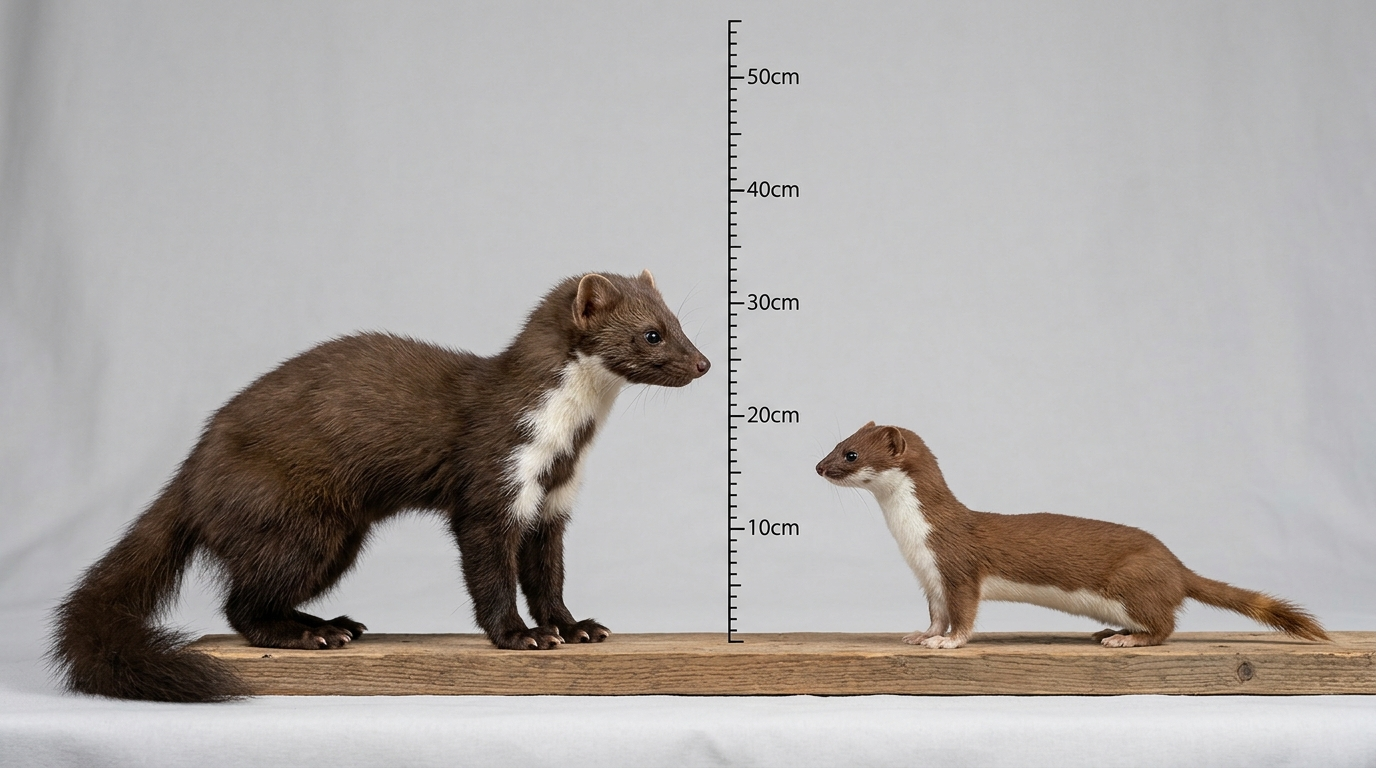
The simplest, most reliable, and at the same time most surprising identification feature for a layperson: the marten and the weasel differ in size by an entire order of magnitude. It's not that one is „a little bigger" than the other — it's that an adult stone marten weighing a kilogram and a half is ten to twenty times more than an adult least weasel. This is a difference comparable to that between a domestic cat and a small hamster.
The stone marten (Martes foina) measures 40–50 cm in body length, plus a bushy tail of about 22–26 cm. Thus, the total animal measures nearly 70–75 cm from nose to the end of the tail. Mass is typically 1.1–2.3 kg, averaging around 1.5 kg. The silhouette is stocky, strongly built, with short legs and a wide chest.
The least weasel (Mustela nivalis) is the world's smallest carnivore. Body length is 15–23 cm (males larger than females), with a tail of only 4–7 cm. The entire weasel — from muzzle to tail tip — fits in an adult human's hand. Mass is 70–150 g, which is less than an average apple. The silhouette is extremely elongated, „snake-like," with a flat head and almost no neck narrowing.
If the animal that darted across your path was at least the length of a human forearm (40 cm) and had a visible bushy tail — it's a marten. If it was the size of a thick marker and disappeared into a crack a house mouse couldn't enter — it's a weasel. There are practically no intermediate sizes in Polish nature; the stoat is the only candidate for „something in between," but more on that in another text.
§ 02Fur — Density, Color, Seasonal Changes
The second feature visible from a greater distance is fur color and texture. Here, the differences are less dramatic than in dimensions, but they have one surprising property — in the weasel, they change depending on the season and geographic latitude.
The stone marten has uniformly dark brown fur, sometimes with a slight grayish cast, dense and double-layered (underfur + guard hair). The summer coat is slightly thinner and more reddish; the winter coat is thick, long, and soft to the touch. The belly is usually slightly lighter than the back, but still in brown tones. No stone marten individual in Poland turns white in winter; if you see a white mustelid on the snow — it's not a marten.
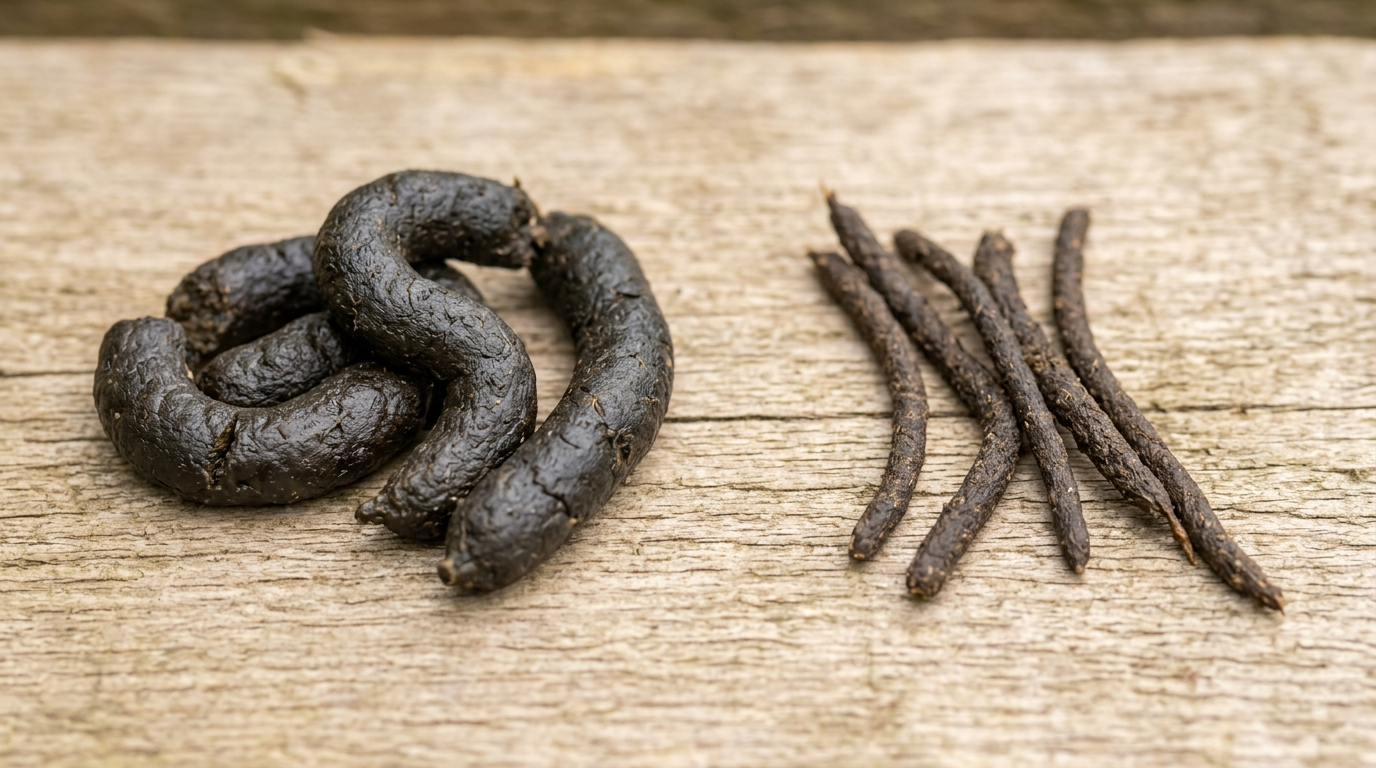
The least weasel has clearly two-toned fur: the upper body is reddish-brown to chestnut, while the underside (chin, throat, chest, belly, inner sides of legs) is pure white. The boundary between colors is sharp, straight, and runs along the sides of the body. The hair is short, smooth-lying, and glossy — in contrast to the fluffy, „meaty" fur of the marten. This is also why the weasel's tiny, slender droppings can sometimes be easily mistaken for a dropped feather.
The most interesting feature of the weasel is seasonal color dimorphism. In northern and eastern Poland — in the Suwałki region, Tuchola Forest, Masuria, and the Carpathians — part of the population turns completely white in winter, resembling a stoat (with which it is often confused). In the west and south of the country, the change is only partial: the animal remains brown, only slightly lighter. This phenomenon, known as seasonal polymorphism, is hereditary and dependent on climatic conditions.
A white weasel on snow in Poland is not necessarily a stoat. The key is the tip of the tail: in a stoat, it is always black; in a least weasel, it is uniformly white or briefly brown. The second marker — the tail itself: in the weasel, it's very short (up to 7 cm); in the stoat, it's significantly longer (8–12 cm). More in the guide to similar mustelid species in Poland.
§ 03Bib — White and Bifurcated in Martens, Absent in Weasels
The bib, or the light patch on the chest and neck, is a classic identification marker for mustelids. In the stone marten, it is an absolutely unique feature — and it's most often how the species is identified on a trail camera photo.
The stone marten has a pure white bib, sometimes with a creamy tint, but never yellow or orange (this feature distinguishes it from its cousin — the pine marten). The bib is bifurcated — in the lower part, it splits into a „V" or „Y" shape and descends onto both front legs, sometimes as far as the wrists. The contrast with the rest of the fur is strong, the edges of the patch are sharp, well-defined against the dark brown background.
The least weasel does not have a bib in the classic sense. The entire underside of the body — from the throat to the belly — is simply white, a uniform coat without a distinct patch. The boundary between the brown top and white bottom runs straight along the sides, without any bifurcations, wedges, or „patches." Some individuals have tiny brown spots on the chest, but these are individual variations, not a species trait.
A white wedge descending with a bifurcation onto the legs — a marten. A completely white underside without a distinct patch — a weasel. This single difference is enough for 90% of field situations.
A practical note: in a trail camera photo in night mode, both undersides glow brightly in infrared and may look similar. In that case, look not at the contrast itself, but at the dimensions of the animal relative to known objects in the frame (brick, threshold, paving stone) — size basically always settles it. If you are comparing two martens with each other (rather than a marten with a weasel), you will find the key in the text pine marten vs stone marten.
§ 04Tail — Proportions and Function
The third easy-to-spot feature is the length and thickness of the tail relative to the body. Here, the difference is almost caricatured and visible even in a blurry frame.
The stone marten's tail measures 22–26 cm — which is nearly half the body length. It is thick, densely furred, with clearly protruding guard hairs, and uniformly dark brown along its entire length. In motion, the animal holds it horizontally or slightly curved; at rest, it often wraps it around its body like a boa. Functionally, the marten's tail serves as a rudder during jumps from branch to branch and a thermal insulator while sleeping in a hollow.
The least weasel's tail is only 4–7 cm — less than one-third of the body length. It is thin, short-haired, and uniformly brown or dark ginger, without a black tip (which is a stoat characteristic). It is practically invisible upon first contact — many observers think the weasel „has no tail at all." Functionally, it serves mainly for balance in narrow tunnels — the weasel doesn't jump through trees; hunting occurs in rodent burrows where a long tail would be a hindrance.
Look at the proportions: if the tail makes up about half the body length and is bushy — you are looking at a marten. If it looks like a small attached quarter and is thin — it's a weasel. This feature is visible even in an out-of-focus photo and from a greater distance.
§ 05Paws and Claws — Anatomy, Tracks, Snow
The paws of both species have five toes with non-retractable claws — a common feature of the entire mustelid family. However, the differences are significant and visible not only on the paw itself but also in the tracks the animals leave on snow, mud, or dust.
The stone marten has relatively short, strong paws with a wide palm pad and five small downward-curving claws. The soles are naked or very sparsely furred. A marten's track in snow or mud is typically 3.5–4.5 cm long, clearly five-toed (though the fifth toe doesn't always register), with well-visible claw points. The gait — galloping, in pairs: two paws next to each other, with a stride of 30–50 cm.
The least weasel has tiny, slender paws, almost „mouse hands" in scale. The claws are very thin and sharp, used for gripping branches and killing rather than digging. The soles of the paws are short-haired. A weasel's track in snow is only 1.2–1.8 cm long — about the size of a thumb nail. Often only four toe prints are visible; the fifth rarely leaves a mark. The gait is in pairs, but the tracks are only 15–25 cm apart.
In practice: if you find a five-toed track the size of a large coin on fresh snow in the garden in the morning, it's a marten. If it's just as distinct but the size of a pea — it's a weasel. We have described the full tracking key in the guide marten tracks and signs.
- Number of toes visible in the track: marten 4–5, weasel 4 (rarely 5).
- Size of a single print: marten 35–45 mm, weasel 12–18 mm.
- Gait character: both gallop in pairs, but the marten has a longer stride (30–50 cm vs. 15–25 cm).
- Claws: thick and short in the marten, thin and sharp in the weasel — in snow, they register as distinct, tiny points.
- Paw soles: stone marten's are naked, weasel's are short-haired (a difference from the pine marten, whose paws are densely furred in winter).
§ 06Head, Eyes, Ears — Identification En Face
When an animal looks into the trail camera lens or unexpectedly sticks its snout out of a crack in a barn, a fourth set of identification features comes into play — the head from the front. Here, the differences are again distinct and complement each other.
The stone marten's head is relatively broad, short, and almost triangular, with a clear narrowing at the neck boundary. The muzzle is moderately elongated, the nose light pink to flesh-colored, wet, and well-visible against the dark fur background. The eyes are large, dark, almost black, slightly slanted, and set high. The ears are rounded, short, with a light edge (creamy or whitish fur tint on the pinna), protruding clearly above the head line.
The least weasel's head is flat, narrow, without a neck narrowing — it looks like a natural extension of the body. The muzzle is tiny and short; the nose is black or dark brown and wet. The eyes are small, black, dot-like, and set to the side. The ears are tiny, low, and almost merge with the head line — often invisible in trail camera photos when the animal is looking at the lens. This „snaky" profile allows the weasel to squeeze its head into an opening the size of a small coin.
Both martens and weasels have long, stiff vibrissae (whiskers) — touch organs essential for moving in tight burrows and chimneys. In the marten, they are long and thick, reaching beyond the neck line; in the weasel, they are shorter, but proportionally just as distinct relative to the head. This is another feature worth checking in a macro photo.
Identification en face is particularly useful when the animal is only partially visible — a head sticking out from behind a gutter edge, peering out of a hole in the foundation. We have described the full set of field features for such situations in the guide on how to recognize the presence of a marten or weasel in the garden.
§ 07Comparison Table — Everything in One Place
All discussed features collected for quick verification — in the field, when viewing a trail camera photo, or when a family member runs in out of breath describing „something that darted through the kitchen."
| Feature | Stone Marten (M. foina) | Least Weasel (M. nivalis) |
|---|---|---|
| Body length | 40–50 cm | 15–23 cm |
| Tail length | 22–26 cm (~½ of body) | 4–7 cm (~⅓ of body) |
| Mass | 1.1–2.3 kg (avg. 1.5 kg) | 70–150 g |
| Silhouette | stocky, strongly built | extremely elongated, „snaky" |
| Fur — color | uniformly dark brown | top reddish-brown, bottom white |
| Seasonal color change | none | in NE Poland, turns completely white in winter |
| Bib | white, bifurcated, descends onto legs | none — entire underside uniformly white |
| Nose | light pink / flesh-colored | black or dark brown |
| Ears | clearly protruding, rounded | tiny, almost invisible |
| Single track | 35–45 mm, 5 toes | 12–18 mm, 4 toes |
| Gallop stride | 30–50 cm | 15–25 cm |
| Fits in your hand? | no | yes |
If identifying the species proves difficult — because the photo is blurry, the track is faint, and the house still hosts an uninvited guest — it pays to commission identification and next steps to a specialist. Our field agents can tell from one trail camera photo and one inspection of the attic which species you are dealing with, and then propose further steps in accordance with the law. For people who prefer to focus on their daily duties and have the problem solved without errors, this is often the fastest path to a peaceful night's sleep.
★Frequently asked questions
How can you tell a marten from a weasel at first glance?
The simplest and most reliable feature is size. A stone marten is an animal 40–50 cm long plus 22–26 cm of tail, weighing 1.1–2.3 kg — the size of a large cat. A least weasel measures 15–23 cm plus a 4–7 cm short tail and weighs 70–150 g — it fits in an adult human's hand. Second quick feature: the bib — white and bifurcated, descending onto the legs in a marten; absence of a distinct bib (entirely white underside) in a weasel.
How much does an adult marten weigh and how much does an adult weasel weigh?
An adult stone marten typically weighs 1.1–2.3 kg, averaging about 1.5 kg, with males being slightly heavier than females. An adult least weasel weighs 70–150 g — less than an average apple. The difference in mass is thus over a dozen times and is itself enough to identify the species if the size of the animal can be assessed in the field.
Does a weasel turn white in winter?
Yes, but only partially and not everywhere. In north-eastern Poland — in the Suwałki region, Masuria, Tuchola Forest, and the Carpathians — part of the least weasel population turns completely white in winter, resembling a stoat. The distinguishing key: in the weasel, the tail tip remains white; in the stoat, it always has a black tip. In western and southern Poland, the change is only partial — the fur lightens but remains brown. The stone marten never turns white.
What is a bib and how does it differ between a marten and a weasel?
A bib is a light patch on the chest and neck of a mustelid, contrasting with the dark fur. In the stone marten, it is pure white, bifurcated, in the shape of a V or Y, and splits to descend onto both front legs. In the least weasel, there is no bib in the classic sense — the entire underside of the body (throat, chest, belly) is uniformly white, without a distinct patch and without bifurcations. This is one of the most reliable morphological differences between these species.
How big is a marten's tail compared to a weasel's?
A stone marten's tail measures 22–26 cm and constitutes nearly half of the body length — it is thick, bushy, and densely furred. A least weasel's tail is only 4–7 cm, which is one-third of the body length — thin, short-haired, without a bushy texture. This difference is visible even in a blurry photo and is one of the fastest identification features during observation in motion.
Can marten and weasel tracks in the snow be distinguished?
Yes, and quite easily. A single track of a stone marten is 3.5–4.5 cm long, five-toed (though the fifth toe is not always visible), with distinct claw points. A single track of a least weasel is only 1.2–1.8 cm — the size of a thumb nail — usually four-toed. Both species gait in pairs, but the marten has a spacing of 30–50 cm, while the weasel is 15–25 cm. Full tracking key: marten tracks and signs.